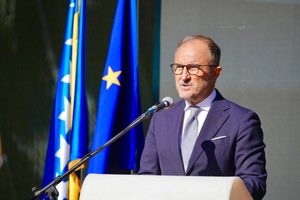


Tirana, Albania hosted the third installment of the BSC Leaders Meetings series, focusing on the topic “Albania and the Western Balkans in the EU by 2030: Tackling the Obstacles Ahead.” This event featured a panel of prominent figures including Albania’s Prime Minister Edi Rama, Prof. Dr. Daniela Schwarzer from the Bertelsmann Stiftung, Majlinda Bregu, Secretary General of the Regional Cooperation Council, and Vessela Tcherneva, Deputy Director of the European Council on Foreign Relations. The discussion was moderated by Nikola Dimitrov, co-founder of the Balkan Center for Constructive Policies – Solucija.

Opening the event, Srđan Cvijić, president of the International Advisory Committee of the Belgrade Centre for Security Policy, emphasized the significance of these meetings for addressing key foreign and security policy issues, particularly EU enlargement. Andi Dobrushi, director of Open Society Foundations – Western Balkans, also welcomed participants, expressing optimism about the panel’s potential to explore Albania’s challenges and opportunities on its path to EU membership.

Prime Minister Edi Rama expressed cautious optimism about Albania’s EU prospects by 2030, highlighting the current democratic challenges but also a growing openness to enlargement within the EU. He stressed the importance of focusing on the future rather than the past to shape a successful path forward.

Daniela Schwarzer critiqued the EU’s integration process, advocating for a gradual approach and emphasizing the necessity of rule of law transformations. She also highlighted the importance of qualified majority voting (QMV) in disciplining EU member states.

Majlinda Bregu discussed the importance of proactive preparation for EU integration, noting varying levels of support across the Balkans and emphasizing a “learning by doing” approach for entering the EU Single Market.
During the discussion, Vessela Tcherneva pointed out that Albania could potentially lead the region in EU integration efforts, depending on its ambition. She also noted the importance of aligning with the EU’s Common Foreign and Security Policy (CFSP), with consensus that failure to comply could lead to withheld EU funding.
The panel was followed by a Chatham House debate titled “Bilateral Disputes and EU Enlargement: A Consensual Divorce,” based on recent policy briefs by BCSP and Solucija, further examining the dynamics of regional disputes and their impact on EU integration.