What began as a luxury tourism investment has evolved into one of the most significant political, environmental and economic debates currently unfolding in the Western Balkans.
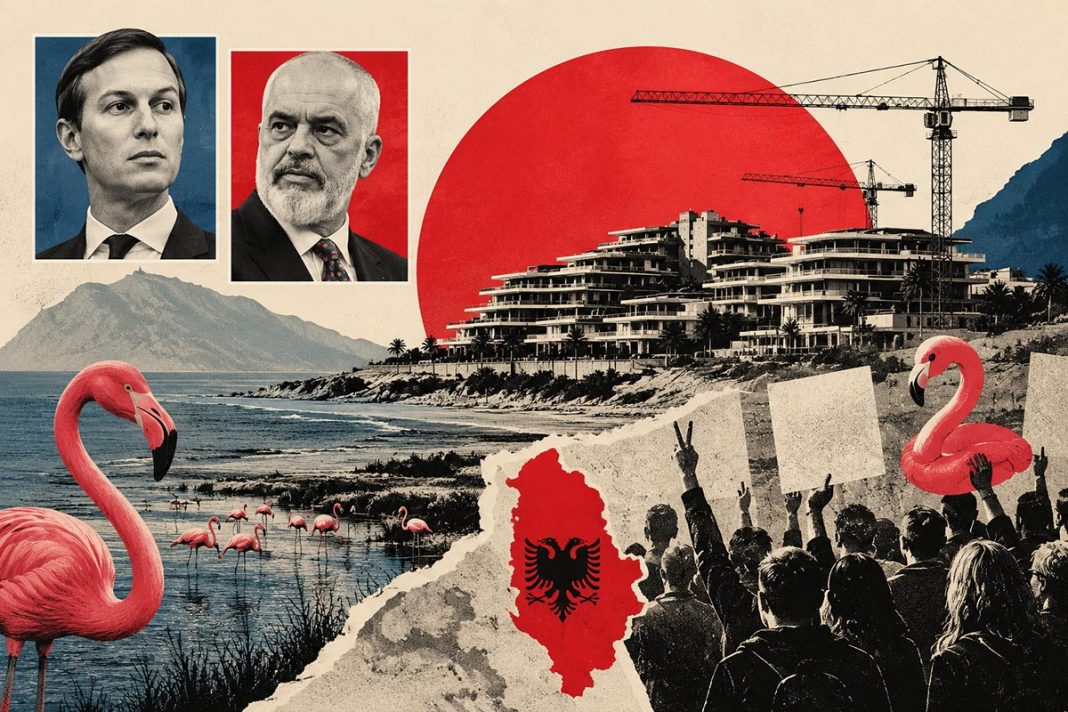
A luxury resort project linked to Jared Kushner has become one of Albania’s most closely watched political and economic controversies, turning a planned tourism development into a wider debate about investment, nature protection and the country’s European future.
The project, backed by Kushner’s investment firm Affinity Partners, is planned near the Vjosa-Narta protected area on Albania’s southern coast, with a separate development also linked to nearby Sazan Island. Albanian Prime Minister Edi Rama has defended the investment as part of his ambition to move the country towards higher-value tourism and position Albania among the Mediterranean’s more competitive destinations.
But the project has triggered growing protests in Tirana and along the coast. Environmental groups and local residents argue that the development could threaten one of Albania’s most sensitive coastal ecosystems, an area known for flamingos, migratory birds and sea turtle habitats. Protesters have turned pink flamingos into a symbol of the campaign, carrying inflatable birds and signs calling for the project to stop.
Rama has rejected calls to halt the development. In an interview with Reuters on 8 June, he insisted the project would go ahead and said Albania should not allow street protests to define how the country develops. He argued that major international investments are essential if Albania wants to move beyond mass tourism and compete with higher-value destinations across the Mediterranean.
The prime minister has also pushed back against images and claims circulating on social media. Speaking to Euronews, Rama said reports of “dying flamingos” and “depressed turtles” were not connected to the actual project and described such claims as exaggerated.
The controversy has now moved beyond environmental campaigning. Questions have also been raised about land ownership, transparency and Albania’s obligations as an EU candidate country. Albania’s anti-corruption authorities have confirmed they are examining issues related to the development, including questions surrounding land ownership and planning decisions, while Greece has expressed concern over property rights in an area where members of Albania’s Greek minority live.
The timing is sensitive. Albania is trying to show Brussels that it can not only align its laws with EU standards, but also implement them in practice. During a recent visit to Tirana, European Council President António Costa stressed that accession requires not only adopting European legislation but also demonstrating its implementation, particularly in areas such as environmental protection and the rule of law.
Supporters argue that the project could generate jobs, attract investment and help Albania move towards higher-value tourism. Critics counter that it risks undermining environmental protection, transparency and public trust at a crucial moment in the country’s EU accession process.
That is why this story is no longer just about a resort.
It has become a test of whether Albania can attract billion-euro investment while convincing its citizens and the European Union that environmental protection, transparency and the rule of law remain non-negotiable.