Slovenia and Uzbekistan Deepen Economic Partnership

Slovenia and Uzbekistan are expanding their economic and scientific cooperation, aiming to double bilateral trade and develop strategic collaboration in the supply and processing of rare earth elements.

The renewed momentum follows the visit of an Uzbekistani delegation to Ljubljana, led by Investment, Industry and Trade Minister Laziz Kudratov, for a session of the Slovenian-Uzbekistani commission for economic cooperation.

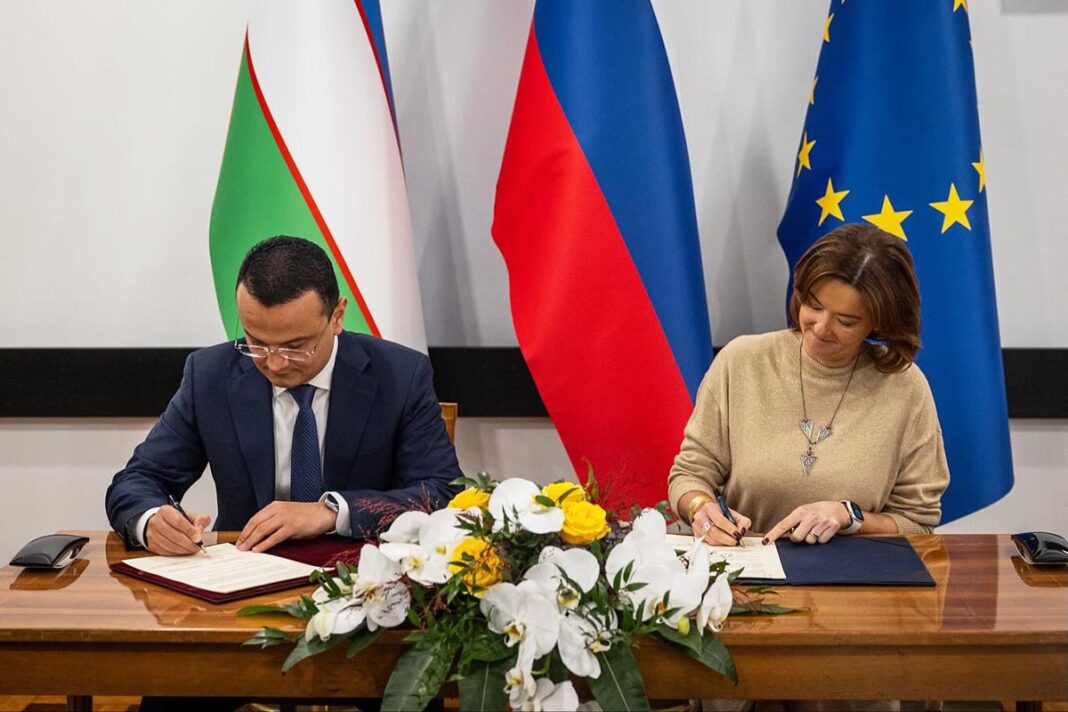
During the visit, Slovenian Foreign Minister Tanja Fajon and Minister Kudratov signed a cooperation protocol outlining new opportunities in logistics, pharmaceuticals, communication technologies, agriculture, and critical raw materials.

Bilateral trade reached USD 176 million in 2024—up 60% from the previous year—making Uzbekistan Slovenia’s second-largest trading partner in Central Asia. Both sides expressed confidence that intensified government-level coordination will help achieve the goal of doubling trade.

A major strategic pillar of the partnership is cooperation on rare earth elements, essential for technologies ranging from smartphones to wind turbines. The Uzbekistani delegation met with researchers at the Jožef Stefan Institute, Slovenia’s leading scientific institution, to explore supply chains, recycling technologies, and joint research. The institute emphasized that closer collaboration would diversify sources of critical materials and reduce Europe’s dependence on China, while helping both countries advance research and industrial applications in this high-value sector.


Have a news tip or story to share? Email us at info@connectingregion.com

Čadež: AI Represents a Generational Opportunity for Serbia

Speaking at the Business Summit 2026 conference in Ložionica, attended by more than 400 participants and 200 business leaders from Serbia...

Slovenian Startup Wins Top Award For DNA Data Storage Technology

BioSistemika won the top prize at the Podim Pitching Competition in Maribor with DATANA, a patented technology designed to store digital data...

Gen Z Lives With AI, But Doesn’t Trust It

Artificial intelligence has become routine for Generation Z in Serbia. More than 80% of young people see AI as...

Microsoft Marks 30 Years in Croatia as AI Becomes the Next Battleground

Microsoft’s journey in Croatia began in 1996 with a modest team of four, led by Goran Radman. Three decades later, the...

Kraš Starts 2026 with Revenue and Profit Growth

Kraš Group reported €45.5 million in revenue in the first quarter of 2026, up 4.3% year-on-year, while net profit...
spot_img

Connecting the Adria Region Decision Makers

The Region is more than a publication - it's where the region's elite converge for insights and opportunities