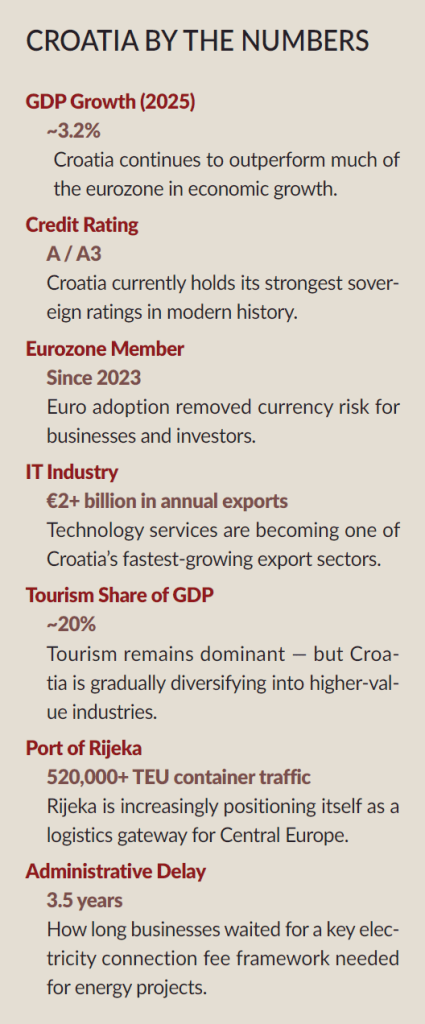
Croatia’s economy is diversifying faster than its reputation suggests but business leaders warn that productivity, infrastructure and institutional speed may determine whether that momentum lasts.
Croatia’s economy is becoming harder to stereotype. Behind the coastline, tourism numbers and seasonal headlines, a quieter transformation is taking shape — driven by industrial exports, AI companies, defence manufacturing and a growing race for productivity.
But business leaders are also warning that the country risks losing momentum to slow administration, labour pressures and delayed infrastructure projects.
For Luka Burilović, President of the Croatian Chamber of Economy, the real challenge is no longer attracting attention — but turning opportunity into long-term competitiveness.
Croatia is often viewed through the prism of tourism, but beneath that image, which sectors are currently outperforming expectations?
The strongest growth today comes from higher value-added industries — industrial manufacturing, technology, energy, pharmaceuticals and digital services. Croatia’s export structure is gradually changing, moving beyond traditional sectors toward more sophisticated products and services.
One of the clearest examples is IT. Croatian companies are increasingly developing their own solutions in artificial intelligence, cybersecurity, fintech and industrial digitalisation, while competing successfully on global markets.
Defence manufacturing is also gaining importance.
Croatian companies have shown they can compete through quality, innovation and flexibility, with many already integrated into European and NATO supply chains.
At the same time, companies producing transformers, energy equipment and specialised industrial solutions are performing strongly across European and international markets.
I also see major potential in nearshoring and supply chain diversification. If railway corridors and intermodal infrastructure are modernised, the Port of Rijeka could become an important logistics alternative for cargo flows toward Central Europe.
From your perspective, what has genuinely improved in everyday business operations over the past few years?
Companies today are far more adaptable. They make decisions faster, are more open to digital transformation and increasingly invest in process optimisation, even under difficult conditions.
What was once reserved for large corporations is now being adopted by medium-sized and smaller companies as well, including practical applications of artificial intelligence in daily operations.
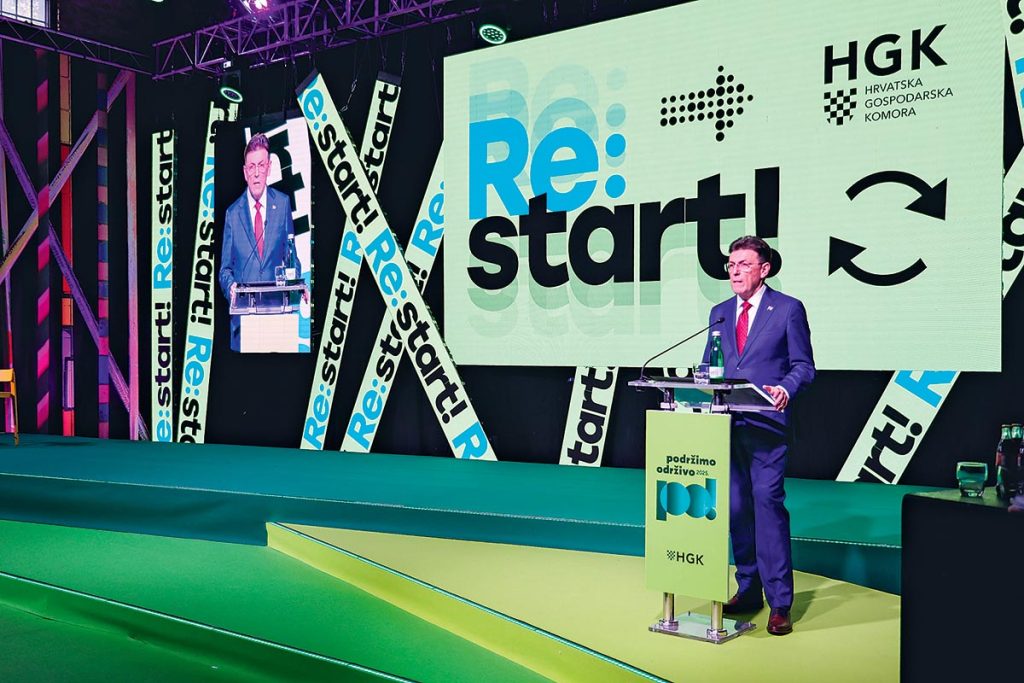
The biggest shift, however, is mindset. Croatian businesses think more strategically and long term than before, especially regarding the green and digital transition. These are no longer abstract strategies — they have become part of operational business reality.
There has also been a visible improvement in supply chain management and risk monitoring, giving companies greater resilience and flexibility.
At the same time, employers increasingly understand that competitiveness depends not only on technology or pricing, but also on their ability to retain quality employees. More companies are investing in salaries, benefits, flexible working models and internal communication.
What currently gives Croatian companies the greatest sense of optimism?
Croatia’s continued international integration, particularly the expected accession to the OECD, is a major source of confidence.
When we compare today’s position with the period after the global financial crisis, the difference is substantial. EU membership, Schengen and the eurozone have significantly strengthened both economic resilience and financing conditions.
“Time is a non-renewable resource.”
This is visible through Croatia’s historically high credit rating and far more favourable financing environment than in previous decades. Currency instability is no longer a dominant concern for companies, allowing them to focus more on real competitiveness.
And when conversations become more candid, which concerns come up most often?
Administrative inefficiency remains one of the biggest frustrations. Companies increasingly feel institutions still do not fully understand how valuable time is in business. Delayed and inconsistent decisions often result in missed opportunities or abandoned investments.
There is also growing concern about the balance between the public and private sectors. Strong wage growth in public administration has made it increasingly difficult for many private companies to compete for labour while remaining profitable.
Beyond labour shortages, business leaders are even more concerned about productivity and the availability of relevant skills. Many also speak openly about long-term uncertainty created by geopolitical instability and slower decision-making processes.
Where is Croatia still losing competitive advantage today?
Primarily in the speed of administrative procedures, especially for large infrastructure and energy projects. Despite strong investor interest, projects often become trapped between institutions, which extends timelines and increases costs. Strategic projects still move too slowly.
Croatia is also lagging in the development of key energy infrastructure, particularly electricity networks and battery systems needed for the green transition.
The investment momentum exists. The challenge is turning that momentum into concrete projects quickly enough to create long-term competitive advantage.
If you had to identify one structural issue Croatia must solve to become a consistently competitive economy, what would it be?
Productivity. Long-term competitiveness cannot be built primarily on low costs. Croatia needs a stronger shift toward technology, innovation, digital transformation and higher value-added products and services.
That also requires a much closer connection between education and the real needs of the economy, with a stronger focus on lifelong learning and technological adaptation.
People do not all need to become IT experts, but they do need to understand how new technologies work and how to apply them in their own industries.
The faster Croatia connects education, business and innovation, the easier it will be to transform potential into lasting competitiveness.
