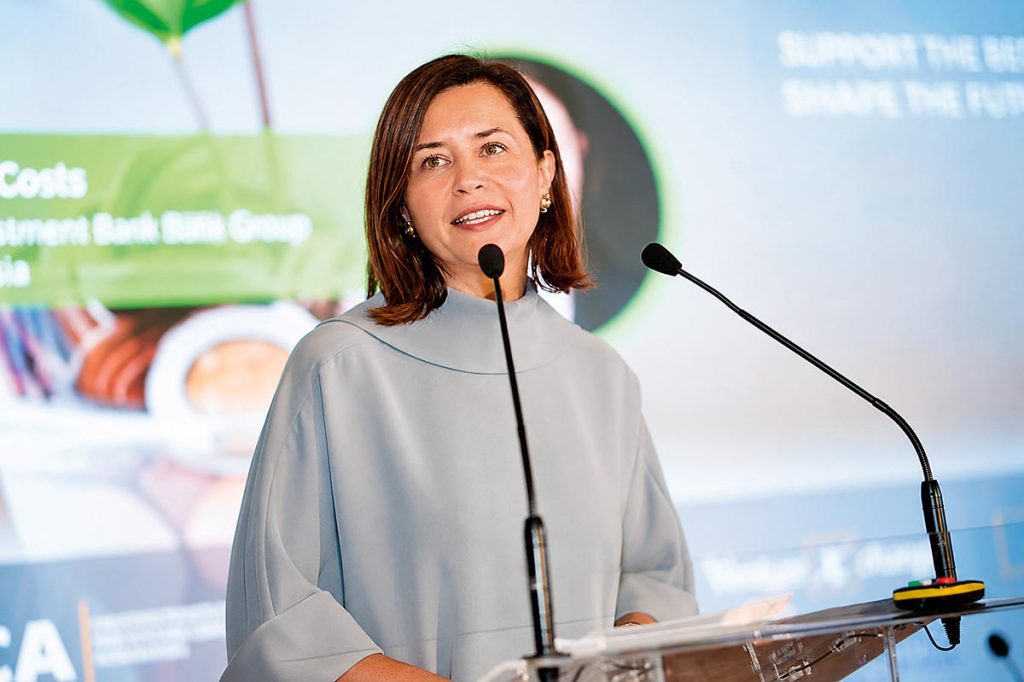
Croatia has no shortage of capital. The challenge is turning ambition into investment-ready projects. Slađana Ćosić, Head of the European Investment Bank Group Office in Croatia, explains where momentum is building, why execution matters more than funding, and what will determine the country’s ability to attract long-term investment.
For years, the conversation around development in Croatia has focused on access to funding. Yet as European capital becomes increasingly available through a combination of EU instruments, national programmes and development finance, the question is no longer where the money will come from. The question is whether projects are ready to absorb it.
That shift is reshaping the role of the European Investment Bank. Once primarily associated with large infrastructure projects, the EIB today positions itself as Europe’s climate bank, directing capital towards energy transition, sustainable transport, urban development and longterm competitiveness.
From Zagreb and Split to rail modernisation and renewable energy projects, Croatia is increasingly part of that transformation. But attracting investment is no longer simply a matter of securing funding. Execution, preparation and project quality have become decisive factors.
According to Slađana Ćosić, Head of the EIB Group Office in Croatia, countries that consistently move projects from concept to implementation will be the ones that attract the largest share of long-term capital in the decade ahead.
The European Investment Bank has repositioned itself as the EU’s climate bank. What has that changed on the ground in Croatia and which types of projects are being funded today that would not have been financed five years ago?
It has fundamentally changed how we invest in Croatia’s future. We have moved from funding isolated assets to enabling systemic change across key sectors of the country’s green transition.
As part of the EIB’s climate agenda, we prioritise projects that help decarbonise the economy and strengthen long-term sustainability, from renewable energy and energy efficiency to cleaner public transport. This has opened the door to investments that would have been significantly more difficult to finance just a few years ago.
One example is the €400 million loan we signed last year as part of a broader €900 million framework to modernise Croatia’s rail network and rolling stock. It represents the largest public-sector investment we have supported in the country. We have also launched direct financing for cities such as Zagreb and Split to support public transport decarbonisation, building renovation and urban infrastructure upgrades.
Today we are financing climate-friendly investments ranging from low-carbon transport and energy-efficient housing to modern green infrastructure. Ultimately, these projects translate into cleaner air, lower energy costs and more sustainable growth.
Croatia has no shortage of access to European funding. Where is the strongest momentum today and which sectors still lack a credible pipeline of projects?
Momentum is strongest in clean energy, transport modernisation, investment in small and medium-sized businesses and sustainable urban development, including housing.
Over the past few years, EIB activity in Croatia has reached record levels. Much of that growth has been concentrated in greener transport solutions, low-carbon cities and support for companies of all sizes, from innovative start-ups to major public enterprises.
What is changing is that investment is moving beyond core infrastructure towards projects that directly improve competitiveness and quality of life. The next stage will involve scaling up support for innovation, venture capital and emerging sectors such as security and defence technologies.
The limiting factor, however, is not funding.
The limiting factor is the number of fully investment-ready projects.
Even when financing is available, progress can slow if projects remain stuck in permitting processes or lack sufficient preparation. Areas such as affordable housing and complex climate-adaptation infrastructure would benefit from stronger project design and implementation capacity.
Our role is not only to provide financing but also to help transform ambitious ideas into bankable projects.
Energy transition has become one of Europe’s defining investment priorities. Is Croatia ahead of the curve in developing bankable energy projects or still catching up?
Croatia is making solid progress, but it is still catching up with Europe’s leading markets.
The country has established a clear direction when it comes to renewables and decarbonisation and we are seeing an increasingly robust pipeline of clean-energy projects emerge.
Recently, the EIB financed €30 million for a renewable energy expansion project with HEP and provided €207 million to the City of Zagreb to support solar energy deployment, affordable housing and electric public transport. These are tangible examples of a transition that is gaining momentum.
The next challenge will be modernising energy grids, strengthening storage capacity and improving overall system flexibility. These investments are essential if Croatia is to integrate larger volumes of renewable energy while maintaining resilience and energy security.
That is where development finance institutions can play a particularly important role, not only by providing capital but by helping prepare complex projects that can attract additional investors.
In many markets, projects fail not because of a lack of capital but because they are not investment-ready. When projects in Croatia fall short, where do they most often break down: strategy, structure or execution?
In most cases, the problem is not the vision. Croatian projects generally begin with strong strategic ideas. The challenge tends to emerge later, in the details of project structuring and implementation planning.
Financial models are not always sufficiently developed, governance arrangements may require additional work and procurement frameworks can sometimes remain incomplete. These are often the issues that prevent otherwise promising projects from moving forward.
“The limiting factor isn’t money; it’s the number of fully investment-ready projects.”
The encouraging part is that these problems are solvable. Alongside financing, we provide advisory support that helps project promoters strengthen planning, navigate procedures and improve implementation capacity.
When those foundations are in place, strong ideas are far more likely to be delivered on time and on budget.
As competition for capital intensifies across Europe, stability alone is no longer enough. What will ultimately determine whether Croatia attracts a larger share of long-term investment?
The key factor will be Croatia’s ability to consistently generate a strong pipeline of high-quality projects.
Many countries offer stability. What attracts long-term capital is a steady flow of credible investment opportunities supported by strong execution.
Croatia already possesses important advantages. It is part of the euro area, has access to significant European funding and enjoys considerable renewable energy potential. The challenge is to translate those advantages into a continuous stream of projects that can move efficiently from concept to implementation.
If Croatia can repeatedly demonstrate that ambitious plans become real projects, investors will respond.
The objective is to close the gap between ideas and execution by streamlining procedures, strengthening local capacity and maintaining high project standards. Countries that do this successfully will attract more investment and accelerate their long-term development.
The appointment of Marko Primorac as Vice-President has given Croatia greater visibility within the European Investment Bank. Does that visibility translate into influence or do funding decisions remain entirely independent of national context?
Funding decisions at the EIB remain firmly merit-based. Projects are assessed according to their quality, impact and alignment with European priorities, not according to national quotas or political considerations.
The appointment of a Croatian Vice-President does not alter those principles.
At the same time, Marko Primorac’s appointment is significant for both Croatia and the EIB. Greater visibility helps ensure that national priorities are clearly understood within the broader European context and strengthens Croatia’s presence within senior-level discussions.
Visibility can improve understanding and engagement.
What it does not change is the way projects are assessed. Ultimately, financing continues to follow project quality and long-term impact.