Governments still dominate headlines. Investors increasingly determine outcomes. Across Adria, the balance of influence is quietly shifting from politics to capital.
For much of the past three decades, the story of Adria was told through politics. Elections changed governments. Summits produced declarations. Ministers announced strategies. National debates revolved around European integration, reforms, geopolitical alignments and economic promises. Political leaders dominated the conversation because they appeared to control the direction of change.
Yet beneath the surface, another force was steadily becoming more important.
The roads being built, the ports being expanded, the factories being opened and the energy systems being modernised all depended on one thing: access to capital. Ambition alone was never enough. Every major project required financing, and financing increasingly came from institutions and investors operating far beyond national borders.
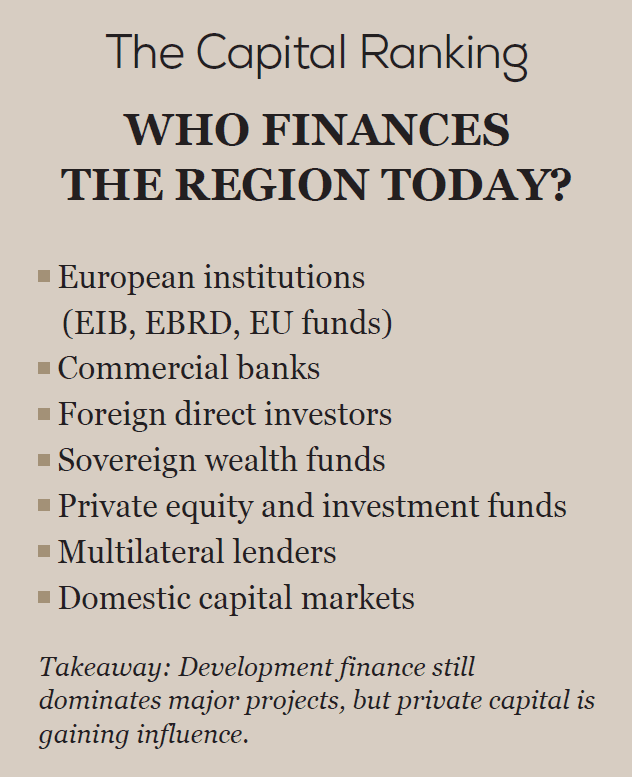
Today, many of the decisions that will shape the future of Adria are made not only in government offices but also in investment committees, development banks, sovereign wealth funds and corporate boardrooms. A new railway corridor, a wind farm, a technology campus or a tourism development may be announced by politicians, but before construction begins somebody must decide whether the project deserves financing. Increasingly, that decision determines which visions become reality and which remain little more than headlines.
The region’s political map has changed remarkably little over the past decade. Its map of economic influence has not.
THE SILENT TRANSFER OF POWER
The shift did not happen overnight. In the years that followed the transition from socialist economies and the political turbulence of the 1990s, governments naturally occupied centre stage. States were rebuilding institutions, privatising industries and redefining their place within Europe. Political leadership mattered enormously because governments were responsible for creating the foundations of modern market economies.
As those foundations strengthened, however, a different reality emerged. The scale of investment required to modernise infrastructure, transform energy systems, improve connectivity and support economic growth far exceeded what national budgets could provide. No country in Adria possessed the financial resources necessary to fund all of its ambitions independently.
That reality fundamentally altered the relationship between politics and development. Governments could identify priorities and propose projects, but capital increasingly determined which initiatives moved forward. Over time, influence followed financing. Institutions capable of funding major infrastructure projects acquired a growing role in shaping economic priorities, while investors became increasingly important participants in the region’s development story.
This is one reason why conversations about growth today often focus on investment flows rather than government spending. The projects that attract financing move ahead. Those that fail to attract confidence frequently remain on paper.
BRUSSELS’ MOST EFFECTIVE TOOL
Much has been written about the political influence of the European Union in Southeast Europe. Far less attention has been paid to its financial influence, despite the fact that it may ultimately prove even more significant.
For more than two decades, European institutions have helped finance the infrastructure that underpins economic development across the region. Roads, railways, energy networks, water systems, ports and digital infrastructure have all benefited from European-backed financing. In practical terms, institutions such as the European Investment Bank and the European Bank for Reconstruction and Development have become permanent architects of regional transformation.
Governments can announce projects. Capital decides which ones get built.
Their influence extends beyond lending. By determining which projects meet international standards, which reforms unlock financing and which sectors receive strategic support, they help shape the direction of development itself. The impact is rarely dramatic or immediate, yet it is profound. A modernised railway can alter trade patterns for generations. A new transmission line can strengthen energy security for an entire country. A port expansion can redefine the economic prospects of a region.
Political influence often changes with elections. Infrastructure financed and built today can shape economic realities for decades.
THE RISE OF CAPITAL COMPETITION
The competition taking place across Adria today looks very different from the one that defined previous decades.
For years, governments focused on political milestones, diplomatic recognition and progress towards European integration. While those objectives remain important, an equally significant competition has emerged. Countries are increasingly competing for investment.
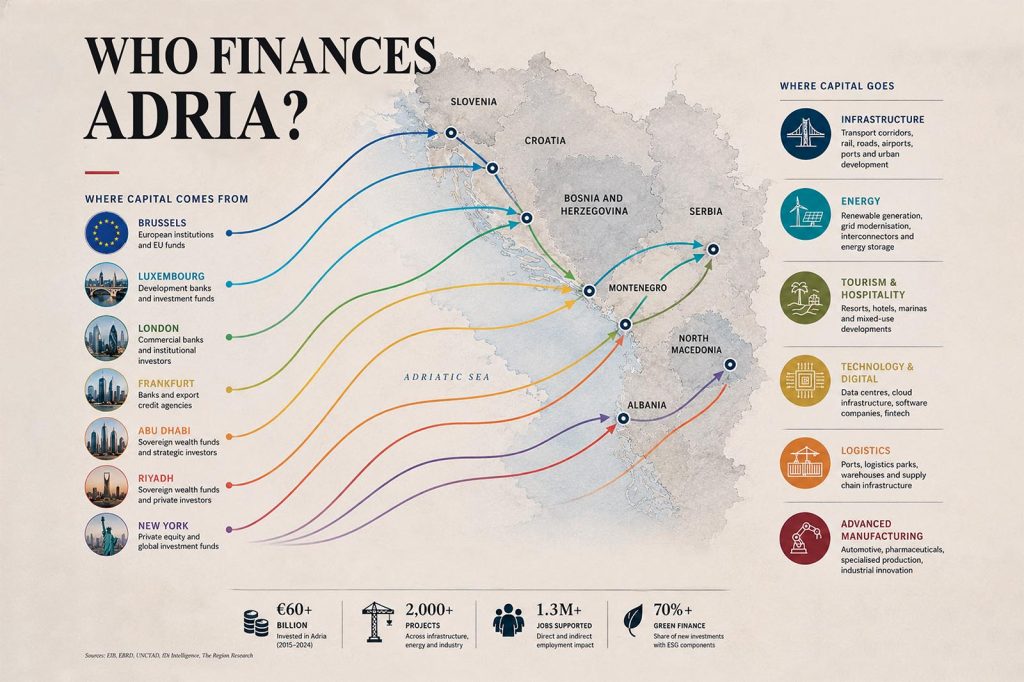
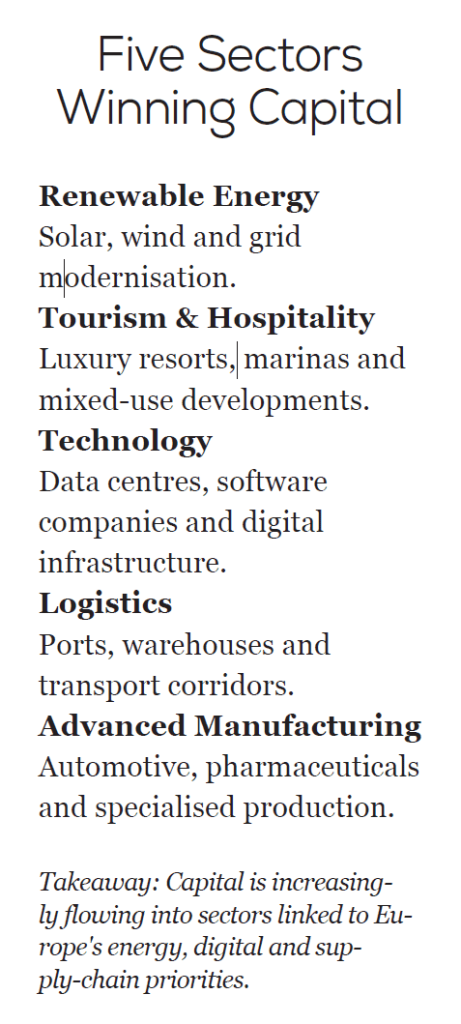
The race is visible across multiple sectors. Cities seek to attract technology companies and innovation hubs. Governments compete for manufacturing projects, logistics centres and renewable energy investments. Ports position themselves as gateways for regional trade, while tourism destinations seek international investors capable of supporting ambitious developments.
In this environment, success depends less on rhetoric and more on credibility. Investors have little interest in political slogans. They pay attention to execution. They want to know whether permits can be obtained efficiently, whether regulations are predictable, whether contracts are respected and whether infrastructure can be delivered on time. These practical considerations often matter far more than grand announcements.
As global competition for investment intensifies, the ability to inspire confidence may become one of the most important economic assets a country can possess.
WHY GULF CAPITAL MATTERS
One of the most important developments of the past decade has been the growing presence of investors from the Gulf. Capital originating in the United Arab Emirates, Saudi Arabia and Qatar has become increasingly visible throughout Southeast Europe, particularly in tourism, real estate, aviation and large-scale development projects.
The significance of this trend extends beyond the individual investments themselves. Gulf investors frequently approach opportunities with longer time horizons and greater appetite for large-scale developments than many traditional financial institutions. Their objectives often combine commercial returns with broader strategic considerations, allowing them to pursue projects that others might consider too complex or too ambitious.
For governments seeking transformational investments, this can be highly attractive. For the region as a whole, it signals something equally important: Adria is increasingly viewed through a global rather than purely European lens.
The arrival of Gulf capital reflects growing international confidence in the region’s long-term potential. Investors with global options are choosing to allocate resources here because they see opportunity. That may be one of the strongest endorsements any economy can receive.
THE NEXT DECADE
The coming decade is unlikely to be defined by a shortage of capital. Around the world, enormous pools of investment are searching for opportunities in infrastructure, renewable energy, advanced manufacturing, digital networks, artificial intelligence and logistics. The question is not whether investment capital exists. The question is where it will flow.
For Adria, attracting a greater share of those flows will require more than favourable geography or competitive labour costs. It will require credibility, institutional capacity and the ability to execute projects efficiently. Countries capable of creating stable and predictable environments will attract disproportionate levels of investment. Those that fail to do so may find capital looking elsewhere.
This may be the most important economic reality facing the region today. The challenge is no longer attracting attention. The challenge is converting attention into investment and investment into long-term growth.
THE NEW GEOGRAPHY OF POWER
Political leaders will continue to shape public debate. They will negotiate agreements, attend summits and announce national priorities. Their role remains essential. Yet beneath those visible layers of decision-making, a quieter force is reshaping the region.
The factories being built, the energy systems being modernised, the ports being expanded and the technologies being deployed all depend on capital allocation. Investors may not appear on election ballots and development banks rarely dominate headlines, yet their decisions increasingly influence which regions grow fastest, which industries expand and which opportunities emerge.
For much of history, geography defined economic destiny. Countries prospered because of their location, natural resources or access to trade routes. In the twenty-first century, another factor may matter just as much: the ability to attract capital.
That is the new geography of power. And it is where the next chapter of Adria’s economic story will be written.