A region with fewer people than London has produced World Cup finalists, global stars and generations of elite footballers. The question is no longer whether it belongs on football’s biggest stage. It is why it keeps returning
Every four years, the World Cup reminds the world of football’s established powers. Brazil. Germany. Argentina. France. And then there is our region.
The seven countries stretching from the Alps to the Adriatic and the Balkans are home to fewer than 20 million people. Yet few parts of the world have produced a richer football legacy relative to their size.
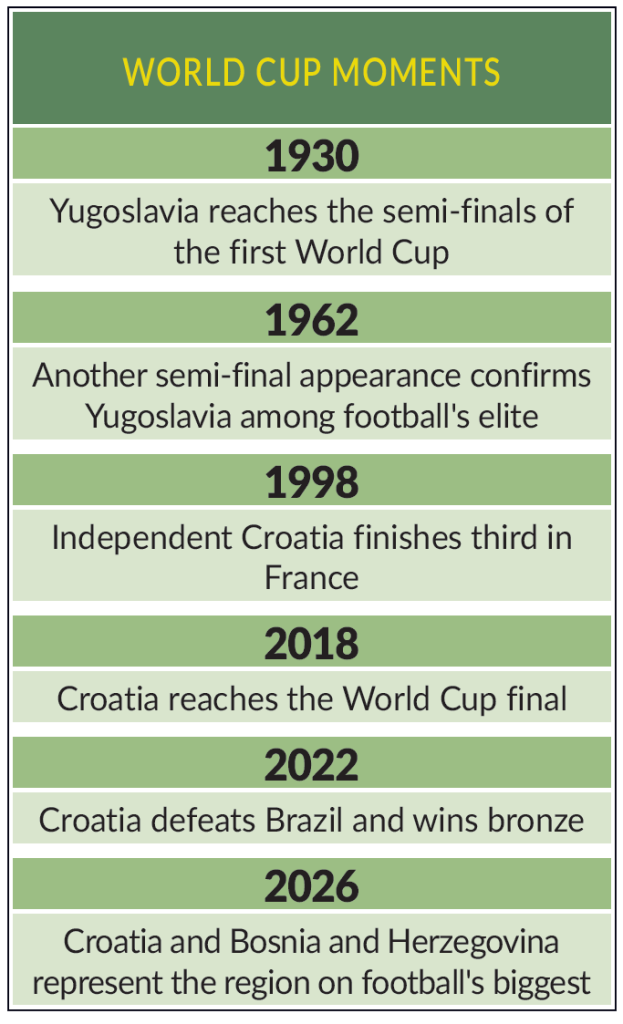
This year’s World Cup features Croatia and Bosnia and Herzegovina. Before them came Yugoslavia, one of the most respected football nations of the twentieth century. The flags have changed. The production line of talent has not.
The record speaks for itself. Yugoslavia reached the semi-finals of the inaugural World Cup in 1930 and again in 1962.
Croatia finished third in 1998, reached the final in 2018 and returned to the podium in 2022. Serbia has qualified for multiple World Cups as an independent nation, while Slovenia and Bosnia and Herzegovina have also reached football’s biggest stage.
Yet statistics alone do not explain the phenomenon. Across the region, football became part of everyday life long before modern academies and billion-euro transfer markets. Generations grew up playing in streets, schoolyards and neighbourhood pitches, creating a culture that rewarded creativity, technical skill and resilience.
From Dragan Džajić and Safet Sušić to Dejan Savićević, Robert Prosinečki, Davor Šuker, Nemanja Vidić, Edin Džeko and Luka Modrić, the region has repeatedly produced players capable of shaping entire eras of the game.
Its influence extends beyond players. Coaches from the region have worked across Europe, while local clubs continue to develop talent sought by the world’s biggest teams. For decades, football has been one of the region’s most successful exports.
That is why the World Cup remains such a powerful moment. It is a reminder that influence is not always measured by population, territory or economic size.
Nearly a century after Yugoslavia first stepped onto the World Cup stage, the lesson remains the same: In football, this region has never thought of itself as small.