In one of his first major interviews since becoming EBRD Managing Director for South-Eastern Europe, Grzegorz Zielinski discusses investment, competitiveness, energy transition and why the region’s future will be defined less by ambition and more by execution.
South-Eastern Europe is entering a decisive period. As Europe searches for new sources of growth, strengthens its energy security and accelerates the transition to a more competitive and sustainable economy, the region finds itself increasingly at the centre of major economic and geopolitical shifts. Yet while opportunities are expanding, so too is the pressure to deliver.
Few people have a broader perspective on that challenge than Grzegorz Zielinski. Recently appointed Managing Director for South-Eastern Europe at the European Bank for Reconstruction and Development (EBRD), he oversees a diverse region that spans both the Western Balkans and several European Union member states, each moving at a different pace but facing many of the same questions: how to attract investment, strengthen competitiveness, modernise infrastructure and accelerate economic transformation.
In this exclusive interview with The Region, Zielinski argues that South-Eastern Europe’s strategic relevance is no longer in question. The real challenge, he says, is turning ambition into execution and ensuring that opportunities are translated into lasting economic weight.
You have worked across some of Europe’s most ambitious energy and infrastructure transformations. Looking at South-Eastern Europe today, do you see a region approaching strategic relevance or one still struggling to convert potential into real economic weight?
South Eastern Europe is already strategically relevant, not only from an energy perspective, but as a region that sits at the intersection of Europe’s key economic priorities, from infrastructure and connectivity to competitiveness, resilience and green transition. Its importance is therefore both economic and geopolitical, and increasingly recognised as such.
The gap is therefore not about relevance, but about speed and consistency of delivery
What is often underestimated, however, is the internal diversity of the region. Within the EBRD context, we cover both the Western Balkans and the EU member states such as Romania, Bulgaria and Greece, which differ significantly in scale, market depth and institutional maturity.
Larger EU economies increasingly operate at a different level, with greater capacity to absorb investment and deploy more complex, market-based instruments across sectors, from transport and urban infrastructure to financial markets and industrial and energy transition.
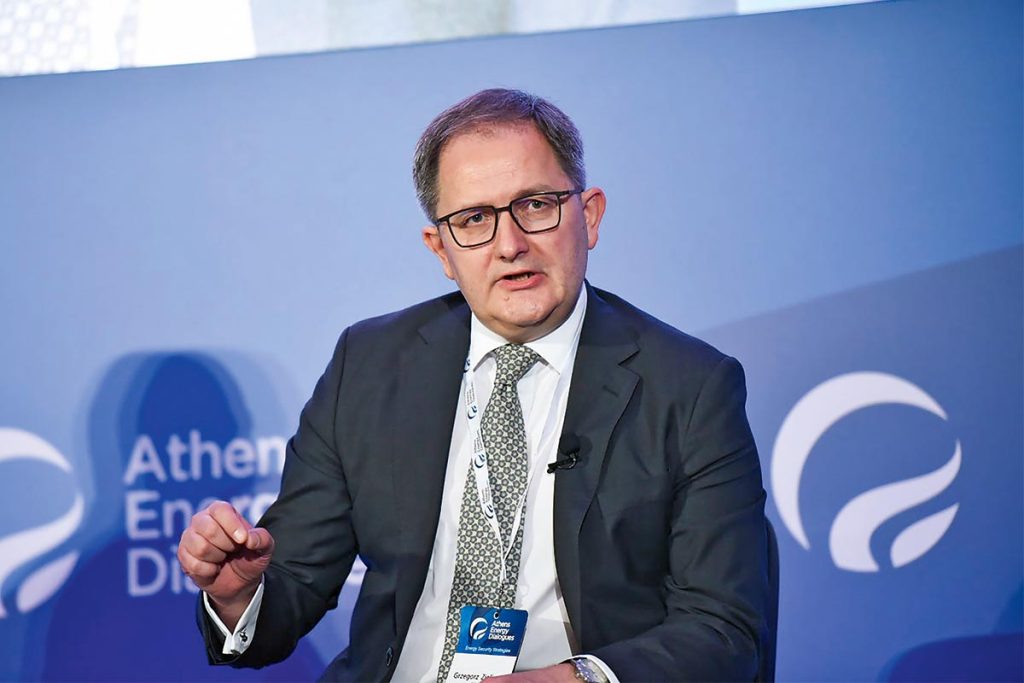
The gap is therefore not about relevance, but about speed and consistency of delivery. In the Western Balkans in particular, progress is visible, but implementation and regulatory alignment still lag. The role of the EBRD is to bridge that gap, supporting institutional strengthening where needed, but equally helping to scale investment and crowd in private capital. The region’s strategic importance is established; the priority now is to translate that into sustained economic weight.
The countries you will oversee are moving at very different political and economic speeds. In a region where reform fatigue is increasingly visible, what matters more today for long-term investors: political stability, institutional credibility or market opportunity?
Political stability, institutional credibility and market opportunity are not substitutes; they are interdependent pillars.
Market opportunity may attract initial interest, particularly in larger economies, but without credible institutions and predictable rules, it cannot translate into sustained investments. At the same time, stability on its own is not sufficient if markets remain shallow or overly state-driven.
Investors ultimately respond to coherence and predictability, not isolated strengths
In practice, what matters most for investors is the absence of a weak link. In some markets, the binding constraint is institutional credibility, in others, it is policy consistency or insufficiently developed market mechanisms. This is where differences across the region become more pronounced. In more advanced markets, the focus is increasingly on deepening capital markets and enabling more sophisticated, market-driven structures, including PPPs or bankable merchant risk. In others, the priority remains more foundational.
Our role at the EBRD is to address these gaps in a targeted way, strengthening institutions where needed, while also structuring bankable, investable projects. Investors ultimately respond to coherence and predictability, not isolated strengths.
South-Eastern Europe speaks often about green transition and energy independence, yet many economies in the region still face infrastructure gaps and slow implementation. Where do you believe the region is genuinely progressing, and where is it still falling behind?
There is clear and tangible progress across the region, particularly where policy commitment is sustained. This is most visible in renewable energy, energy efficiency and, in more advanced EU markets, in increasingly complex transition pathways.
At the same time, the transition is broadening beyond infrastructure alone; it is equally about how effectively companies adapt, how financial systems mobilise capital and how regulatory frameworks enable private participation.
The main constraint, however, remains implementation. While ambition is no longer in question, delivery is still uneven, with gaps in project preparation and permitting, regulatory predictability and the systematic engagement of the private sector.
Bridging this gap between strong ambition and consistent execution is where the real opportunity lies, and where institutions like the EBRD can play a catalytic role.
The region rarely lacks strategies, conferences or announced investment plans. From your experience inside the EBRD, what usually separates projects that genuinely transform economies from those that remain trapped in presentations and political speeches?
The key distinction is not ambition, but economic credibility, readiness for execution, and full and unwavering commitment of project sponsors, from both the private and public sectors.
Projects that move forward share a simple foundation: they are economically sound, well prepared and realistically deliverable. They respond to real demand and can attract financing, are supported by credible feasibility work and clear regulations, and sit with institutions capable of implementing them.
By contrast, projects that remain at the level of announcements typically fall short on preparation or implementation. The ambition is there, but the fundamentals are not.
The next phase is not about redefining strategies, but about consistent, large-scale implementation
What ultimately distinguishes transformative projects is their wider, systemic impact. It is not a matter of delivering single investments, but about setting standards, crowding in private investment and creating models that can be replicated.
At its core, the principle is straightforward: projects that are economically sound and supported by credible frameworks and delivery capacity move forward. Those are the projects that genuinely transform economies through scale-up.
South-Eastern Europe has spent decades being described as “a region with potential.” What would need to happen over the next five years for the region to stop being viewed as Europe’s future opportunity and start being seen as one of its serious economic engines?
The region has already demonstrated that transformation is possible; many economies have fundamentally changed over the past decades. The next phase is not about redefining strategies, but about consistent, large-scale implementation.
In EBRD’s experience, success now hinges on three priorities: policy consistency and institutional credibility to reduce uncertainty and sustain reform momentum; scaling up investment delivery, particularly in energy transition and environmental and transport infrastructure; and deepening the role of private capital, moving beyond public funding towards more market-based solutions.
While the external environment is becoming increasingly complex, this only reinforces the need for focus and discipline. By continuing reforms, strengthening resilience and enhancing competitiveness, the region is well-positioned to accelerate its trajectory.
The foundations are already there. With sustained effort and strong partnerships, South Eastern Europe has a clear path to move beyond the narrative of “potential” and establish itself as a recognised and credible driver of sustained and innovative European growth.
