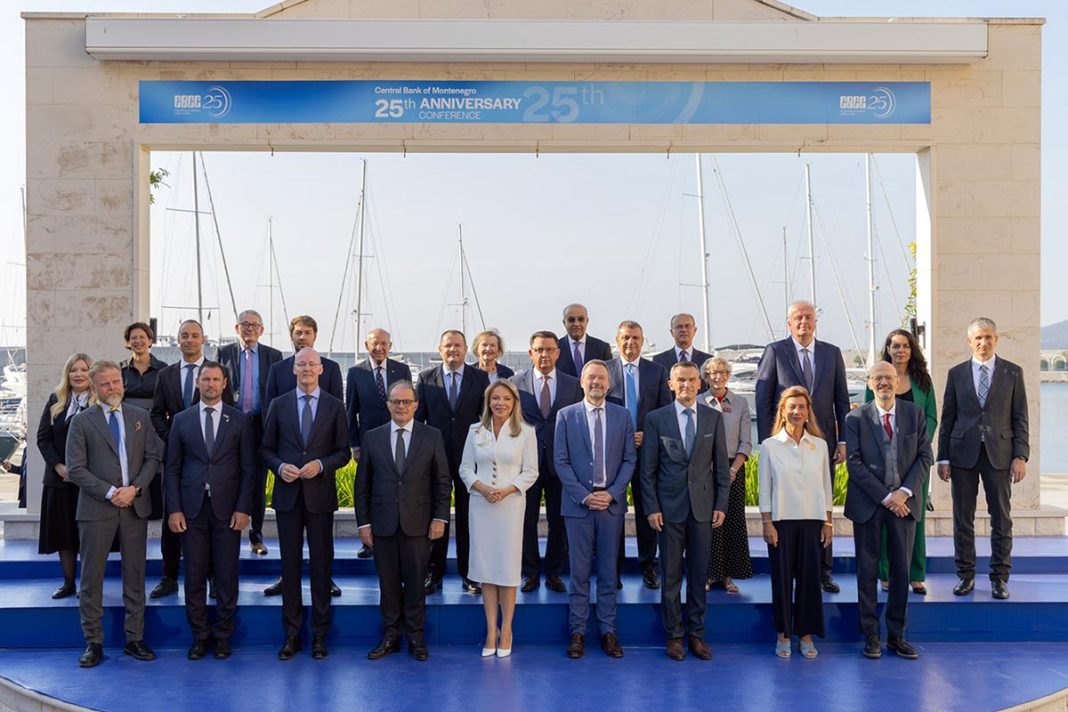
The Central Bank of Montenegro (CBCG) has brought together senior figures from European and international financial institutions in Tivat for a high-level conference marking 25 years since its establishment.
The conference, titled Central Banking in a High-Risk Environment: Stability, Infrastructure and Trust, gathers central bank governors from the euro area, European Union and the region, alongside senior representatives of the European Systemic Risk Board, the EU Anti-Money Laundering Authority, Deutsche Bundesbank, Bank of England, International Monetary Fund and World Bank.
Representatives of Montenegrin state institutions, the diplomatic community, commercial banks and academia are also attending.
The opening ceremony featured CBCG Governor Irena Radović and Montenegro’s President Jakov Milatović, while IMF Managing Director Kristalina Georgieva addressed participants by video message.
Radović said the anniversary comes at an important moment for both Montenegro and its central bank, as the country approaches the final stages of its European integration process and CBCG undergoes its most significant transformation since its establishment.
“Celebrating 25 years of the Central Bank of Montenegro, we find ourselves between two important chapters. The first 25 years were dedicated to building an institution capable of safeguarding financial stability and earning trust. Ahead of us is a new chapter – bringing our institution into the European System of Central Banks, ready not only to become part of it, but to actively contribute to it,” Radović said.
She highlighted Montenegro’s entry into the SEPA area and the introduction of instant payments through the TIPS Clone project among the reforms bringing the country closer to the European financial system.
President Milatović described CBCG as one of the key pillars of Montenegro’s financial stability, institutional credibility and European transformation, stressing that strong and independent institutions are essential to the country’s future development.
In her address, Georgieva emphasised the importance of trusted institutions at a time of heightened global uncertainty.
“Such trust is the most valuable currency of a central bank,” she said.
Georgieva also pointed to the potential economic impact of Montenegro’s EU accession, saying that, under the right conditions, GDP per capita could increase by as much as 30 to 35 per cent over the next decade.
The conference continues with panels examining some of the defining issues facing modern central banking, including financial stability amid global fragmentation, financial integrity, technological transformation and the future role of the euro in a rapidly changing international environment.