
Along Albania’s southern coast, thousands of flamingos gather each year in the lagoons around Vlora and Narta. Most visitors come looking for beaches. Those who stop a little earlier discover one of Europe’s most remarkable wildlife spectacles.
The first thing that surprises you is not the birds. It is the silence. Just north of Vlora, where the Adriatic begins to blur into the Ionian Sea, the landscape suddenly changes. The roads become emptier. The hotels disappear. Salt flats stretch towards the horizon. The sea retreats into shallow lagoons. Everything feels wider, slower and somehow older.
Then a movement appears in the distance.
At first it looks like a pale pink line floating above the water. Only when you lift a pair of binoculars do individual shapes emerge. Hundreds become thousands. Flamingos.
For many travellers, flamingos belong to Africa, the Camargue in southern France or the wetlands of Spain. Few expect to encounter them in Albania.
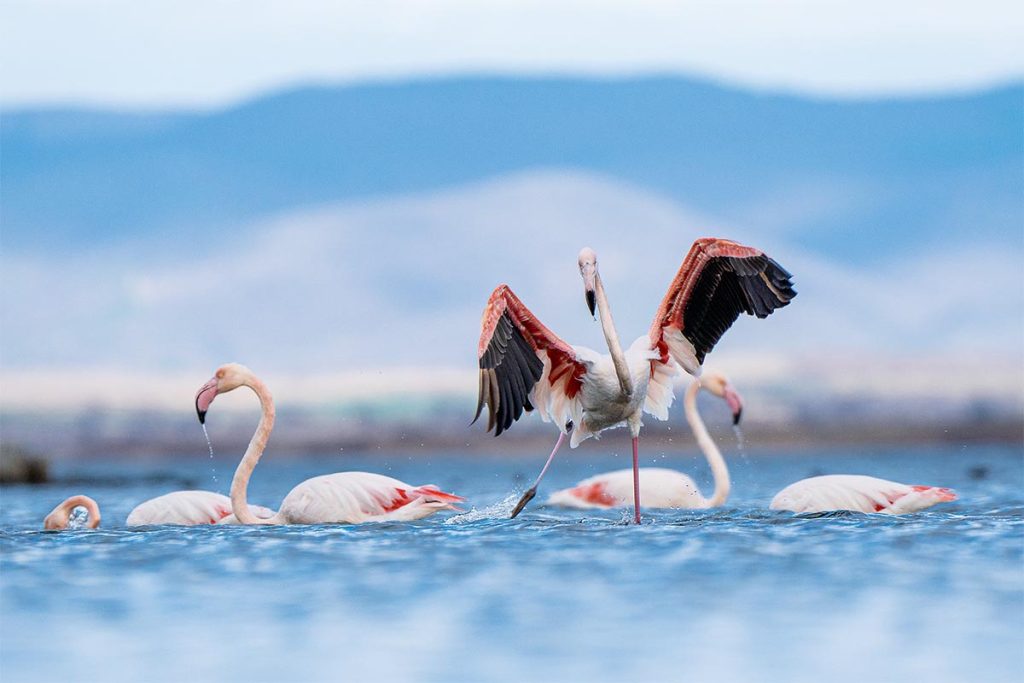
Yet the Narta Lagoon, part of a vast protected ecosystem near Vlora, has become one of the most important habitats for flamingos in the Adriatic region. During migration periods and winter months, their numbers can reach several thousand, transforming the shallow waters into a moving landscape of pink and white.
Standing on the edge of the lagoon at sunrise, it is easy to understand why they choose this place.
The water is calm and shallow. Small crustaceans and algae thrive in the saltrich environment. Long stretches of wetlands remain largely undisturbed. For flamingos, it is a sanctuary. For visitors, it feels almost unreal.
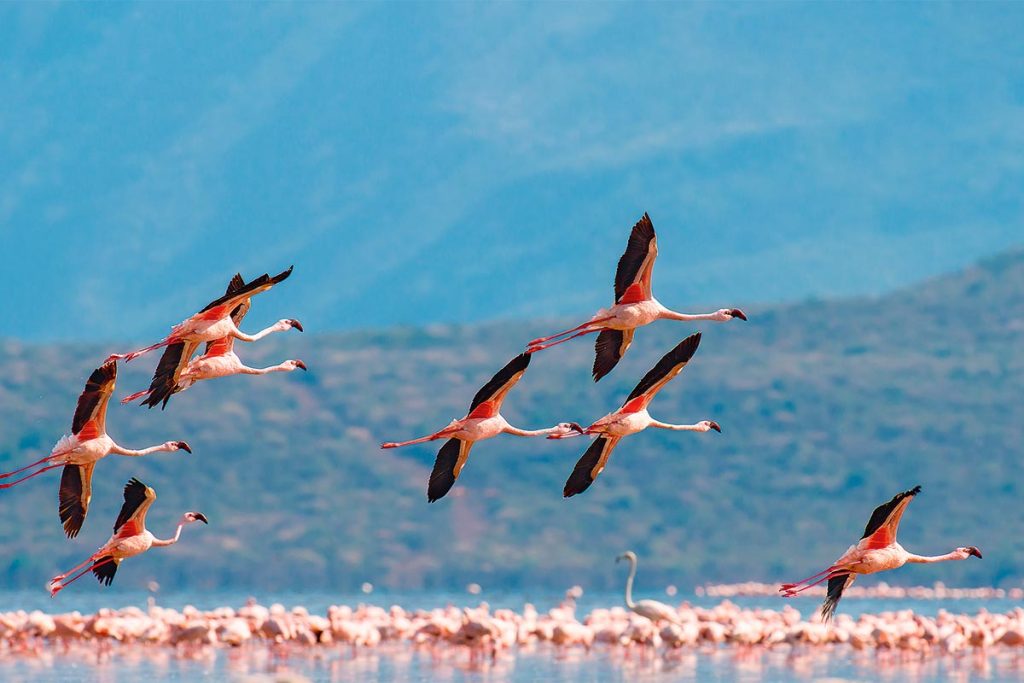
The birds move with surprising elegance. Groups drift across the lagoon like floating brushstrokes. Occasionally an entire flock lifts into the air at once, revealing flashes of black beneath their pink wings before circling back towards the water.
What makes the experience particularly memorable is its sense of discovery.
Unlike many famous wildlife destinations, there are no crowds gathered behind fences. No visitor centres filled with souvenir shops. No organised spectacle. You simply arrive. A dirt road, a wooden observation point and an endless horizon.
Nature does the rest. Yet flamingos are only part of the story.
The lagoon forms one of Albania’s most important wetland ecosystems, at tracting more than two hundred bird species throughout the year. Pelicans, herons, egrets and numerous migratory birds use the area as a resting point along one of Europe’s major migration routes.
Just offshore lies another surprise: the island of Zvernec.
Connected to the mainland by a long wooden footbridge that seems to float above the water, the tiny island is covered by a dense pine forest and crowned by a centuries-old Orthodox monastery. The transition from open lagoon to shaded woodland takes only minutes, yet feels like entering a different world.
Locals often describe Zvernec as one of Albania’s most peaceful places.
After spending an afternoon there, it is difficult to disagree.
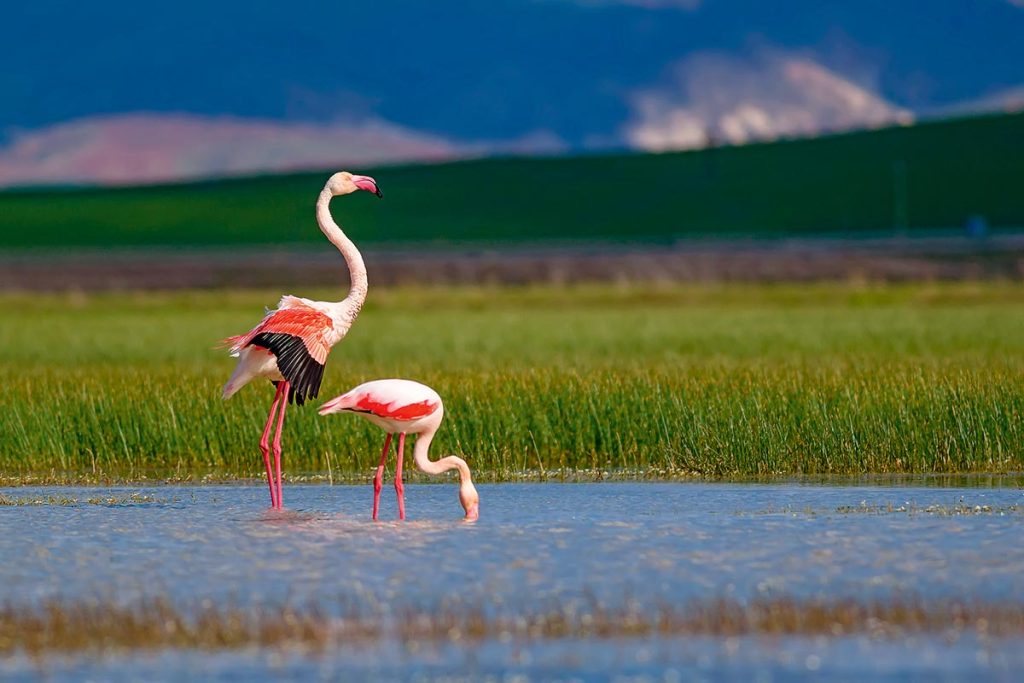
The scent of pine mixes with sea air. Cicadas provide the soundtrack. The monastery’s stone walls reflect centuries of history while flamingos continue their quiet performance across the water beyond.
Together, Narta and Zvernec reveal a side of Albania that rarely appears in travel brochures.
This is not the Albania of crowded beaches, luxury resorts or nightlife.
It is an Albania of wetlands, migration routes and landscapes that still belong primarily to nature.
As the sun begins to set, the lagoon changes colour once again. Gold turns to orange. The water becomes a mirror. Flamingos gather into distant clusters, their reflections stretching across the surface.
For a moment, the entire scene appears painted rather than real.
Then the birds move.
And the picture comes alive.
