Montenegro does not suffer from invisibility. Quite the opposite.
Over the past decade, the country has built one of the most recognisable destination brands in Europe. Its coastline, cuisine and lifestyle have travelled across international media through carefully orchestrated campaigns, high-profile events and celebrity endorsements. From Sveti Stefan’s global iconography to luxury marina developments and headline-making visits from international figures, Montenegro learned how to sell atmosphere — and sell it well.
Few small countries have done this as effectively.
But success in tourism branding has created an unintended side effect. While Montenegro is widely known as a place to visit, it remains far less understood as a place to do business.
That gap — between image and economic substance — defines the country’s next visibility challenge.
FROM DESIRE TO DECISION-MAKING
Global audiences associate Montenegro with beauty, leisure and exclusivity. Investors, however, ask different questions.
They want to understand regulatory alignment, governance standards, financial stability, dispute resolution mechanisms and long-term predictability. They assess talent pipelines, sector competitiveness and policy coherence. These elements exist within Montenegro’s reform trajectory — particularly as the country advances in EU accession and strengthens institutional frameworks — but they are not communicated with the same clarity and consistency as the tourism narrative.
Visibility that drives tourism does not automatically translate into credibility that drives investment.

Farzana Baduel, President & CEO of Curzon PR and a Fellow of the Chartered Institute of Public Relations in the United Kingdom, sees this challenge across emerging markets.
“The single biggest mistake countries make is failing to define a clear strategic positioning,” she says. “Too many try to be everything to all investors and trade partners, and in doing so dilute their impact entirely. Reputation for international business is built on clarity, not breadth — on depth of excellence rather than broad ambition.”
For Montenegro, the question is no longer whether it can attract attention. It is whether it can sharpen that attention toward specific sectors, strengths and longterm advantages.
WHEN A STRONG IMAGE BECOMES A NARROW ONE
Branding is a double-edged sword. What makes a country desirable can also confine it.
The dominance of the tourism narrative has, at times, overshadowed progress in areas that matter to investors: financial reform, infrastructure planning, regulatory harmonisation and the emergence of internationally oriented companies. For global decision-makers scanning markets quickly, perception often precedes detail. If perception is incomplete, opportunity is delayed.
Baduel cautions against attempting to compensate with messaging alone.
“Credibility cannot be built through communications alone. If communications outpace reality, credibility will be short-lived. Strategic communications can articulate progress and close perception gaps — but it cannot manufacture credibility.”
In other words, communication must follow substance — but it must follow it deliberately.
A REGIONAL PERSPECTIVE ON VISIBILITY
Regional PR professionals observe that Montenegro’s international image has long been shaped by cultural and lifestyle moments.

Danijel Koletić, CEO of APRIORI WORLD in Croatia, notes that global recognition initially formed around cultural exposure and iconic imagery.
“In business terms, however,” he argues, “Montenegro’s perception still begins with tourism. Yet tourism itself receives insufficient strategic investment, particularly outside the coastline. Infrastructure visibility and consistent communication at key touchpoints — from airports to border crossings — remain underleveraged.”
His criticism points to a broader issue: visibility is not only about international campaigns. It is also about the everyday experience of partners and investors interacting with the system.
PR BEYOND PROMOTION
In small markets, PR is often equated with exposure — events, media coverage, promotional campaigns. That model works for consumer branding. It is less effective for capital markets and institutional credibility.
Strategic PR for business operates differently. It aligns leadership messaging, clarifies reform trajectories and prepares organisations for scrutiny. It manages expectations before pressure intensifies.

Ljiljana Burzan-Nikolić, Executive Director of BI Communication in Montenegro, argues that the country possesses underappreciated structural advantages.
“International partners respond strongly to Montenegro’s accessibility, geopolitical clarity and the agility of its business community,” she says. “Direct access to decision-makers and faster communication flows often compensate for limits of scale. NATO membership and the EU path reinforce strategic alignment and security.”
Yet she adds a crucial qualifier:
“In today’s visibility economy, perception is shaped by consistency. Reputation must be treated as a strategic asset — aligning transparent governance, measurable performance and private-sector excellence into a coherent international narrative.”
The distinction is important. Visibility is not noise. It is coherence.
A NEW PHASE OF VISIBILITY
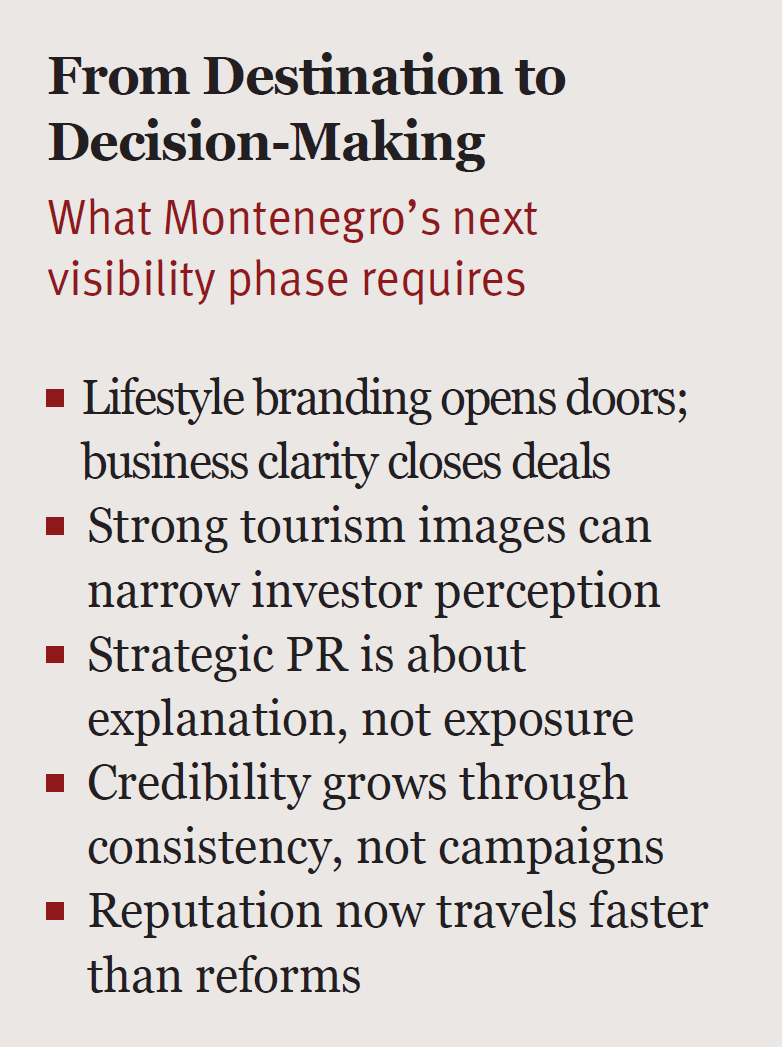
Montenegro is entering a phase where visibility must do more than inspire. It must inform.
The country has successfully positioned itself as aspirational. The next step is to position itself as predictable. Investors seek clarity more than charm. They reward alignment more than aesthetics.
This does not require abandoning the tourism brand that has served Montenegro well. It requires expanding it — layering economic narrative onto emotional appeal.
Those companies and institutions that understand this shift early will be better positioned as Montenegro’s business story matures. Those that rely solely on inherited perception may struggle to be taken seriously beyond the season.
Visibility, once again, becomes a form of capital.
WHAT MONTENEGRO’S BUSINESS LEADERS MUST NOW ASK
Are we known only for where we are — or also for how we operate?
Do international partners understand our systems, or just our scenery?
Are we shaping expectations — or inheriting them?
The next chapter of Montenegro’s international positioning will not be written in sunsets and celebrity visits. It will be written in clarity, consistency and institutional confidence.
Montenegro mastered desire. The real test now is mastering credibility.
