Davor Kunc on capital, execution and Montenegro’s next investment phase
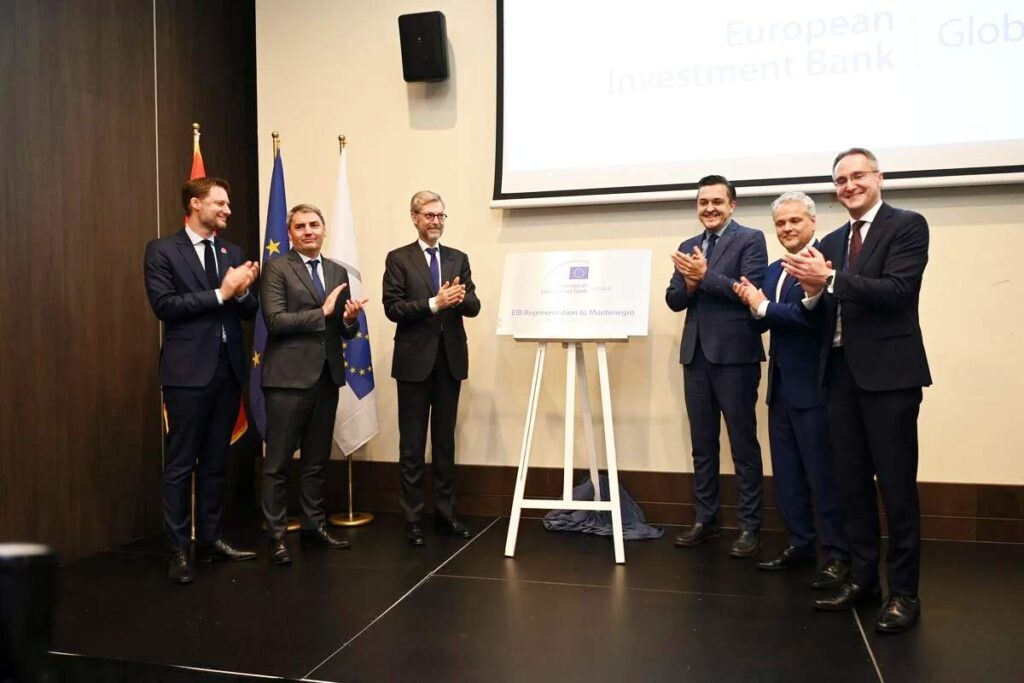
When the European Investment Bank opened its first permanent office in Montenegro, it signalled a structural shift rather than a ceremonial milestone. As the country moves toward the final stretch of EU accession, the focus is no longer limited to negotiating chapters — it is about implementation capacity, investment absorption and measurable economic impact. European capital is increasingly aligning with reform momentum, and execution is becoming the central variable.
We spoke with Davor Kunc, Head of the EIB Representation to Montenegro, about where financing is headed, what still needs fixing and how Montenegro can position itself before membership rather than after it.
The EIB has opened its first office in Montenegro. Why now?
As the EU bank owned by its Member States, our mandate is to actively support Montenegro’s EU accession process. With all 33 negotiating chapters expected to close by the end of 2026, the country is entering a decisive implementation phase. Enlargement remains a strategic EU priority, and Montenegro’s steady progress has created the right conditions for a permanent presence.
A local office enables daily coordination with ministries, financial institutions and project promoters. This proximity strengthens project preparation, accelerates decision-making and allows us to deploy both financial and advisory instruments more effectively. At this stage, delivery is as important as reform commitments.
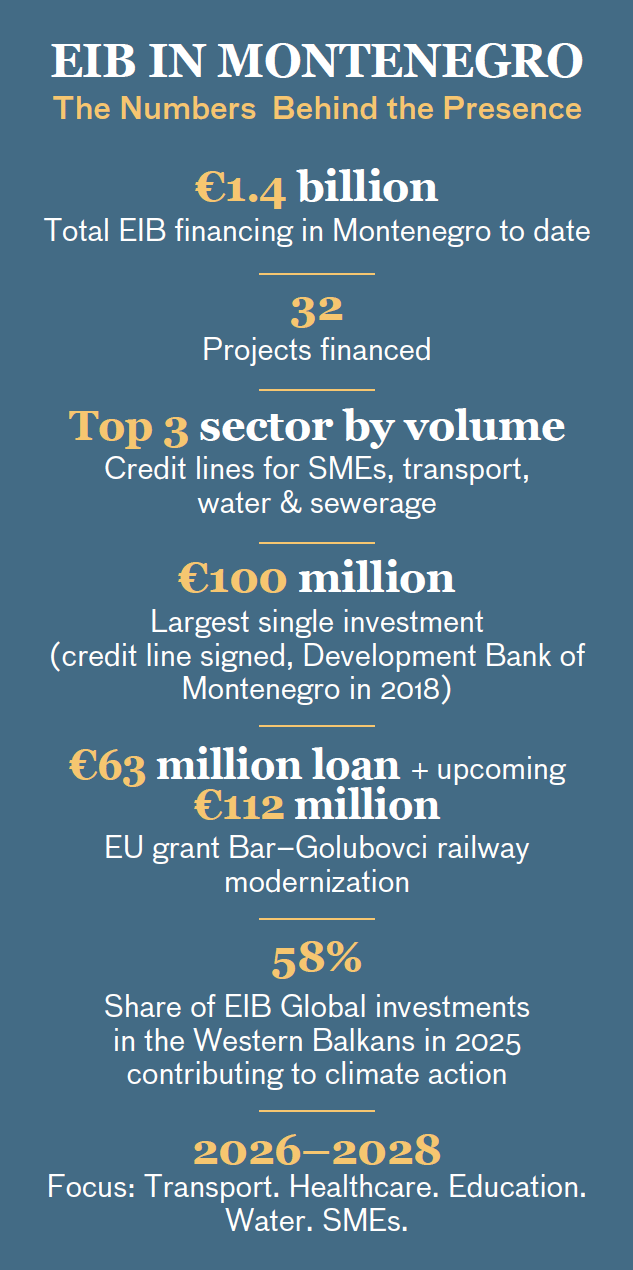
The impact is already visible. The Bar–Golubovci railway section — one of Montenegro’s key transport corridors — is supported by a €63 million EIB Global loan combined with €112 million in EU grants. The modernisation will improve safety, efficiency and capacity for more than 1.3 million passengers and nearly 1.9 million tonnes of freight annually, reinforcing Montenegro’s regional connectivity.
Where is the next wave of financing headed?
Our focus is on sectors that underpin long-term competitiveness: transport connectivity, green transition, healthcare, education and water infrastructure.
In transport, we continue financing rehabilitation of major road corridors and railway sections, as well as the modernisation of the air traffic control system. Preparatory studies for the renovation of the Port of Bar — Montenegro’s primary maritime gateway — are underway with EIB technical assistance, creating a pipeline for future strategic investment.
In healthcare, we are preparing financing for equipment upgrades in more than 30 hospitals and health centers nationwide. In education, a new framework loan for school modernisation is in preparation and may be complemented by EU grants. Through the “Better Schools for All” programme, 813 pre-school, primary and secondary schools are currently being assessed to thereafter reconstruct the prioritized schools and with it ensure safer, more inclusive and better-equipped learning environments — strengthening longterm human capital.
Support for SMEs remains central, particularly in innovation, digitalisation and decarbonisation. We are also exploring new investment opportunities in the energy sector aligned with Montenegro’s climate commitments and European transition objectives.
What still slows investment?
The primary constraint remains project readiness. A strong pipeline of well-prepared projects aligned with EU standards allows financing to move faster and at greater scale.
Further improvements in governance, regulatory simplification and permitting procedures would accelerate capital flows and shorten implementation timelines. Montenegro has made significant progress, but the coming phase will depend heavily on institutional coordination and execution capacity.
Through advisory initiatives that strengthen technical preparation and mobilise EU grants, we support this process. However, implementation speed ultimately determines economic impact.
How does Montenegro compare regionally?
Financing volumes reflect growing confidence. EIB activity has increased from approximately €60 million in 2024 to €83 million in 2025, with over €200 million expected this year. This upward trajectory signals both improved preparation and stronger strategic alignment.
Croatia provides a useful reference. Following EU accession, EU grants expanded significantly and EIB financing increased markedly compared to pre-membership levels. Montenegro now has the opportunity to build similar absorption capacity before accession, positioning itself to fully leverage EU funding from the first day of membership.
Current investments are already generating measurable results. In education, more than €55 million has modernised infrastructure nationwide. In the water sector, a €57 million EIB loan combined with €59 million in EU grants is upgrading water supply and wastewater systems across multiple municipalities, particularly in the northern region, addressing structural bottlenecks that directly affect competitiveness and quality of life.
What changes for SMEs?
Through cooperation with the Development Bank of Montenegro, €100 million has supported over 300 SMEs, including €20 million dedicated to green investments. A new €50 million credit line focused exclusively on green-eligible projects is under preparation.
The EU-backed Guarantee for SME Resilience is unlocking €15 million in loans, helping companies adapt to evolving EU standards, including carbon-related requirements.
In parallel, the upcoming Greening Financial Systems Programme will support the Central Bank and commercial banks in assessing and reporting climate risks, strengthening alignment with European regulatory frameworks and supporting private sector competitiveness.
Five years from now, what would success look like?
Success would mean Montenegro fully integrated into the EU single market, with infrastructure meeting European standards and institutions capable of managing large-scale investment efficiently and transparently.
It would mean driving along reliable transport corridors, patients treated in modernised hospitals and students taught in refurbished classrooms.
Success would be underlined with upgraded water systems that keep Montenegro’s rivers and lakes clean, and a private sector prepared for a carbon-adjusted European economy.
The opportunity is substantial. The decisive factor will be sustained execution — ensuring that reform momentum translates into durable economic growth and improved living standards.