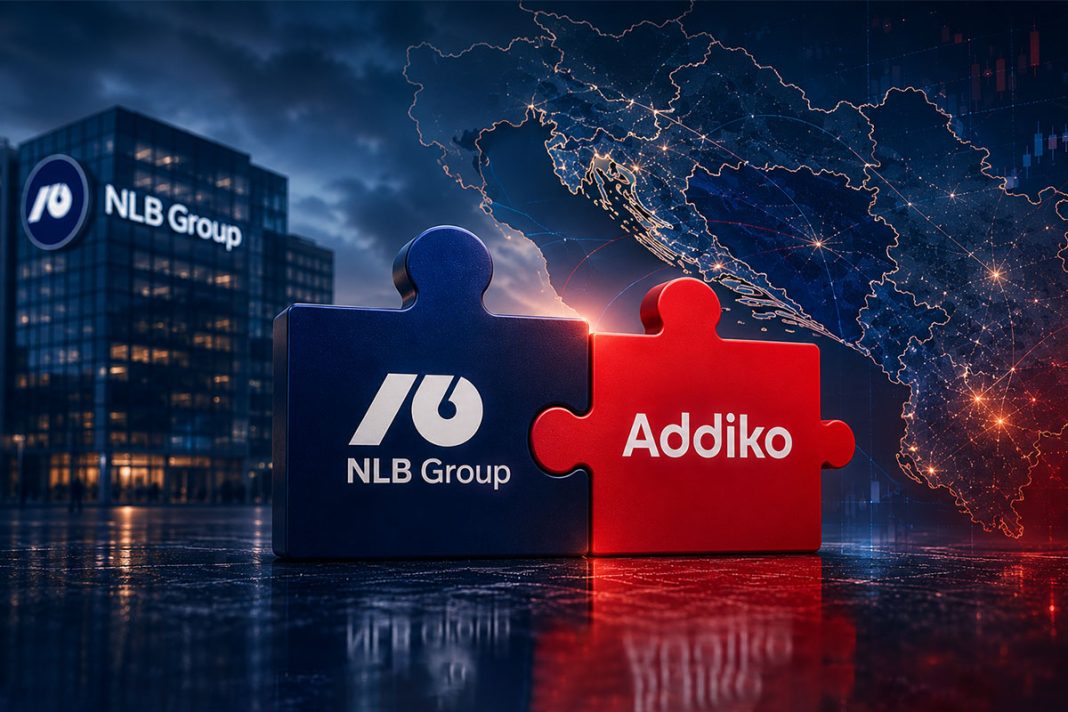
The fight for Addiko Bank may appear to be another acquisition story in Europe’s banking sector. In reality, it is becoming a revealing snapshot of how financial power across Southeast Europe is beginning to shift.
Slovenia’s NLB has returned with a €29-per-share bid for Addiko Bank after failing to secure control of the lender in 2024. Austria’s Raiffeisen Bank International (RBI) has meanwhile raised its own offer to €26.50 per share, turning Addiko into one of the region’s most contested banking assets.
What sits behind the competing bids is not simply a battle over one bank, but a wider race for scale, market positioning and long-term influence in a region where banking consolidation is accelerating once again.
For Boran Kerim, Founder and CEO of Belgrade-based BSK Consulting, the growing interest in Addiko comes as no surprise.
“Serbia’s banking market is too small for the number of banks operating in it,” Kerim says. “Consolidation is inevitable.”
According to him, the country’s six largest banks already control roughly 75–80% of the market, leaving increasingly limited room for smaller players to expand organically.
In Europe’s increasingly unforgiving banking landscape, scale is no longer optional.
That reality helps explain why Addiko — despite not being among the region’s largest lenders — has suddenly become strategically important.
“In such a structure, Addiko represents a specific niche focused on retail and SME banking, which makes it strategically useful for buyers looking to strengthen exactly those segments,” Kerim explains.
Its appeal, however, extends beyond Serbia alone.

Addiko operates across Slovenia, Croatia, Bosnia and Herzegovina, Serbia and Montenegro — markets that remain highly relevant for banking groups seeking regional reach, stronger cross-border positioning and deeper access to Southeast European growth corridors.
Its real value may not be its balance sheet, but its geography.
For NLB especially, acquiring Addiko would significantly strengthen its ambition to position itself as one of the defining banking groups of the wider Adria region. The renewed bid also reflects broader pressures reshaping banking across Europe: rising regulatory costs, expensive digital transformation, slower economic growth and intensifying competition from fintech firms.
Larger balance sheets increasingly mean greater resilience.
Still, Kerim cautions against interpreting the Addiko battle purely as a regional power struggle.
“It doesn’t appear to be part of a wider regional trend,” he says. “When we look at the potential buyers, we see banks that are already present in the Serbian market. This is more a local competition for positioning at the moment when Addiko’s owners decided to sell.”
That distinction matters.
While the transaction carries broader regional implications, the underlying logic may ultimately be rooted in Serbia’s own banking structure — particularly the shrinking space for organic growth in a market that is already highly concentrated.
Yet the consolidation wave is clearly spreading beyond Addiko alone.
Serbia’s AIKGroup recently agreed to acquire a majority stake in Croatia’s Podravska banka, further underscoring how regional financial players are increasingly pursuing cross-border expansion and stronger positions within EU markets.
Together, the two transactions point toward a banking sector entering a new phase — one in which regional groups are becoming more ambitious, while mid-sized and specialised banks are increasingly viewed as strategic assets rather than standalone institutions.
For years, banking across Southeast Europe was largely shaped by Western European expansion. Austrian and Italian groups moved aggressively into post-transition markets, building regional networks stretching from Ljubljana to Skopje. Today, however, a new dynamic is beginning to emerge: regional financial players themselves are becoming consolidators.
That shift may prove more significant than any individual transaction.
Because banking influence extends far beyond balance sheets. Banks shape access to capital, business expansion, infrastructure financing, digital adoption and long-term economic integration. In fragmented economies still navigating uneven growth and investment gaps, financial networks often become one of the few structures connecting markets at scale.
Kerim nevertheless argues that consolidation alone will not solve the region’s deeper financing limitations.
“We don’t need more banks. We need a capital market that will provide companies with alternative sources of financing,” he says.
That observation may ultimately become the most important lesson of the entire Addiko story.
Because while larger banking groups may bring efficiency, scale and stronger capital positions, economies that remain overly dependent on bank financing continue to face structural limits on long-term growth and investment diversification.
If the acquisition ultimately goes through, analysts believe it is unlikely to be the last major deal reshaping the sector.
Instead, the battle for Addiko may ultimately be remembered as another signal that banking in Southeast Europe is entering a new era — one defined less by market entry and more by consolidation, scale and the race for regional influence.