
From a CASSINI Hackathon win to building software designed to prevent satellite collisions, SpaceGuardian CEO Luka Zlatečan believes Europe still has a chance to lead in space — and that small countries like Slovenia need not remain on the sidelines.
SpaceGuardian began as a winning idea at the CASSINI Hackathon. Today, the Slovenian start-up is developing software aimed at solving a very real problem in an increasingly crowded orbit: what happens when satellites operated by different companies are at risk of colliding.
For CEO Luka Zlatečan, the opportunity extends far beyond one company. Slovenia’s growing presence in the European space sector, the rapid advance of artificial intelligence and the ability of small countries to build technology for global markets are all part of the same story. A software engineer with more than a decade of experience and one of the superfinalists of the AmCham Top Potential of the Year 2026 programme, Zlatečan represents a generation for whom building internationally from Slovenia is not an aspiration for the distant future, but a starting point.
SpaceGuardian began with a hackathon challenge and has moved remarkably quickly towards becoming a real space-tech company. At what point did you realise that what you had built was not simply a winning project, but something that could become an internationally relevant business?
When people who actually run satellites told us the problem was real. Winning CASSINI in November 2024, first in Slovenia and then at the European level, only proved the idea worked in a competition.
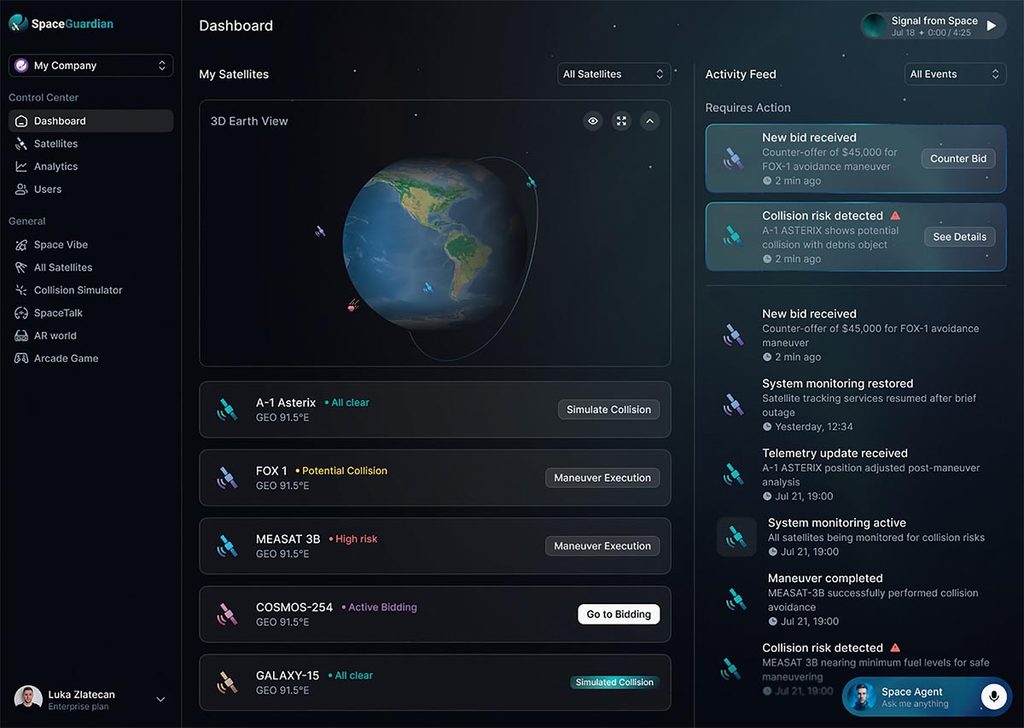
The hackathon put us in front of EU space experts, and through them in front of satellite companies. They all said the same thing: deciding which satellite moves out of the way before two of them collide is still done by email and phone, and it’s a real problem for them. That’s when it stopped being a hackathon project.
Slovenia is a small market and hardly the first country most people associate with the global space industry. Does coming from a small country make building a company like SpaceGuardian more difficult, or does it force you to think internationally from day one?
Both. Nobody in the space industry thinks of Slovenia first, so the country’s name doesn’t open doors for us. That’s starting to change. In January 2025 Slovenia became a full ESA member, the first new one in ten years, which gives Slovenia an equal seat at ESA and Slovenian companies full access to all its programmes. But the size also made one decision for us early: the home market is too small, so we’ve worked internationally since the start.
SpaceGuardian is addressing an increasingly serious problem: managing satellite traffic and preventing collisions in an ever more crowded orbit. How significant is this challenge becoming, and where exactly do you see the commercial opportunity for SpaceGuardian?
There are nearly 17,000 working satellites in orbit today, up from fewer than 1,000 in 2010. When two companies’ satellites are heading for a collision, they often sort it out over email, or they don’t sort it out at all.
Space isn’t settled, and the companies that will lead it are still small or don’t exist yet
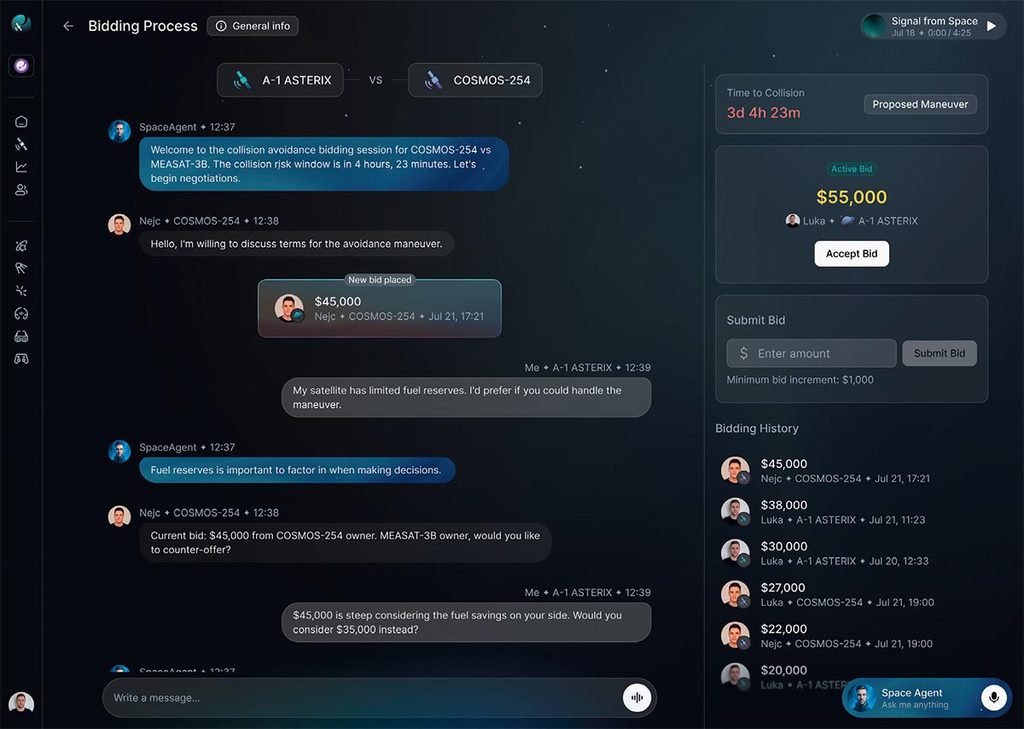
We want to be the place where that gets settled. Our software spots satellites that are about to come too close, works out how one of them should move out of the way, and helps the two companies agree which one moves. Each company still makes the final decision about its own satellite. Moving costs fuel, so on our platform one company can pay the other to move. Customers pay a subscription for the software, and we take a commission on those deals.
Our first customers will be smaller satellite companies that can’t afford a team watching around the clock. We don’t have paying customers yet. We’re preparing our first trial with a European space company and have a letter of intent from a partner.
Europe has traditionally been seen as strong in science and engineering but less successful than the United States in turning technological innovation into globally dominant companies. In the emerging space economy, does Europe have an opportunity to change that pattern?
I think so. Europe missed search, social and cloud because it showed up after those markets were settled. Space isn’t settled, and the companies that will lead it are still small or don’t exist yet.
Europe has the engineers, which was never its weak point, and ESA and EU programmes behind them. What it needs is to buy from its own start-ups instead of waiting for them to prove themselves in America first.
For companies from Slovenia and the wider region, where do you see the most realistic opportunities within the European space economy? Must they build satellites and rockets, or is much of the opportunity actually in software, data, AI and services surrounding the space infrastructure?
No. Satellites and rockets need capital and facilities this region doesn’t have. Software needs people, and the people are here. We’re a core team of four in Slovenia building software for satellite companies, and nothing about that requires a launch pad.
AI is central to SpaceGuardian’s technology, but it is also rapidly changing your other field, software development. You recently wrote about AI solving problems that you once enjoyed solving yourself. Has AI already fundamentally changed what it means to be a software engineer, and what skills will distinguish exceptional developers five years from now?
Yes. Writing code used to be the hard part, and it isn’t any more. AI now writes a lot of it, including problems I used to enjoy solving myself. What’s left is deciding what to build and checking whether what the AI produced is actually right.
AI will give you code that works. Knowing when it’s still the wrong solution is the hard part
In five years the best developers will understand the whole product and the business it serves. For us that means knowing how a satellite company actually works day to day. And they’ll have taste. AI will give you code that works. Knowing when it’s still the wrong solution is the hard part.
You work simultaneously across technology, entrepreneurship and leadership. What has been harder for you personally: solving complex technical problems or learning how to turn technology into a company, communicate a vision and lead people?
Turning it into a company. I’ve built software products for more than ten years, and technical problems have answers you can test. Leading people doesn’t. Nothing tells you whether you explained where the company is going well enough, or whether you made the right call for the team. You find out months later, if at all.
Slovenia and the wider Southeast European region produce strong engineers and entrepreneurs, yet many of the most ambitious people still build their careers elsewhere. What would need to change for this region to become a place where globally significant technology companies are not the exception?
More local capital, and founders who built global companies and then stayed. The money is the obvious part. The founders matter more, because people believe what they’ve seen someone do. When someone who built a company for the world market still lives here and backs the next teams, ambitious people stop assuming they have to leave.
If we speak again in 2030, what would have to have happened for you to consider the next four years a success, for SpaceGuardian, but also for Slovenia’s technology ecosystem?
For SpaceGuardian: satellite companies paying for our software and using it to protect their own satellites every day.

Today we have a working platform that runs on real, live data about satellites at risk of colliding, and our first trial is being prepared. Getting from there to paying customers, and raising a funding round on the way, is the job.
For Slovenia: a few more technology companies selling worldwide from Slovenia. If I can name them when we talk in 2030, the four years went well.