Brussels has offered the Western Balkans an unprecedented financial incentive to accelerate economic convergence. But as reforms advance at different speeds, a more uncomfortable question is emerging: can the region turn European funding into lasting prosperity?
Six billion euros is a substantial sum for a region whose economic future has been debated in Brussels for more than two decades. It is enough to help finance new infrastructure, modernise energy systems, strengthen businesses and accelerate integration with the European market. Yet the European Union‘s Growth Plan for the Western Balkans is built around a proposition that makes the money considerably harder to obtain than the headline suggests: governments must first demonstrate that they are prepared to change the way their economies and institutions function.
For years, the Western Balkans have been promised that European integration would bring greater prosperity, stronger institutions and improved living standards. Progress has been uneven, while the gap separating the region from the EU remains substantial. The €6 billion Reform and Growth Facility, covering 2024 to 2027, is designed to change the incentives. Rather than financing aspirations, Brussels intends to reward measurable reforms. The question is whether this approach can succeed where repeated political commitments have produced only partial results.
The economic urgency is difficult to ignore. In its April 2026 assessment, the World Bank projected growth of 2.8% across the six Western Balkan economies this year, rising to 3.2% in 2027.
These figures suggest continued expansion, but hardly the acceleration needed for rapid convergence with wealthier European economies. Labour shortages, emigration, weak productivity and international uncertainty continue to constrain the region’s prospects.
The International Monetary Fund offered a more ambitious perspective in September, suggesting that EU accession could raise GDP per capita by approximately one-third over a decade under favourable conditions. Crucially, those gains would depend on domestic structural reforms, deeper integration into the European single market and effective use of EU funding. Money, in other words, is only one part of the equation.
THE DIFFERENCE BETWEEN PROMISED AND DELIVERED
The facility’s structure reveals the European Commission’s intentions. Of the €6 billion, €2 billion is provided in grants and €4 billion in concessional loans. At least half of the overall funding is intended to support investment through the Western Balkans Investment Framework, with resources directed towards transport, energy, digital infrastructure, education and other priorities. Payments depend on specific reform milestones, including improvements in governance, the business environment and the rule of law.
This is not simply another European assistance programme. It introduces financial consequences for failing to deliver. Governments that miss agreed targets can have payments withheld, while funds associated with reforms that remain incomplete beyond the permitted deadlines may ultimately be reduced and redistributed. The arrangement effectively turns reform performance into a form of regional competition.
The first results illustrate how difficult that transition may prove. According to European Commission programme reporting, €396.4 million was released during 2025, while 39 reform steps were assessed as achieved across the six economies. Those steps represented only around 5% of the total commitments under the facility. The figures expose the considerable distance between announcing reforms and completing them.
The real measure of success will not be how much money Brussels releases, but how much economic capacity the region builds
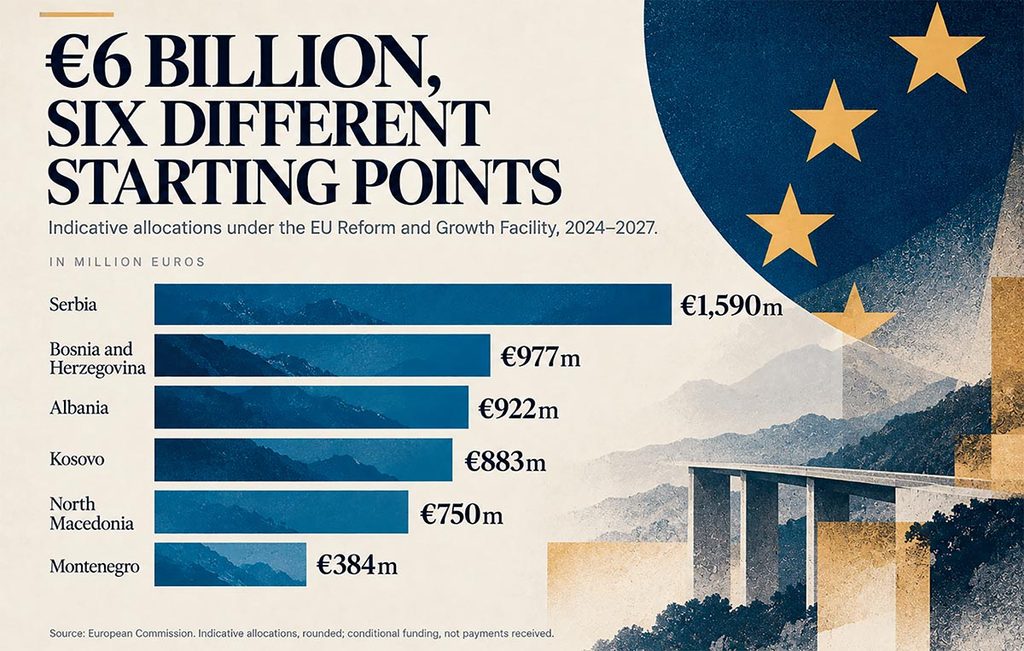
Progress has not been uniform. Albania, Montenegro and North Macedonia secured further European Commission release approvals in May 2026, while Serbia received approval for its first reform-linked release in January. Bosnia and Herzegovina’s delays in submitting its reform agenda had already resulted in a 10% reduction in its initial indicative allocation, subsequently bringing it to approximately €977 million. Kosovo’s progress was complicated by domestic political difficulties that prevented the necessary financial agreements from being finalised during 2025.
By July 2026, the European Commission was openly discussing the possibility of reallocating unused funds from economies that failed to implement their commitments. No reallocation decision had been taken at that point, but the warning was significant. Governments faced the prospect that delays could translate into resources becoming available to better-performing neighbours.
SIX ECONOMIES, DIFFERENT SPEEDS
The distribution of funding reflects the considerable differences between the six economies. Serbia has the largest indicative allocation, at approximately €1.59 billion, followed by Bosnia and Herzegovina with €977 million, Albania with €922 million, Kosovo with €883 million, North Macedonia with €750 million and Montenegro with €384 million. These are conditional funding envelopes, not guaranteed payments.
By May 2026, the European Commission reported that €212.8 million had been released under Albania’s envelope, compared with €142.1 million for North Macedonia and €89.3 million for Montenegro. Serbia had received pre-financing and subsequently obtained approval for its first reform-linked release.
The differences reflect varying payment schedules, institutional readiness and reform progress rather than a simple ranking of political commitment.
Serbia illustrates the political sensitivity of the arrangement.
In February, European Enlargement Commissioner Marta Kos raised concerns about changes to judicial legislation that Brussels feared could weaken judicial independence. The EU indicated that Serbia’s financial package was under review, demonstrating that access to funding could be affected by disputes over democratic institutions, not merely economic policy.
Bosnia and Herzegovina faces a different challenge. Its complex political and administrative structure has complicated the coordination needed to meet reform conditions. Meanwhile, Albania, Montenegro and North Macedonia have demonstrated progress in specific areas, from electricity-market integration and renewable energy to digital government and cybersecurity. Such achievements may appear technical, but reliable energy markets, functioning public services and predictable regulations are precisely the conditions businesses assess when making investment decisions.
CAN €6 BILLION REALLY CHANGE THE REGION?
The more difficult question concerns the scale of the programme relative to the challenges it is expected to address. Six billion euros over four years is meaningful, but it cannot independently transform economies burdened by weak productivity, demographic decline and infrastructure gaps. Nor is the entire sum a grant. Four billion euros consists of concessional loans, making the quality of investments as important as their speed of implementation.
The most valuable projects will generate economic returns beyond their immediate construction costs. A modernised railway can improve trade competitiveness, a stronger electricity network can support industrial development, and better digital infrastructure can reduce administrative burdens for businesses. But expensive projects with limited economic benefits could leave governments with additional debt without delivering the productivity improvements the programme is intended to encourage.
There is also the question of whether European financing can mobilise substantially greater private investment. Public money is most effective when it reduces risks and creates conditions in which businesses are prepared to invest their own capital. If the Growth Plan succeeds in strengthening institutions and making regional markets more accessible, its impact could extend well beyond the original €6 billion. If it merely finances projects that governments would have undertaken anyway, the longer-term gains may prove disappointing.
INTEGRATION CANNOT STOP AT THE BORDER
Perhaps the greatest potential of the Growth Plan lies not in its financing, but in its ambition to bring the Western Balkans closer to the European single market before full EU membership. For businesses operating across the region, fragmented regulations, border delays, inconsistent standards and administrative procedures remain everyday obstacles. Removing them could deliver benefits that continue long after the programme ends.
The European Commission estimates that deeper integration through the Common Regional Market could potentially increase regional economic growth by 10%. Achieving such gains, however, requires cooperation among governments whose political relationships are often more complicated than their economic interests.
This is where the Growth Plan encounters one of the region’s oldest contradictions. Governments regularly express support for regional economic cooperation, yet practical implementation becomes entangled in political disputes. A manufacturer establishing a regional supply chain or an exporter transporting goods across several borders has little interest in the diplomatic explanations for delays. What matters is whether the system works.
Greater integration would strengthen the Western Balkans’ position within European supply chains at a time when companies are seeking more resilient networks of suppliers. The region has geographical proximity to major EU markets and established industrial capabilities, but those advantages are diminished by regulatory uncertainty, infrastructure limitations and shortages of skilled workers.
The World Bank’s latest regional assessment reinforces the importance of employment and human capital. Better infrastructure will achieve little if businesses cannot recruit the people needed to operate and expand. Retaining skilled workers will remain difficult unless productivity improvements translate into better wages and credible career opportunities.
THE COST OF ANOTHER DELAY
The Growth Plan also raises an uncomfortable question about the political economy of reform. Governments have often been willing to adopt strategies, establish working groups and announce legislative changes. The harder task is ensuring that those measures alter how institutions actually operate. A new law does not automatically create an independent regulator, an efficient court or a transparent procurement system. Those outcomes depend on enforcement, administrative capacity and political restraint.
The danger is that reform becomes a procedural exercise, with governments concentrating on satisfying the conditions necessary to unlock payments while avoiding changes that challenge entrenched interests. The European Commission must therefore assess not only whether formal milestones have been completed, but whether the resulting improvements are credible and sustainable.
For the region’s businesses, the stakes are immediate. Companies cannot postpone investment decisions indefinitely while waiting for institutions to become more predictable.
International investors can choose alternative locations, while domestic entrepreneurs may decide that expansion elsewhere offers better prospects. Every year of delayed reform carries costs that do not appear in the European Commission’s disbursement tables.
There is nevertheless reason for cautious optimism. The facility gives governments an immediate financial incentive to implement reforms that have long been recognised as necessary. It also makes progress easier to compare and provides a mechanism for rewarding stronger performance. If applied consistently, that approach could help shift attention from political declarations towards measurable economic outcomes.
When the programme reaches the end of its 2024–2027 financing period, the number of completed reform milestones will matter, as will the amount of funding released. But neither will be sufficient to establish success. The more meaningful indicators will be whether trade has become easier, institutions more reliable, energy systems more resilient and businesses more productive.
Europe has made €6 billion available to accelerate that transformation.
The opportunity is considerable, but neither unlimited nor unconditional. The greatest risk is not that Brussels will fail to provide the money. It is that the Western Balkans will once again struggle to turn an opportunity for economic change into lasting results.
And unlike another delayed political promise, this time the cost of failure can be counted in euros.