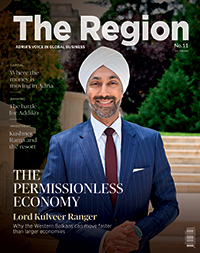
As Montenegro accelerates its energy transition and aligns its power sector with European standards, Elektroprivreda Crne Gore (EPCG) stands at the centre of the country’s economic and environmental future. Under the leadership of Executive Director Zdravko Dragaš, the stateowned utility is working to modernise its operations, expand renewable energy capacity and strengthen international partnerships. In this conversation, Dragaš explains how EPCG is preparing for the next decade—balancing investment speed with sustainability, addressing the challenges of Pljevlja, and positioning Montenegro’s power sector within a rapidly evolving regional energy market.
What is the one thing EPCG must change immediately to be ready for the next decade?
The most important change EPCG must make immediately concerns the way development is managed. We are entering a period in which energy companies no longer have the luxury of slow processes and unclear priorities.
That is why we insist on more efficient decision-making, clear responsibility and the modernisation of operations, fully aligned with European standards in production and corporate governance.
This process also requires stronger digitalisation and a clear link between strategy, investment and measurable results.
Renewable energy is a strategic direction, but also a politically sensitive issue. Where do you draw the line between speed, sustainability and the public interest?
Renewable energy sources represent our strategic direction, but the speed of implementation must never outweigh quality. The line is drawn where shortterm interests intersect with long-term sustainability.
EPCG develops projects with full transparency, thorough expert analysis and open dialogue with the public. Only such an approach ensures that the energy transition is both sustainable and socially acceptable. No project can be implemented at the expense of the environment or public trust.
Our approach combines momentum with responsibility—allowing for high-quality environmental impact assessments, continuous dialogue with local communities and long-term sustainability. Only such projects have real value.
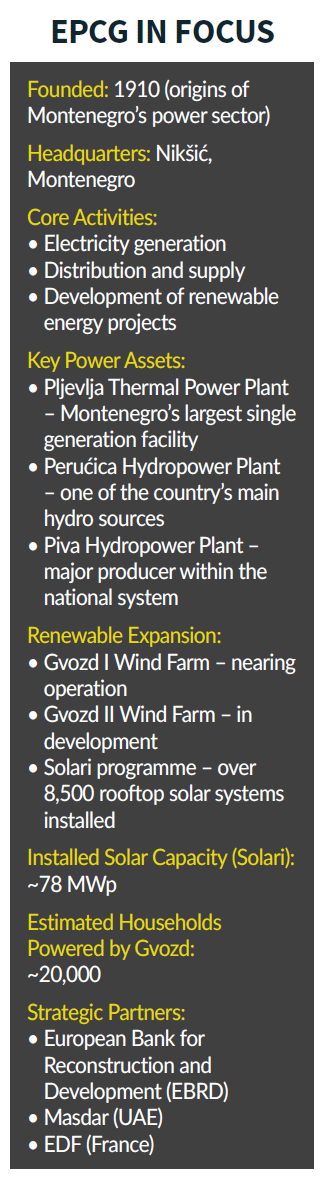
A strong example is the Gvozd I wind farm, which is expected to enter operation soon, while development continues on Gvozd II. This project, valued at around €82 million and financed by the European Bank for Reconstruction and Development (EBRD), is expected to generate between 150 and 200 GWh of electricity annually—enough to supply around 20,000 households. The Gvozd wind system will significantly increase the share of renewables in EPCG’s portfolio while substantially reducing CO₂ emissions.
Equally important is the Solari project, which has already delivered measurable results. As of January this year, more than 8,500 solar systems had been installed, with total capacity approaching 78 MWp. At the same time, CO₂ emissions have been reduced by around 114 tonnes.
We will continue intensively developing renewable projects, as they represent the future of Montenegro’s energy sector and the foundation of its long-term stability. Current projects include the Kapino Polje solar plant, the Željezara Nikšić solar facility, as well as Krupac, Štedim, Slano Dam and Vrtac Dam, for which building permits have already been secured or are close to approval.
Pljevlja symbolises Montenegro’s energy and environmental challenges. What is the long-term solution—and what is no longer acceptable?
For EPCG, Pljevlja is both an energy and a social issue. Our long-term approach is based on the principles of a just transition, ensuring stronger environmental protection while maintaining job security and stability for the local community.
The ecological reconstruction of the Pljevlja Thermal Power Plant, along with the successful launch of the DeNOx and DeSOx systems, demonstrates that responsible management of existing capacities can deliver measurable results. Shortly after the denitrification system was commissioned, nitrogen oxide emissions fell from roughly 480 mg/Nm³ to below 130 mg/Nm³, with readings of around 108 mg recorded in some intervals—well below the designed limit of 150 mg/Nm³.
Initial measurements for sulphur dioxide show concentrations reduced to around 61 mg/Nm³. For comparison, emissions in March 2025 stood at approximately 4,544 mg/Nm³, and after the adaptation of the boiler and chimney in December 2025 they fell to 3,249 mg/Nm³. Today’s levels are many times lower than previously recorded values, confirming the high efficiency of the newly installed systems.
These results have a significant longterm impact on the health of Pljevlja’s citizens and the quality of life in the city. What is no longer acceptable is ignoring environmental standards or delaying solutions essential for protecting public health and ensuring a sustainable future for Pljevlja.
International partnerships are becoming increasingly important. Do you see EPCG primarily as a national pillar or a regional energy player?
I see EPCG as a strong pillar of Montenegro’s national energy system, but with a clear ambition to become a recognised regional player.
Ensuring the stability of the domestic system remains our priority, but partnerships with international companies open new opportunities. One example is the planned Kruševo hydropower plant on the lower course of the Piva River, which has attracted strong interest from the French energy group EDF.
We are also cooperating with Masdar from Abu Dhabi, which has expressed interest in jointly developing renewable energy projects, particularly wind capacity—an area where Montenegro has significant natural potential.
With both partners we have signed cooperation agreements reflecting a shared strategic interest. Such partnerships represent an important step towards aligning our operations with the European energy market and strengthening EPCG’s regional position. That ambition does not contradict the national interest—it is its natural extension.
You lead a state-owned company after working in the private sector. What business logic are you bringing into EPCG, and what system habits are hardest to change?
My experience in the private sector tells me that focus must be placed on efficiency, planning and measurable results. Every investment must have a clear justification, timeline and measurable impact—it must serve a defined purpose and deliver longterm value.

This is precisely where I see the greatest room for progress. At the same time, the most difficult challenge is changing the inertia of large systems and the habit of extending processes without real need.
Nevertheless, I am convinced EPCG can become a modern and stable state-owned enterprise—one that takes care of its people, especially those working in production, while confidently moving toward a greener energy future.
We are on the right path. Our business logic is built on modernisation, sustainability and the green transition, while fully respecting the people who have carried Montenegro’s energy system for decades.
