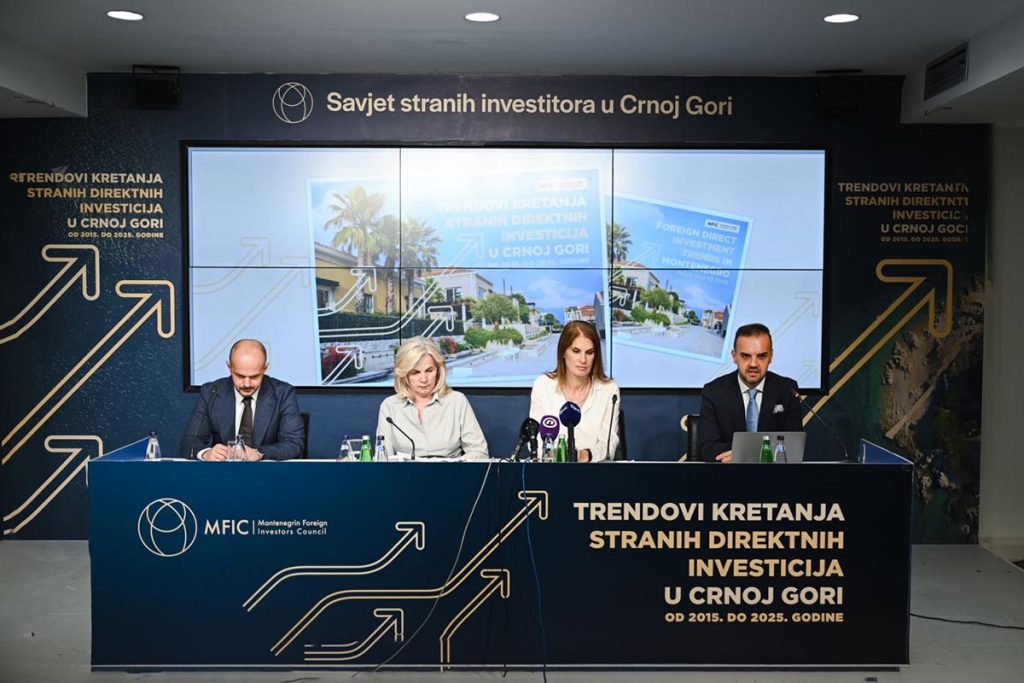
Montenegro continues to rank among the Western Balkans’ most investment-intensive economies, but the structure of those investments has shifted sharply away from productive sectors towards real estate, according to a new report published by the Montenegrin Foreign Investors Council – MFIC.
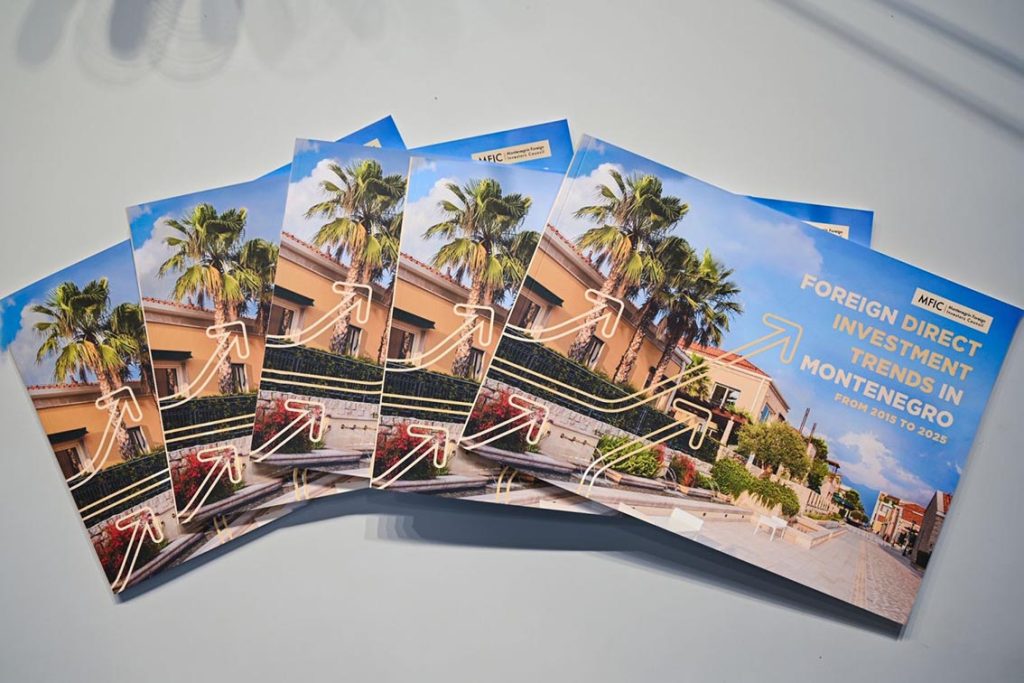
The report, Foreign Direct Investment Trends in Montenegro from 2015 to 2025, concludes that while foreign direct investment (FDI) inflows remain resilient, an increasing share of capital is flowing into property rather than businesses that generate exports, innovation and long-term economic growth.
According to the analysis, investments in companies and banks accounted for 46% of total FDI in 2015. By 2025, that share had fallen to around 13%. Over the same period, real estate investment became the dominant category, reaching almost 54% of all foreign investment in 2023 and remaining close to half of total inflows in 2025.
The report argues that this transformation reflects a broader change in Montenegro’s economic model.
Rather than attracting new productive capacity, technology and manufacturing, the country has increasingly benefited from property purchases and tourism-related investment. While these sectors provide an immediate boost to economic activity, the report warns they contribute less to productivity growth, export capacity and economic diversification over the long term.
Despite these structural concerns, Montenegro’s overall investment performance remains solid.
Net FDI reached €530.7 million in 2025, an increase of 8% compared with 2024, while total inflows exceeded €1 billion. However, the report notes that net investment remains around one-third below the record level recorded in 2022.
The report also highlights a significant decline in productive investment.
Compared with 2015, investment in productive projects has fallen by 62%, while investment in real estate has increased by more than 250%. Even though productive investment recovered modestly in 2025, the improvement remains too limited to signal a broader investment cycle, according to the authors.
Regionally, Montenegro continues to perform strongly when measured relative to the size of its economy. Foreign direct investment accounted for 7.2% of GDP, placing the country among the leading economies in the Western Balkans on this indicator. Nevertheless, the report argues that quality now matters as much as quantity.
The MFIC points to Croatia’s more diversified investment base and Serbia’s ability to attract manufacturing, infrastructure and industrial projects as examples of how foreign investment can contribute more directly to long-term competitiveness.
Looking ahead, the report identifies Montenegro’s EU accession process as one of its greatest opportunities.
It argues that eventual EU membership could strengthen investor confidence by improving legal certainty, institutional stability and access to the European single market. However, it also stresses that membership alone will not guarantee higher-quality investment unless it is accompanied by reforms that improve the business environment and attract projects in ICT, renewable energy, advanced manufacturing and other high-value sectors.
The report ultimately delivers a clear message: Montenegro has demonstrated that it can attract foreign capital. The next challenge is ensuring that more of that capital creates productive businesses, skilled jobs and sustainable long-term growth rather than continuing to concentrate primarily in real estate.