
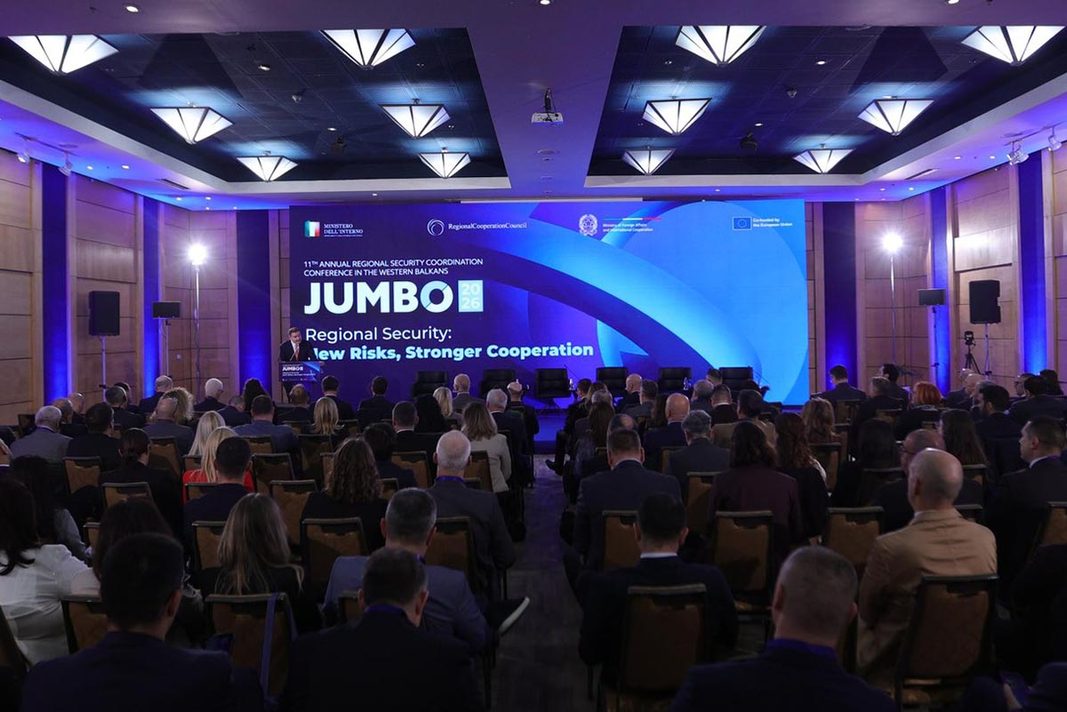
Albania is an integral part of Europe’s security architecture and has a responsibility to contribute to addressing threats that transcend national borders, said Interior Minister Ervin Demo at the conference.
“Albania is not Europe’s backyard. We are part of its front door. That door must be secure,” Demo said, stressing that Albania’s security is inseparable from that of the wider European continent. He argued that emerging challenges, including organised crime, illegal trafficking, cyber threats and new forms of criminal activity, require stronger institutions, faster information exchange, improved technological capabilities and coordinated cross-border operations.
Referring to the European Commission’s 2026 Report on Albania, the Minister highlighted progress in cooperation with EU member states and European agencies, increased anti-drug operations, joint patrols and efforts to trace criminal assets. He also pointed to improvements in the country’s capacity to combat cybercrime and strengthen international cooperation. However, he acknowledged that further progress is needed in financial investigations and in securing prosecutions and convictions for financial crimes, including offences linked to cybercrime, trafficking and illegal firearms possession.
The importance of improving technical capabilities for analysing digital evidence and protecting critical infrastructure has also been underlined. He referred to last week’s meeting of regional interior ministers in Budva, where participants discussed online child protection, internet fraud, migrant smuggling and the implementation of the EU Pact on Migration and Asylum, in cooperation with Frontex, the European Union Agency for Asylum (EUAA) and Europol.
The Tirana conference also presented preliminary findings from the regional “Secure Meter 2026” survey, which examines public perceptions of security and levels of trust across the region. Reliable data and evidence were essential for developing effective security policies and identifying areas requiring stronger institutional action. Demo further highlighted the strategic importance of the EU–Western Balkans Security Partnership, emphasising that security on both sides of the Adriatic is interconnected.
It has been concluded that regional security cooperation is not only a priority but also a prerequisite for economic development, investment and progress towards European integration.