Montenegro continues to attract international investment and advance towards European Union membership. Yet the latest assessment by foreign companies operating in the country suggests that improvements in the business environment are proving harder to achieve than progress on paper.
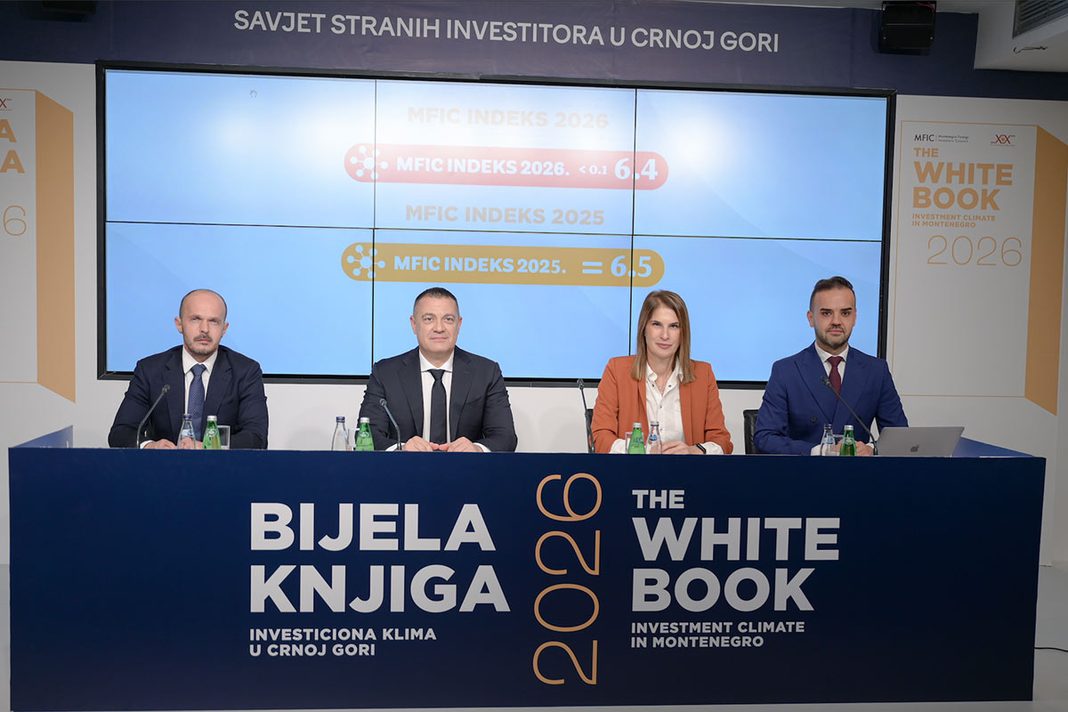
The 2026 White Book, published by the Montenegrin Foreign Investors Council (MFIC), shows that the country’s Ease of Doing Business Index slipped from 6.5 to 6.4 out of ten, while the broader investment climate rating remained unchanged at 6.3.
The decline is small, but the findings reveal a more complicated picture: some sectors are benefiting from reforms and modernisation, while others remain constrained by administrative inefficiency, infrastructure deficiencies and shortages of qualified workers.
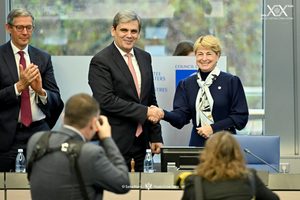
Presenting the report in Podgorica, MFIC Board President Branko Mitrović cautioned against interpreting the slight decline as a dramatic deterioration in business conditions. Montenegro has made important progress, particularly in European integration and regulatory reform, but the benefits are not yet sufficiently visible in companies’ everyday operations.
“Progress is evident, but its pace and effects are still insufficient to significantly improve the overall investment climate,” Mitrović said.
The findings are based on a survey of 34 MFIC member companies. The organisation represents 40 international businesses that collectively generate approximately 21% of Montenegro’s GDP and employ nearly 6,000 people.
An Economy Moving at Different Speeds
The sectoral results reveal striking differences in how investors experience Montenegro’s economy.
Banking and finance emerged as the highest-rated sector, improving from 7.0 to 7.1, supported by regulatory reforms, alignment with European standards and Montenegro’s integration into European payment systems, including SEPA.
Telecommunications and ICT, previously the strongest-performing sector, slipped from 7.2 to 7.0, despite continued investment in 5G and fibre-optic infrastructure.
Tourism presents a particularly interesting contradiction. Its overall rating rose from 5.9 to 6.3, the first improvement after several years of decline. Yet companies operating directly in the sector gave business conditions a score of just 4.5.
The discrepancy suggests that improvements in the sector’s broader outlook are not necessarily translating into better operating conditions. Labour shortages, inadequate infrastructure, seasonal pressures and airport limitations remain significant obstacles.
Transport and logistics recorded the sharpest decline, falling from 6.3 to 5.7, making it the lowest-rated sector. Ageing railways, border delays, inadequate airport facilities and the underused potential of the Port of Bar continue to undermine competitiveness.
Trade also weakened, declining from 6.8 to 6.4, while manufacturing and energy fell from 6.1 to 5.9.
When Bureaucracy Becomes an Investment Risk
Some of the report’s most revealing findings concern the functioning of public institutions.
Public administration efficiency received a score of just 4.6, the lowest among the economic parameters assessed. Companies continue to report missed deadlines, inconsistent interpretations of regulations and repeated requests for documentation already submitted.
The length of commercial court proceedings received an even lower score of 3.6.
For investors, such problems have direct financial consequences. Delays in obtaining permits, resolving disputes or collecting payments can affect the viability of projects and discourage further expansion.
Digitalisation offers a more encouraging picture, although progress remains uneven. The public services digitalisation index increased from 5.0 to 5.4, but institutional capacity to deliver those services received only 4.9.
The construction sector illustrates the contradiction. While online access to property information improved, the rating for building permit procedures dropped sharply from 5.5 to 4.7.
In other words, obtaining information about an investment is becoming easier. Turning that investment into a functioning project remains considerably more difficult.
The European Competitiveness Test
For the first time, the White Book assessed Montenegro’s readiness to operate within the European single market.
The overall score was 5.9, with economic competitiveness rated at 5.3 and public administration readiness at just 5.1.
These findings raise questions about whether Montenegro’s economic institutions and domestic businesses are developing quickly enough to match the country’s ambitions for EU membership.
Completing accession negotiations and preparing an economy to compete within the European single market are not the same achievement, Mitrović warned.
He also called for a change in how Montenegro measures the success of foreign investment. Rather than focusing primarily on the total amount of capital entering the country, greater attention should be paid to its contribution to productivity, exports, technological development and long-term economic value.
The distinction is important for an economy seeking to diversify beyond a relatively narrow range of sectors.
Plenty of Recommendations, Slower Implementation
The 2026 White Book contains 70 recommendations for improving Montenegro’s investment environment, including 18 new proposals and 52 carried over from previous years.
According to MFIC Executive Director Arijana Nikolić Vučinić, seven recommendations have been fully implemented, progress has been recorded on 37, while eight have seen no improvement.
The figures point to a recurring challenge: identifying obstacles is proving easier than removing them.
The research was completed before the announcement of the proposed Euro model changes to the wage system, meaning the findings do not reflect investors’ assessments of those measures.
Montenegro has made progress in modernising parts of its economy, improving digital services and aligning its regulatory framework with European standards. But the latest White Book suggests that investors are increasingly looking beyond legislative achievements towards the practical results of reform.
For a country approaching a potentially transformative stage of European integration, the distinction matters. The next measure of success will be not simply how much investment Montenegro attracts, but how effectively its institutions enable that investment to create lasting economic value.