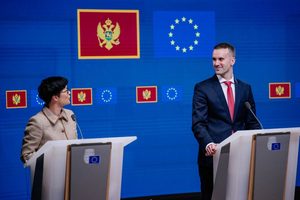

At the Munich Security Conference, a forum renowned for its gravitas in global security dialogue, the aspirations of three Western Balkan nations towards European Union membership were vocally reiterated, setting a target year of 2028 for their accession. The leaders of North Macedonia, Albania, and Montenegro, buoyed by their countries’ pro-European administrations, pressed for the commencement of accession dialogues at the earliest opportunity.
In a statement that underscored the depth of his nation’s commitment to this European dream, North Macedonian President Stevo Pendarovski highlighted the historic concession made by his country in resolving the protracted name dispute with Greece—a gesture of goodwill that paved the way for NATO membership but has yet to secure a berth in the EU. “Seventeen years in the waiting room of the EU seems a prolonged affair, yet our resolve remains unshaken,” Pendarovski noted, albeit with a cautious addendum on the necessity for the EU to refine its decision-making processes to accommodate new entrants.

Echoing this sentiment of readiness albeit without a rigid timetable, Albanian Prime Minister Edi Rama articulated his country’s desire not for immediate membership but for the green light to begin talks—a process he views as a transformative journey for Albania’s institutional integrity. Since achieving candidate status in 2014, Albania’s European aspirations have been marked by a steady, if slow, progression, with the first significant intergovernmental dialogue taking place in July 2022.
Montenegro’s President Jakov Milatovic presented perhaps the most ambitious timeline, eyeing 2028 for full EU integration. Since Croatia’s accession in 2013, the Balkan region has been in a state of anticipatory flux regarding EU expansion, with Montenegro, alongside its neighbours, striving to align more closely with European standards and practices.
The Munich Security Conference, now in its 60th iteration, has once again served as a pivotal stage for nations to voice their concerns, ambitions, and visions for the future. Notably absent from this year’s invite list were representatives from Russia, Iran, and North Korea, a decision reflecting the current geopolitical tensions and the conference’s emphasis on dialogue among those committed to the international rules-based order.
As the Western Balkans continue to navigate their path towards European integration, the EU finds itself at a crossroads, balancing enlargement with the need for internal consolidation. The coming years will undoubtedly test the union’s capacity for inclusivity and adaptation in an ever-evolving global landscape.