
What Washington’s New National Security Strategy Really Signals for Europe — and for Adria
Released on the White House website in November 2025, Washington’s newest National Security Strategy abandons the familiar cadence of past decades — a document that arrived only last month but has already reframed the transatlantic conversation.
Its chapter on Europe, pointedly titled Promoting European Greatness, reads less like diplomatic prose and more like a strategic reckoning.
In strikingly direct terms for an official document, the United States portrays Europe not as a settled pillar of the democratic order but as a civilisation in a slow structural crisis. The NSS describes an over-regulated economy, eroding confidence, demographic contraction, political suppression and migration policies that strain cohesion. It warns that Europe could be “unrecognizable in 20 years or less” if course corrections fail to materialise.
Agree or disagree, this is the vocabulary of America’s new strategic doctrine — and in geopolitics, vocabulary signals intent.
A STRATEGY THAT SAYS
THE QUIET PART OUT LOUD
Washington’s shift is not stylistic; it is strategic. The United States is signalling that the old habit of wrapping concerns in polite transatlantic language has run its course. Where previous administrations tempered pressure with polite phrasing, this one states the diagnosis flatly — and lets the consequences speak for themselves.
The NSS frames Europe as a continent with ample assets but faltering momentum: wealthy yet hesitant, capable yet divided, ambitious yet indecisive. It argues that Europe cannot regain strategic relevance without restoring economic dynamism, political clarity and cultural confidence.
The subtext carries the real weight: A Europe preoccupied with its internal contradictions cannot help shape an external order defined by speed, volatility and competition.





Across Europe, the National Security Strategy has triggered unusually sharp reactions from senior officials. EU foreign policy chief Josep Borrell has warned that the document’s language “raises serious questions about America’s view of Europe as a strategic partner,” while German Foreign Minister Annalena Baerbock has cautioned that framing Europe in terms of “civilizational decline” risks undermining decades of transatlantic cooperation. France’s Europe Minister Jean-Noël Barrot has described the NSS as a dramatic departure from the values-based partnership that once defined the West, and Italy’s Foreign Minister Antonio Tajani has insisted that Europe cannot be treated as a stage for ideological experiments. Even traditionally Atlanticist voices, such as Polish Foreign Minister Radosław Sikorski, have expressed unease at a document that appears to cast Europe more as a liability than an ally.
Across business circles — from Germany’s BDI to France’s MEDEF — the concern is more pragmatic: harsh U.S. rhetoric has a habit of preceding pressure on trade, supply chains and investment screening. For many in Brussels, the deeper worry is that the NSS quietly redefines Europe not as a co-architect of the West, but as a problem Washington intends to correct.
WHAT “EUROPE” MEANS IN THE NSS
Understanding the distinction is essential to understanding the implications
1. EU Europe
Used when criticising regulation, sovereignty erosion and limits on speech.
Target: EU institutions and political direction.
2. NATO Europe
Used when discussing defence spending, Russia or alliance reliability.
Target: NATO allies, including non-EU states.
3. Civilisational Europe
Used when referring to identity, birthrates or cultural cohesion.
Target: The broader Western cultural sphere.
WHICH “EUROPE”
IS WASHINGTON
TALKING ABOUT?
The NSS relies on a term Washington uses with deliberate elasticity: Europe. It shifts meaning depending on the argument.
When the document attacks regulatory suffocation, sovereignty erosion or constraints on free expression, it is unmistakably targeting EU institutions and policies. These are EU-level choices — and Washington names them as such.
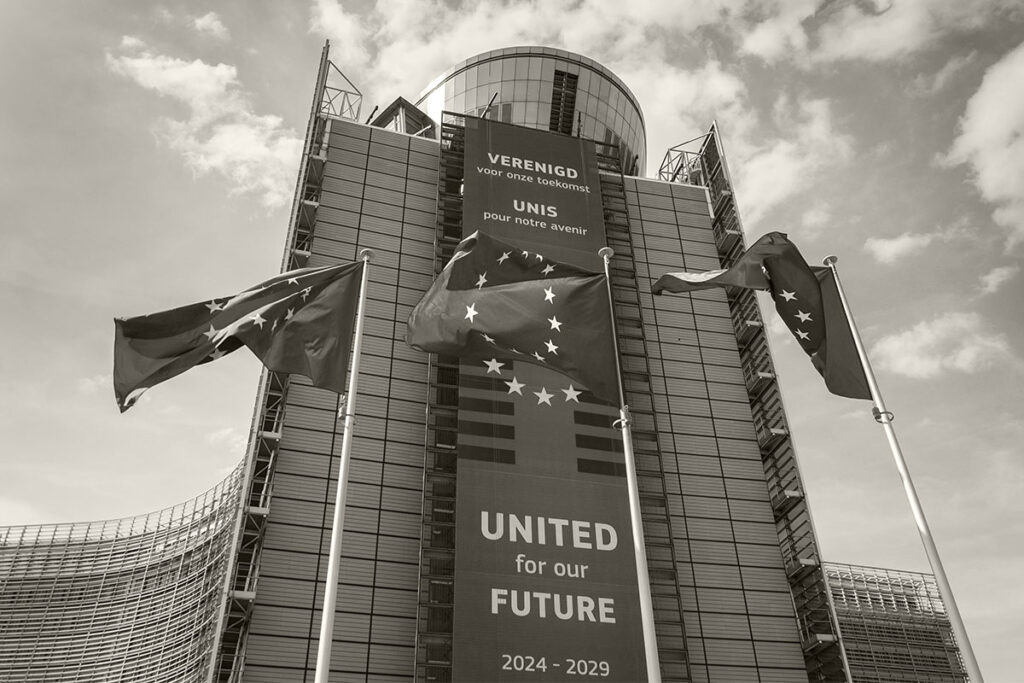
When the subject turns to defence, reliability and Russia, the term expands to NATO Europe — a set of allies the United States expects to invest more, deliver more, and hesitate less.
And beneath both lies a broader cultural critique. Here, “Europe” denotes a civilisational space wrestling with identity, confidence and cohesion — a cultural Europe rather than an institutional one.
Decoding which version of Europe the NSS invokes matters, because each carries distinct implications for the Adria region.
ADRIA IS NO LONGER
WATCHING FROM
THE STANDS
The Adria region sits at the intersection of Europe’s promise and its fragilities — and Washington’s new framing lands here with particular force. The push for stronger defence places NATO members like Croatia, Slovenia and Montenegro under a sharper spotlight, while raising new questions for neutral Serbia. The demand for competitiveness reaches directly into EU accession debates, regulatory reforms and investment conditions across the region. And the call for political clarity underscores broader questions of governance, cohesion and long-term orientation.
The NSS makes one thing plain: Europe’s next phase of momentum may have to be generated at its edges, not its centre.
WHAT THIS MEANS FOR ADRIA
• Faster Reforms Will Matter More
Washington is signalling impatience with slow-moving systems.
Adria’s agility becomes an asset.
• Defence Expectations Will Rise
NATO members face harder scrutiny.
Non-NATO states face harder questions.
• EU Accession Is Now Strategic, Not Procedural
The U.S. now sees enlargement through the lens of competitiveness and stability.
• The Periphery Has Leverage
Regions capable of delivering stability, clarity and growth will shape the next chapter of Europe’s evolution.
A MOMENT OF PRESSURE
By describing Europe’s vulnerabilities so bluntly, the NSS inadvertently highlights where renewal might begin. The Adria region has qualities older EU economies increasingly lack: institutional agility, reform appetite and a political landscape that has not fully ossified. If Europe needs an injection of clarity, adaptability and demographic resilience, it may find more of it in Zagreb, Belgrade, Ljubljana, Sarajevo, Skopje and Tirana than in some of the EU’s older capitals.
The NSS does not spell this out, but the logic is unmistakable: the periphery may become the engine.
THE DEBATE EXPLODES
INTO THE OPEN
Since the article was first drafted, the Strategy’s impact has moved decisively beyond diplomatic unease. European Council President António Costa publicly rejected what he described as political interference in Europe’s internal affairs, while German Chancellor Friedrich Merz argued that the language of the document only reinforces the case for greater European strategic autonomy. Reactions have not been confined to mainstream politics. Nationalist parties in parts of Europe have selectively welcomed the NSS’s harsher diagnosis, even as most governments have rejected the implication that Europe’s democratic systems require external correction. More quietly, the debate has reached Europe’s security institutions. In Denmark, defence officials have warned that growing U.S. economic and strategic assertiveness toward allies could itself become a source of vulnerability. Taken together, these responses suggest that the NSS has accelerated a shift already underway: transatlantic disagreements that once played out behind closed doors are now becoming part of Europe’s open political and security conversation.





If Washington’s sharper tone felt provocative yesterday, today it is unmistakably a rupture. Within hours, Polish Prime Minister Donald Tusk fired back publicly, warning the United States that “Europe is your closest ally, not your problem,” and even questioning whether America’s strategic posture toward Europe has fundamentally shifted.
And from a radically different vantage point, Elon Musk weighed in with a provocation of his own, declaring that the EU “should be abolished” and sovereignty returned to individual states.
From within the European Union itself, Hungary’s Prime Minister Viktor Orbán offered a different response. Without endorsing Washington’s authority to judge Europe, Orbán argued that parts of the diagnosis should not come as a surprise, repeating his long-standing criticism of what he calls Europe’s over-centralisation, demographic decline and erosion of national sovereignty. His remarks underscored a deeper reality exposed by the NSS: America’s sharper language does not confront a united Europe, but a continent already divided over its direction. In that sense, the Strategy has not introduced a new fault line so much as illuminated an existing one.
These reactions, though ideologically worlds apart, crystallise the same pressure point: the NSS has punctured the usual diplomatic cushioning. Leaders and influencers are now speaking with a directness usually reserved for private briefings. The conversation Washington started is no longer a policy debate — it has become a public stress test of the West’s cohesion.
THE NEW
TRANSATLANTIC REALITY
The United States is not stepping back from Europe; it is engaging with a sharper point of view. The era of automatic reassurance is over. In its place are harder, more urgent questions.
Can Europe defend itself?
Can it innovate?
Can it maintain cohesion across divergent political landscapes?
Can it adapt faster than the pressures bearing down upon it?
For the Adria region, these questions are not theoretical. They shape capital flows, diplomatic priorities, infrastructure planning, energy strategy and the viability of EU enlargement. They will determine which states emerge as stabilisers — and which drift.
Washington’s NSS signals not the end of the transatlantic partnership, but the end of its comfort. Europe is being asked to rediscover its confidence, its coherence and its competitive edge. And if it succeeds, its next leap forward may begin not in Brussels, but in the parts of the continent still restless enough to build something new.
