Few bilateral business relationships in Central Europe are as steady — or as full of momentum — as that between Austria and Croatia. From energy and infrastructure to advanced manufacturing and tourism, the two economies are woven together by centuries of exchange and a new era of mutual investment. Austria remains among Croatia’s leading investors, while Croatian companies are finding growing success as suppliers and partners in the Austrian market. At the centre of this dynamic stands Advantage Austria, the country’s official trade promotion agency, whose mission is to connect, advise and strengthen Austrian enterprises abroad. In this conversation, Gerhard Schlattl, Director at Advantage Austria Croatia, reflects on current trends, investment flows, and the opportunities driving the next chapter of Austrian–Croatian cooperation.
Austria and Croatia have long been close economic partners. How would you describe the current state of bilateral trade, and which sectors are showing the most dynamic growth this year?
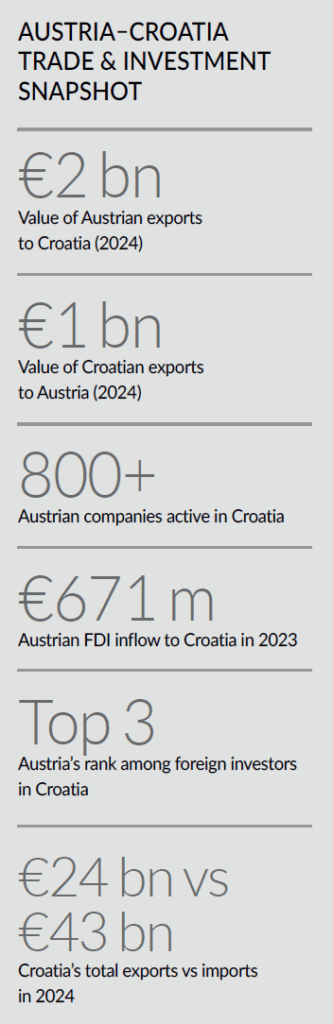
In terms of trade in goods, Austria currently exports goods worth around €2 billion to Croatia, while Croatian exports to Austria total approximately €1 billion. Put differently, Austria exports to Croatia twice as much as Croatia does to Austria. There was quite a spike in Austrian exports beginning in 2021, reflecting renewed business confidence and deepening sectoral ties.
When it comes to trade in services, however, the picture is reversed — largely because so many Austrians love spending their vacations in Croatia. Tourism continues to play a major role in balancing our overall trade exchange and in maintaining Croatia’s strong service-sector surplus.
Croatia’s trade gap continues to widen despite export growth. From your perspective, where do you see room for Austria to help strengthen Croatia’s export capacity and balance trade flows?
There are numerous Austrian foreign direct investments in Croatia, including production facilities, many of which are currently expanding their capacities. This is one clear way to help improve the trade balance. Secondly, our mission at Advantage Austria is to connect Austrian companies with Croatian suppliers, thereby indirectly supporting Croatian exports to Austria.
Over the past two years in Croatia, I have met a remarkable number of highly impressive Croatian firms — particularly in the pharmaceutical industry, metal processing, and communication technologies. Their internationalisation efforts are accelerating, and I am convinced that Croatia’s export potential will grow substantially in the coming years.
Advantage Austria has positioned renewable energy, smart infrastructure, and environmental technology as priority sectors. Which of these areas do you expect to define the next wave of Austrian investment in Croatia?
Right now, we see very strong investor interest in renewable energy, especially in photovoltaic projects. These investments depend heavily on the regulatory framework in Croatia, which determines their pace and scale.
Our role at Advantage Austria Croatia is therefore not only to promote opportunities but also to help improve investment conditions. We work closely with Croatian public institutions to highlight the needs and challenges Austrian investors face, contributing to a more predictable and attractive framework for green investment.
Nearshoring remains a major regional trend. How competitive is Croatia compared to its neighbours when Austrian or Central European companies seek to relocate production closer to home?
From our perspective, Croatia is becoming increasingly competitive as a nearshoring partner. Prices are, of course, important, but other factors are equally — if not more — decisive. Austrian companies expect the highest quality standards from their suppliers, as well as reliability in delivery schedules.
Croatia’s excellent road infrastructure, its EU and Schengen membership, and its proximity to Austria all make it a natural nearshoring destination. These factors together create a strong logistical and regulatory advantage, fostering trust and longterm cooperation between Croatian manufacturers and Austrian partners.
Many investors point to workforce shortages as their biggest challenge. What can be done to make the Croatian labour market more attractive and sustainable for foreign investors?
In the production sector, one clear trend is automation. Austrian companies that have recently expanded their production facilities in Croatia tell us they are investing heavily in high-end machinery and equipment to increase efficiency and reduce dependency on scarce labour.
In the services sector, however, success depends more on the overall package employers offer potential employees — from working conditions to career growth opportunities.
Our job at Advantage Austria is to connect Austrian companies with Croatian suppliers
At Advantage Austria Croatia, we also support Austrian companies through an initiative called #Brain-Regain. It highlights employees who have returned to Croatia after working abroad, sharing their personal stories and motivations. It is both a talent-return and employer-branding initiative that helps Austrian investors in Croatia attract skilled professionals while strengthening the domestic talent pool.
Green transition is at the heart of Europe’s growth agenda. How ready is Croatia’s regulatory and financial environment to attract Austrian companies investing in renewable and low-carbon technologies?
The regulatory framework is absolutely essential when it comes to attracting Austrian investment in renewable technologies. Austrian companies are already active in solar, wind, and gas projects across Croatia.
Key issues often arise in areas such as grid connection, costs, and permits. These procedures should ideally be handled swiftly and transparently to maintain investor confidence and momentum.
At Advantage Austria, we regularly assist Austrian companies in clarifying such obstacles in close partnership with the relevant Croatian authorities. The goal is to ensure that administrative procedures support — rather than slow down — the green transition.
Looking ahead, what will be your key priorities at Advantage Austria in the coming years to deepen Austrian–Croatian economic cooperation?
Today, more than 800 Austrian companies operate in Croatia through their own legal entities, covering virtually every sector — from production and services to retail and technology. They include large corporations, SMEs, and start-ups, all contributing to the strength of our bilateral ties.
Because our business community is so diverse, Advantage Austria must likewise address all major segments. In the years ahead, we will continue to focus on fields such as tourism and hospitality, med-tech, retail, consumer goods, food and beverages, mobility, infrastructure, railway, logistics, security, water, wastewater, and municipal services.
But above all, our work is about connecting people. It’s a people’s business, to put it simply. We see ourselves as a neutral sparring partner and consultant for Austrian companies, identifying the right contacts and opportunities at the right time. Ideally, we know the right person — or at least the person who knows the right one. In doing so, we help perfect the EU internal market by bringing Austrian and Croatian companies closer together — and by ensuring that this partnership continues to grow stronger, smarter, and more resilient with each passing year.
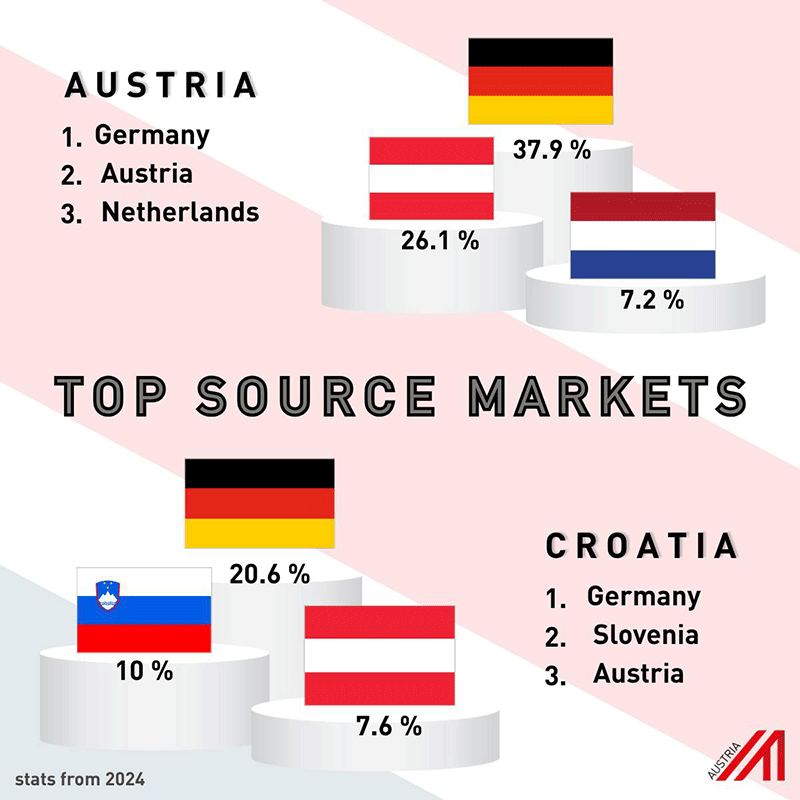
TOP SOURCE MARKETS, 2024
Tourism remains a vital bridge between the two economies. Germany ranks first as the key travel market for both Austria and Croatia, while Austrians consistently place among Croatia’s top three visitor groups — a reminder that business links are often strengthened by human and cultural connections.
