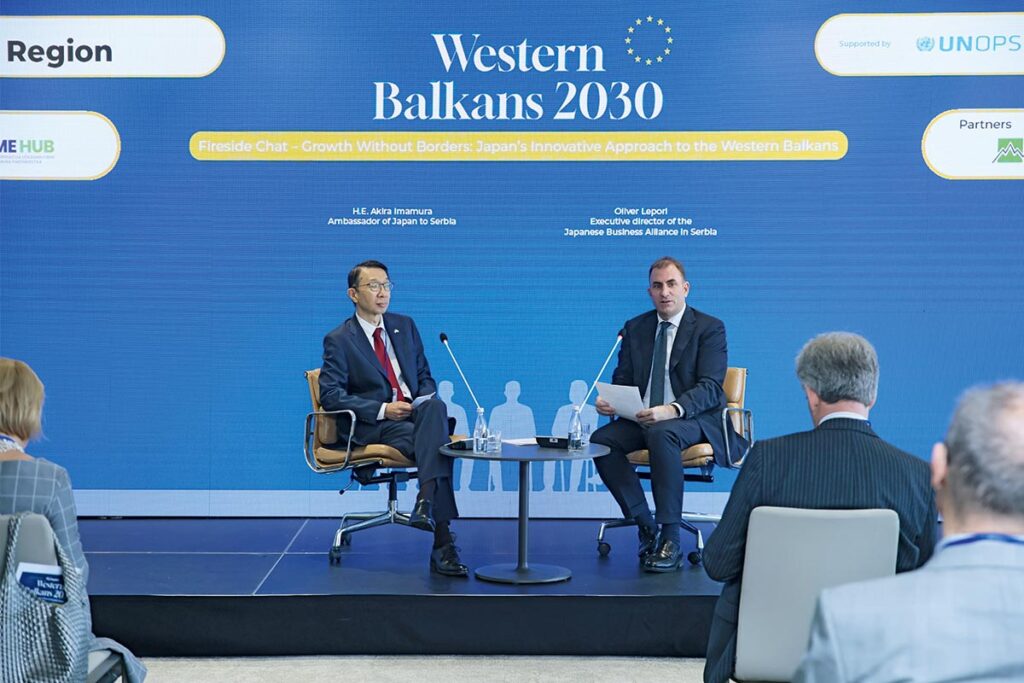
Japan’s role in the Western Balkans is no longer an afterthought of diplomacy — it has evolved into a deliberate strategic engagement with economic, political and cultural weight. From innovation and digital transformation to renewable energy, disaster-risk reduction and youth mobility, Japan is steadily deepening its presence across the region. In this fireside conversation, Oliver Lepori, Executive Director of the Japanese Business Alliance in Serbia, sits down with H.E. Akira Imamura, Ambassador of Japan to Serbia, to unpack how Tokyo views the Western Balkans today — and why Japan believes the region’s next chapter offers shared opportunity. This dialogue took place live during the Western Balkans 2030 conference and has been edited for length and clarity.
DIALOGUE
Lepori:
Ambassador, President Vučić visited Japan recently. How would you describe the significance of that visit?
Ambassador Imamura:
It was a landmark moment — our most substantial high-level political dialogue since 2018. It reconfirmed Serbia’s central role in regional stability and Japan’s position as a strategic partner of the EU.
Prime Minister Ishiba reiterated strong support for Serbia’s EU accession, while President Vučić expressed his backing for Japan’s foreign policy aimed at peace and stability in the world based on the international law and the UN Charter.
Economically, the outcomes were concrete.
Our governments signed a joint declaration announcing the completion of negotiations on the bilateral investment treaty, which, once in force, will send a powerful signal to Japanese investors. President Vučić also met Japan’s major business federation to discuss cooperation in energy, critical minerals and resilient supply chains.
At Expo 2025 Osaka, Serbia’s pavilion attracted more than one million visitors — mostly Japanese — setting an excellent tone for Expo 2027 Belgrade. I hope that we can bring anime, e-sports, music and martial arts to Belgrade.
Lepori:
Innovation was clearly central during the visit. Where do you see the biggest opportunities?
Ambassador Imamura:
Our priority is to help Serbia avoid the middle-income trap through innovation. Two important documents were signed, including an agreement between NTT Data and Serbia’s eGovernment Office to support digital transformation and build open, resilient digital public infrastructure.
JICA is also working closely with Serbian startups. A couple were invited to Japan to explore collaboration and learn from our innovation ecosystem.
Some founders told me they view Japan as an even bigger market than the EU because the fact that Japanese is used by majority of people in Japan makes localization easier.
Together with JBAS, we will host Society 5.0 in Novi Sad on 27 November. It’s Japan’s future vision where physical and digital spaces merge to solve social and economic challenges. We will focus on smart cities, smart manufacturing and smart healthcare.
How Japan Engages the Region
■ Political dialogue and support for stability in all six Western Balkan countries.
■ Innovation partnerships, starting in Serbia but designed for regional scalability.
■ Sustainability cooperation, from renewable energy to forest-based disaster risk prevention.
■ Circular-economy projects, including Japan–France collaboration in Belgrade.
■ Talent development, from SME mentoring to nuclear-tech training.
Lepori:
Sustainability is becoming a core pillar in our cooperation. What are the key areas you’re focusing on?
Ambassador Imamura:
Sustainability for us includes climate action, natural-disaster prevention, environmental protection and the circular economy. We are conducting feasibility studies for major renewable-energy projects and see strong potential in energy-saving technologies — heat pumps produced by a Japanese company in Smederevo are already on the market.
We are also starting cooperation in nuclear energy, beginning with training specialists after decades without nuclear infrastructure in Serbia.
Next-generation solar technology is another promising field.
Japan is ready to share its extensive experience in disaster-risk reduction. Protecting forests to prevent landslides and wildfires — an ecosystem-based approach — is particularly relevant. And in environmental protection, our Japan–France project in Vinča converts waste into electricity and heat, perfectly reflecting the Japanese concept of mottainai — “too valuable to waste.”
Lepori:
Japan has long supported regional cooperation. How do you see that role evolving?
Ambassador Imamura:
The late Prime Minister Abe launched our Western Balkans Cooperation Initiative in 2018 with two pillars: support for EU accession and regional cooperation. We believe reconciliation among ethnic groups is the foundation of lasting peace.
Through RYCO in Tirana, we run the MIRAI programme, bringing young leaders from all six Western Balkan countries to Japan to meet
peers, young business leaders and experience Japanese culture, but also this strengthens mutual connections among each other while spending time together.
Tourism is another practical tool. A JICA expert is developing itineraries that encourage Japanese and global tourists to visit multiple Western Balkan countries in one trip.
Japan in the Western Balkans:
At a Glance
■ Supporting the EU accession and promoting regional cooperation through the Western Balkans Cooperation Initiative (launched 2018).
■ Achieving reconciliation and dialogue as the foundation of long-term peace in the region.
■ Developing multi-country tourism routes for Japanese and international visitors.
■ Strengthening youth mobility through the MIRAI programme for all six WB countries.
■ Sharing expertise in disaster-risk reduction across the entire region.
Lepori:
Japan is a strong supporter of Serbia’s EU path. What does that support look like in practice?
Ambassador Imamura:
It is consistent and strong. Japanese investment in Serbia isn’t only about access to the EU market — it raises the quality of Serbian workforce and develops local talent. JICA’s SME mentoring programme helps small businesses function efficiently within EU-aligned market standards.
Environmental alignment is another major contribution. JICA financed Mitsubishi Heavy Industries’ desulfurization facility at the Nikola Tesla power plant in Obrenovac, which now removes 99% of sulfur emissions — a direct benefit for citizens.
As for Japan’s new government, Prime Minister Takaichi — Japan’s first woman to hold the office — has moved quickly. She convened a Growth Strategy Council to boost competitiveness in AI, quantum computing, biotechnology and other strategic sectors tied to economic security. On foreign and security policy, Japan will increase defence spending from 1.8% to 2% of GDP.
She has stated repeatedly that she carries on the legacy of former Prime Minister Abe. Therefore, I expect his Western Balkan Cooperation initiative — Japan’s support for Serbia’s EU integration and for regional cooperation — to deepen further.
