Through its Spark.me STEAM Adventure programme, doMEn is helping young people turn ideas into practical solutions — from sustainable fashion and autonomous vehicles to AI tools with real public-use potential.
doMEn is backing Montenegro’s next generation of innovators
At a time when digital and technological skills are becoming essential to the competitiveness of smaller economies, investing in young people’s knowledge is no longer a matter of corporate goodwill. It is a development strategy.
That is the logic behind Spark.me STEAM Adventure, a programme launched by doMEn d.o.o. to support young people in Montenegro through practical projects in science, technology, engineering, arts and mathematics.
YOUNG CREATORS DESIGN A GARMENT FOR THE FUTURE
At Fusion Lab, young creatives explored the intersection of fashion, technology and sustainability, developing experimental garments through upcycling, 3D printing and handcraft. The challenge encouraged participants to treat fashion not just as design, but as a platform for innovation and social commentary.
Rather than treating innovation as an abstract buzzword, the initiative focuses on something more valuable: giving young people the chance to build, test, create and solve real problems.
During 2025, the programme supported eight projects designed for participants aged 15 to 30, each centred on competitions and hands-on challenges across STEAM fields. Three projects have already been successfully completed, offering early proof that Montenegro has no shortage of talent, creativity or ambition when the right framework is in place.
The programme runs until April 2026, with a total budget of up to €100,000. Individual projects receive support ranging from €5,000 to €30,000. But its real value lies beyond the financials. Spark.me STEAM Adventure creates space for experimentation, applied learning and the development of ideas that can move beyond the classroom and into everyday life.

The jury included fashion designer Ana Krgović of Shift Studio, Anita Ljuljđurović from doMEn, and Uroš Bulatović, President of the Union of Young Entrepreneurs of Montenegro. Mentorship was provided by sculptor Maja Marinović and fashion designer Jovana Vujosević. The winning concept came from Elena Roganović and Sofija Stijović, students of fashion arts, whose team New Aged presented a minimalist “armour” designed for a postapocalyptic world.
The three projects delivered in 2025 also reveal the breadth of the STEAM approach itself — one that stretches from creative industries to advanced engineering and artificial intelligence.
Fashion, reimagined through technology
In October, participants took part in Fusion Lab, a three-day challenge that asked young creatives to develop innovative garments by combining upcycling, 3D printing and handcraft.
Here, fashion was not treated simply as design, but as a platform for experimentation where aesthetics, technology and social awareness could meet.
The winning team presented a minimalist “armour” for a world shaped by ecological and social crisis — a concept that pointed to a bigger idea: that tomorrow’s innovation may emerge just as easily from the intersection of art and engineering as from the lab alone.
Engineering skills with a practical edge
In November, the focus shifted to applied engineering through SMART Competition 2025, where secondary-school students built and programmed autonomous vehicles capable of recognising obstacles and moving independently along a defined route.
The challenge placed practical work ahead of theory, drawing participants into electronics, coding and team-based problem-solving.
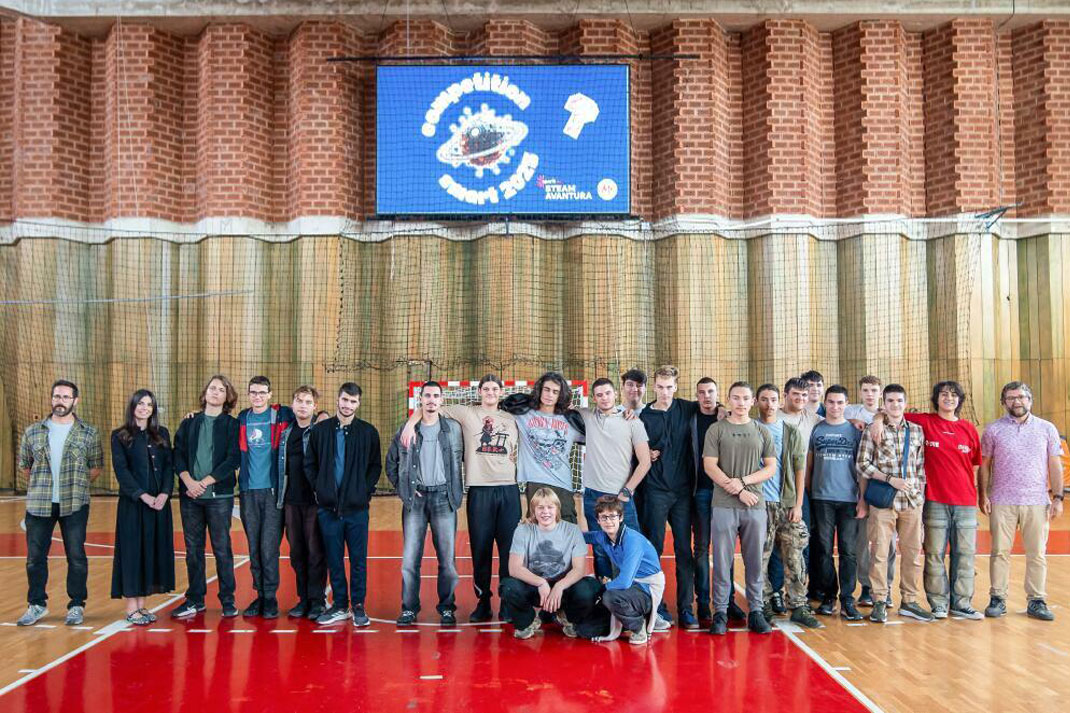
SMART COMPETITION 2025: HIGH-SCHOOL ENGINEERS BUILD AUTONOMOUS VEHICLES
At this hands-on engineering challenge in Tivat, students designed and programmed autonomous vehicles capable of navigating a course while recognising obstacles. First place was awarded to the team from JU SMŠ “Mladost” Tivat: Uroš Vuksanović, Đorđe Martinović, Pavle Grgurović and Ivan Slovnikar.
It also connected local learning with global industry trends through an online masterclass led by Aleksandar Marković, who linked engineering knowledge to the fast-evolving world of gaming and digital technology.
The result was a clear demonstration of how quickly young people can absorb advanced technical skills when they are given strong mentorship, the right infrastructure and a challenge worth solving.
AI aimed at real-world problems
In December, NextGen AI Challenge brought together students and secondary-school participants to tackle concrete social issues using artificial intelligence and data analysis.
Unlike many academic simulations, this project was grounded in real conditions: participants worked with local datasets and were encouraged to think about solutions with genuine public-service value.
The winning team developed a model designed to predict bus arrivals in real time and analyse the stability of public transport services — a practical example of how young talent can produce ideas capable of improving daily life for citizens.
From support to strategy
Taken together, the projects completed in 2025 show what is possible when young people are given the tools to experiment and the freedom to apply knowledge in a meaningful way.
They also make a broader point about Montenegro’s future.
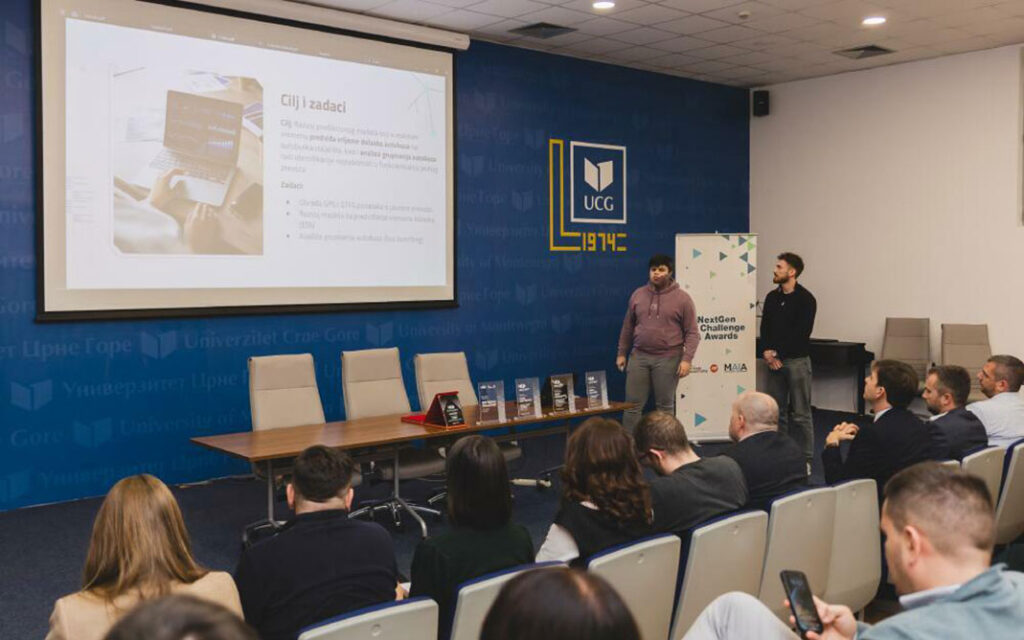
NEXTGEN AI CHALLENGE: APPLYING ARTIFICIAL INTELLIGENCE TO REAL-WORLD PROBLEMS
Young participants tackled practical challenges using artificial intelligence, data science and advanced analytics. The winning team VIDRA, composed of Nikola Lešić and Stefan Labović, developed a model capable of predicting bus arrival times in real time and analysing the reliability of public transport services.
For a country seeking long-term competitiveness in a digital economy, innovation cannot depend only on imported solutions or a handful of established players. It also depends on whether the next generation is given the opportunity to develop relevant skills early, test ideas in practice and see themselves as creators rather than observers of change.
Through Spark.me STEAM Adventure, doMEn d.o.o. is investing precisely in that capacity: in young people who can help shape a more knowledge-based economy and a more competitive digital future for Montenegro.
With five more initiatives still to be implemented, the programme is not closing a chapter, but building continuity — strengthening the country’s STEAM community and widening the space for learning, experimentation and innovation.
