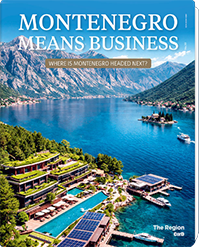
Damien Sorrell on why EU accession has become an investment strategy, which projects will reshape the region, and what must change before 2030.
For decades, EU accession was framed as a diplomatic endurance test. Today, it’s morphing into something far more consequential: an investment race. With infrastructure gaps closing, a new Growth Plan accelerating cross-border reforms and billions in financing on the table, the Western Balkans are no longer simply aligning with Brussels—they’re competing to become Europe’s next investment frontier. Damien Sorrell, Head of the European Investment Bank’s Regional Hub for the Western Balkans, explains why the region is at a turning point, which projects will define the next five years, and what must happen now to turn political momentum into bankable progress.
The Investment Lens of Accession
For years, accession was treated as a diplomatic marathon. Now it increasingly resembles an investment thesis. Where does the EIB see the Western Balkans already aligning with this new reality—and which sectors are genuinely ready for EU-level financing?
Damien Sorrell:
“When I look at the Western Balkans today, I see accession turning into an investment story. The macro picture is more resilient than a decade ago: growth has held up through shocks, inflation is easing and public debt ratios have stabilised. Yet income per capita remains far below EU levels—meaning convergence has enormous upside if reforms and investment move together.
From where we sit, several areas are already aligning with that shift. Connectivity remains fundamental: core transport corridors and energy interconnectors are advancing fastest. Green and digital transitions are becoming bankable themes—renewable capacity is expanding, grid modernisation is in demand,
and governments are investing heavily in digital infrastructure and skills. And SMEs and mid-caps show real momentum. Local banks, supported by EU-backed facilities, are increasingly willing to finance innovation, exports and climate-friendly technologies.
Last year alone, EIB Global signed nearly €700 million in new financing in the Western Balkans—primarily in energy security, sustainable transport, climate action, digitalisation and human capital. The message is clear: accession is no longer just about laws and institutions; it’s about turning alignment into concrete, bankable projects that lift productivity and living standards.”
The Projects That Will Move the Needle
Policy papers are full of green corridors and digital highways. But only a handful of projects can truly shift the region’s trajectory. Which upcoming initiatives have game-changing potential?
“Three stand out.
First, sustainable transport. Through the Western Balkans Investment Framework, we’re financing major upgrades along core TEN-T corridors—modernising railways, improving climate-resilient roads and upgrading inland waterways.
These projects are designed to deepen regional integration and unlock trade.
Second, education and digital skills.
Investments in school modernisation and digitalisation may not grab headlines,but they fundamentally shape productivity.
They equip young people for future jobs and close the skills mismatch that undermines competitiveness.
Third, the green transition. Large-scale financing for solar and wind, combined with green credit lines for SMEs and technical support for decarbonisation, can help the region adapt to tightening EU climate rules and stay competitive in European markets.”
Six Markets, One Investment Space
Fragmentation—six markets, six regulators, six sets of rules—remains the region’s Achilles’ heel. How can the EIB accelerate the emergence of a unified, investment-ready economic space?
“Fragmentation remains one of the biggest constraints on investment. The new EU Growth Plan rightly ties funding to progress in regional integration.
At EIB Global, we work on three fronts.
First, we prioritise projects that physically and digitally connect the region: major rail links, roads along core corridors, energy interconnectors, broadband and data infrastructure.
Second, we support reforms that reduce regulatory fragmentation—from procurement and State aid to
environmental permitting and digital markets. Predictable, harmonised rules allow investors to treat the region as one space.
Third, we help build regional financial markets. Our credit lines and guarantees increasingly target firms operating across borders and integrating into European supply chains.
When infrastructure, regulation and finance align, scale emerges—and investors stop seeing six small markets.”
The Race to Go Green — and the Risk of Falling Behind
Where do the Western Balkans risk slipping behind the EU climate agenda—and where can they leapfrog ahead?
Sorrell:
“The risks are real. Coal still dominates electricity generation in many countries, energy intensity is high and too much municipal waste goes to landfills. As EU climate rules tighten—especially the Carbon Border Adjustment Mechanism—high-carbon exports will face competitiveness challenges and fossil-heavy power systems will become more expensive.
But the region can leapfrog. It has significant untapped renewable potential—solar, wind, hydropower, even geothermal in some areas.
Energy systems here are compact enough to modernise quickly. The right permitting frameworks, modern grids, efficient buildings and fair transition measures can accelerate progress dramatically.
Our focus is on renewable generation, interconnectors, energy-efficient public buildings, green transport and climate-smart water and waste systems. And alongside technology, we support green-skills programmes and just-transition measures. The opportunity is to turn a lag into leadership.”
Money on the Table… But Can the Region Absorb It?
With the Growth Plan and large-scale financing available, what must governments and businesses do now to ensure this capital is actually absorbed?
Sorrell:
“Three things.
First, strengthen project preparation and administrative capacity. Too many delays stem from projects that aren’t mature enough to meet EU standards. Professional project implementation units and strong municipal administrations are essential.
Second, advance regulatory and governance reforms. Predictability in permits, land acquisition, energy and transport regulation—and a transparent, digitalised procurement system—can dramatically improve absorption.
Third, businesses must prepare to use this capital. That means investing in skills, digital tools, management practices and partnerships with EU firms. SME programmes show that firms upgrading their processes invest more, export more and create better jobs.
If institutions strengthen and the private sector modernises, the region can absorb and convert today’s financing into long-term competitiveness.”
2030 and the Underrated Opportunity
What’s the single most underrated opportunity for the Western Balkans on the road to 2030?
Sorrell:
“State capacity. Not the glamorous part—but the decisive one.
The region is entering a decade defined by implementation. Financing is available, direction is clear, and the economic need is obvious. But success hinges on the ability to prepare, procure and deliver complex, EU-standard projects.
The most underrated opportunity is to build digital-first administrations, professional regulators,
interoperable data systems and cross-border procedures that mirror the EU single market. Stronger governance compresses timelines, boosts confidence and unlocks investment that currently sits on the sidelines.
If governments treat public administration reform as a strategic investment—every bit as important as a motorway or wind farm—the Western Balkans can enter 2030 with stronger institutions, faster growth and a clearer path to EU membership.”
