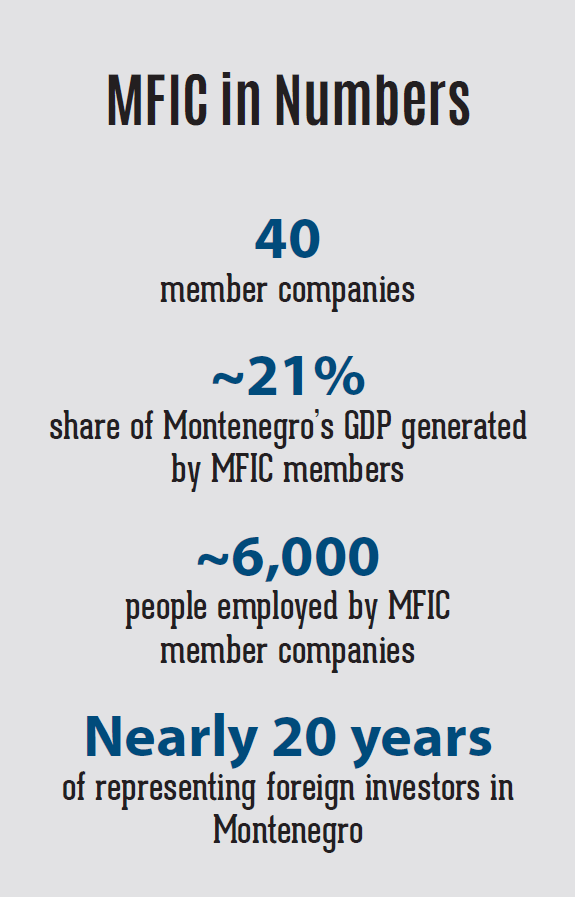
The Montenegrin Foreign Investors Council, which for almost two decades has brought together leading international companies operating in the country, recognises progress in several important areas over the past 12–18 months. Today, the Council consists of 40 member companies that together generate around 21% of Montenegro’s GDP and employ nearly 6,000 people, giving the organisation a credible and well-grounded position when assessing the business environment.
Amid increasingly clear signals from Brussels that Montenegro could become the next full member of the European Union as early as 2028, the most tangible progress has been made in the area of European integration and regulatory alignment with the EU acquis. The acceleration of the negotiation process and the more dynamic adoption of legislation send a strong message to investors that the reform agenda is moving in the right direction.
A particularly important milestone has been Montenegro’s accession to the SEPA system, enabling deeper financial integration with European markets. Cross-border payments are now faster, cheaper and simpler for both companies and citizens. The planned introduction of the TIPS Clone system in July will further strengthen the country’s instant payment infrastructure. These are precisely the kinds of concrete developments that credible investors carefully monitor when making long-term investment decisions.
Modest progress is also visible in the strengthening of dialogue between decision-makers and the business community, particularly through consultations and working groups aimed at involving the private sector more closely in policymaking. Nevertheless, there is still room for stronger cooperation with the business community, especially during the drafting and amendment of regulations that directly affect business operations.
One of the most significant challenges that remains is the issue of legal certainty and institutional efficiency. Slow administrative procedures, lengthy court processes, inconsistent application of regulations and limited predictability continue to influence perceptions of Montenegro as an investment destination.
If one reform could most meaningfully strengthen investor confidence in the coming year, it would be the accelerated digitalisation of administrative services and procedures that directly affect business activity.
While one year is not a long period for systemic reform, it is sufficient to deliver measurable progress in simplifying and speeding up key processes.
A stronger focus on digital services, clear deadlines, transparent procedures and institutional accountability would significantly reduce barriers and the cost of doing business. It is precisely these practical and operational improvements that signal to investors that the system is capable of adapting and moving forward.
