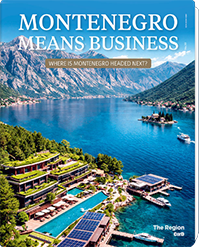
Montenegro enters 2026 with something rare in the Western Balkans: momentum that can be measured.
But in this region, momentum tends to be tested the moment it becomes visible. Montenegro has moved further along the EU accession path than any of its neighbours. Progress is visible in chapters opened, legislation aligned and institutions increasingly tuned to European standards. The closure of Chapter 21 on Trans-European Networks — integrating the country’s transport and energy systems into Europe’s infrastructure grid — marks a shift in substance. Integration is no longer a distant objective. It is already taking shape. That is where expectations begin to rise.
Capital follows direction that proves itself in execution. Montenegro’s edge lies in its alignment. Regulatory frameworks are converging with EU standards at a pace the region has not matched. Financial oversight is strengthening. Infrastructure, energy and digital projects are being built with European compatibility in mind, opening access to funding channels still out of reach for much of the Western Balkans.
Montenegro is ahead. And that position changes the pressure.
Scale, often seen as a limitation, has turned into a structural advantage. Reform cycles move faster. Coordination is tighter. Adjustments that take years elsewhere can be implemented within months. Once direction is set, execution can follow with speed.
The comparison is already shifting. As Montenegro moves closer to the EU core, regional benchmarks lose relevance. European standards become the reference point. That shift brings a different level of scrutiny — on labour markets, institutional capacity, sustainability and the speed at which decisions translate into results.
Change is visible across sectors. Tourism is moving beyond seasonality toward year-round, capital-intensive models. Energy projects are entering the grid. Transport investments are increasingly tied to competitiveness within a wider European system.
The transformation is structural. The political context, however, remains less predictable.
The idea of collective accession has returned to the regional conversation. Montenegro’s response has been clear. Prime Minister Milojko Spajić has signalled that the country intends to enter first and wait for others from within the Union. It is a confident position. It also raises the stakes. The frame shifts from regional comparison to European evaluation.
At this stage, integration is tested through implementation. Momentum raises expectations.
The significance of 2026 lies in whether progress holds under pressure. Continued reform would confirm Montenegro as the most credible EU-adjacent entry point in the Adria market. Any slowdown would narrow the gap between perception and delivery — precisely because expectations are now higher.
This issue looks at Montenegro as a front-runner.
Direction has been set. Delivery will be measured. The role of this magazine remains the same: to examine progress with clarity, without exaggeration and without hesitation.
Montenegro matters now because it is ahead. The harder question is whether it can sustain that position.