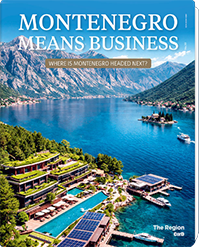
How international architects and local studios are quietly reshaping Montenegro’s coast
For much of the twentieth century, Montenegro’s coastline developed slowly, shaped more by geography than by design. Stone villages climbed hillsides, narrow streets followed the contours of the terrain, and architecture evolved through tradition rather than masterplans.
Today, that coastline is undergoing a different kind of transformation. Over the past two decades, a new generation of projects has introduced an architectural approach rarely seen in the region before — one built through collaboration between international studios, local architects and long-term developers.
At the centre of that shift stand two developments that have redefined Montenegro’s modern coastal identity: Porto Montenegro and Luštica Bay. Though often mentioned together, the two projects represent fundamentally different architectural models.
A marina designed with architectural continuity
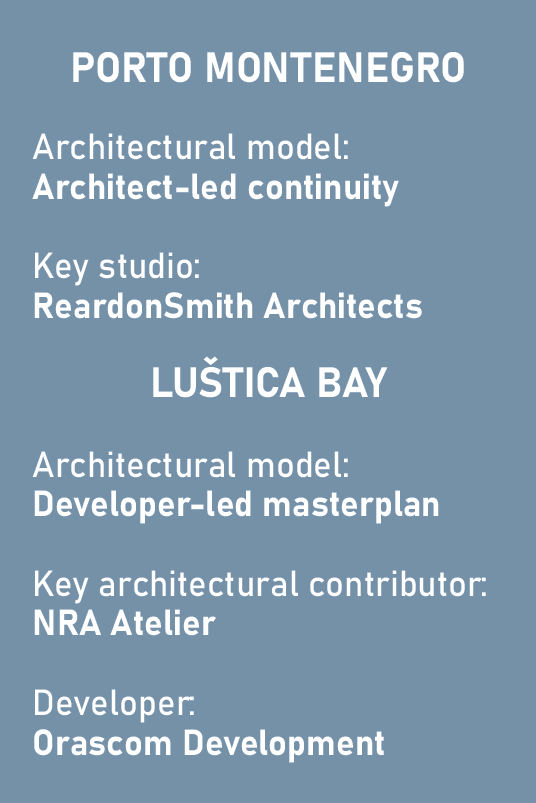
When Porto Montenegro began transforming a former Yugoslav naval base in Tivat into a luxury marina village, its investors made a decision that would shape the project for decades: appoint a single architectural partner to guide its evolution.
That role fell to ReardonSmith Architects, a London-based studio with a long international portfolio in hospitality and waterfront development.
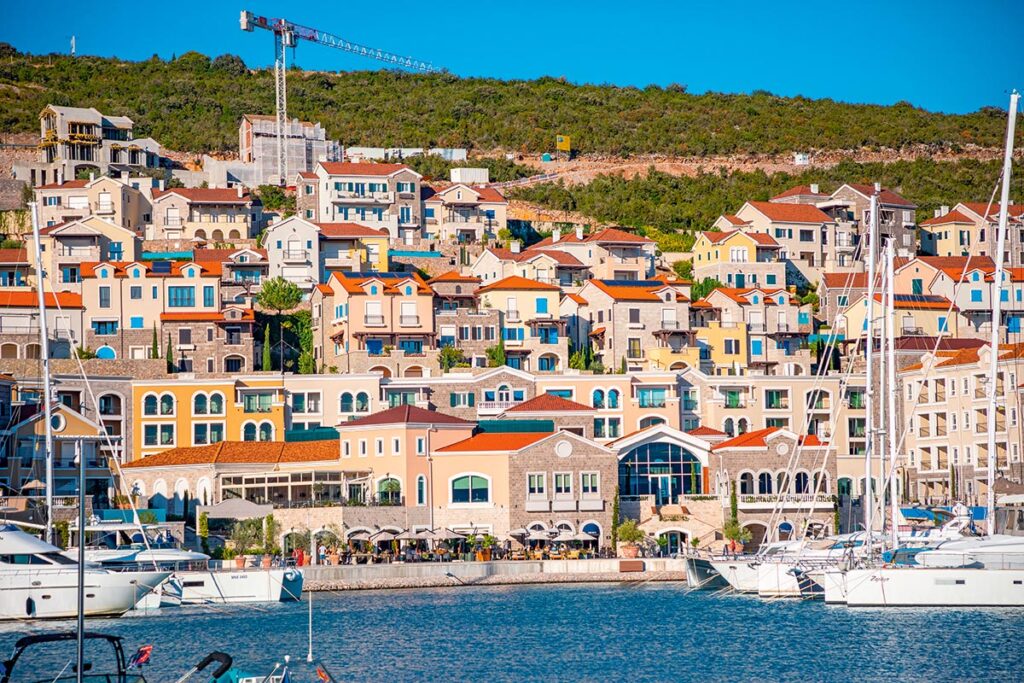
Rather than imposing a striking signature style, ReardonSmith pursued something subtler: architectural continuity. Buildings across the marina district follow a consistent Mediterranean vocabulary — stone façades, shaded balconies, narrow streets that open toward the sea — creating a sense of place that feels deliberately cohesive.
Architecture on Montenegro’s coast is no longer only about style. It is about credibility, continuity and long-term value
In an environment where many coastal developments emerge piecemeal, Porto Montenegro’s architectural discipline has helped the project mature into a functioning urban district rather than a seasonal resort. Hotels, residences, retail streets and public squares operate as parts of the same spatial system.
For investors and residents alike, that consistency translates into something valuable: predictability. Architecture here does not merely frame views of the Adriatic. It reinforces the long-term credibility of the destination itself.
Building a town, not just a resort
Several kilometres away along the coast, Luštica Bay represents a different architectural philosophy.
Developed by Orascom Development, the project was conceived not as a single destination but as an entirely new coastal town unfolding over decades.
Such ambitions require a different design structure. Rather than appointing one dominant architect, the development operates as a curated ecosystem of studios working under a shared masterplan and design guidelines.
Within that framework, NRA Atelier, led by Nikola Radović, has become one of the key architectural contributors to realised phases of the project, including residential areas such as the Blok 5 residences and The Peaks townhouses.
The studio’s approach reflects the broader philosophy of the development: architecture that responds first to landscape, climate and Mediterranean urban traditions rather than visual spectacle. Buildings follow the contours of the hills, streets remain walkable, and materials echo those found in historic coastal settlements.
In this model, architecture becomes less about authorship and more about translation — translating a large-scale vision into human-scale places.
Foreign expertise, local interpretation
The involvement of international architects has been crucial in introducing new standards of planning and construction to Montenegro’s emerging coastal developments. Studios such as ReardonSmith have brought experience from global hospitality and waterfront projects, while local practices like NRA Atelier ensure that new architecture remains rooted in regional context.
This collaboration between global expertise and local interpretation has helped Montenegro avoid a common pitfall of rapid coastal development: the loss of identity. Instead, the new projects attempt to reinterpret Mediterranean traditions rather than replace them.
It is a delicate balance. Too much global influence risks producing anonymous luxury enclaves. Too little risks repeating outdated models of tourism infrastructure. The most successful projects find a middle path.
A coastline reimagined
Architecture rarely transforms a country on its own. Yet in Montenegro, the physical shape of development has become inseparable from the country’s economic story.
Porto Montenegro demonstrated that a disciplined architectural vision could turn a neglected naval base into one of the Adriatic’s most recognised marinas. Luštica Bay is testing whether a carefully governed masterplan can grow into a functioning coastal town over the course of a generation.
Both projects signal a broader shift in how Montenegro approaches development: away from short-term construction and toward long-term place-making.
In the end, the architecture of Montenegro’s coast is no longer simply about buildings. It is about confidence — the belief that the Adriatic can be shaped thoughtfully, one district at a time.
