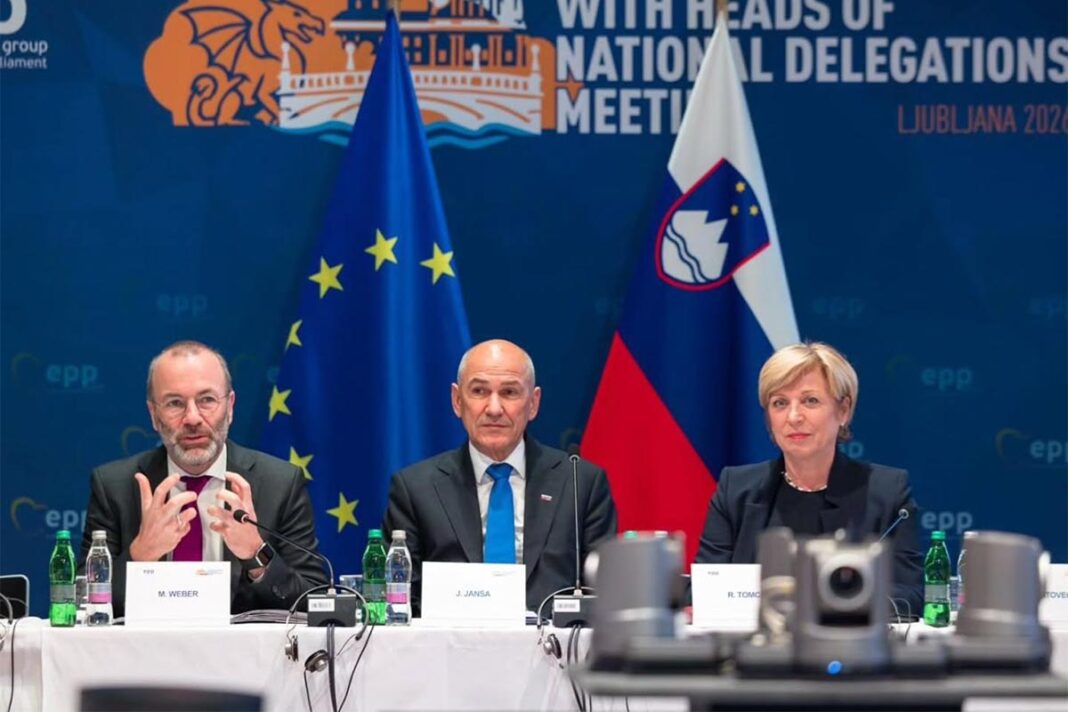
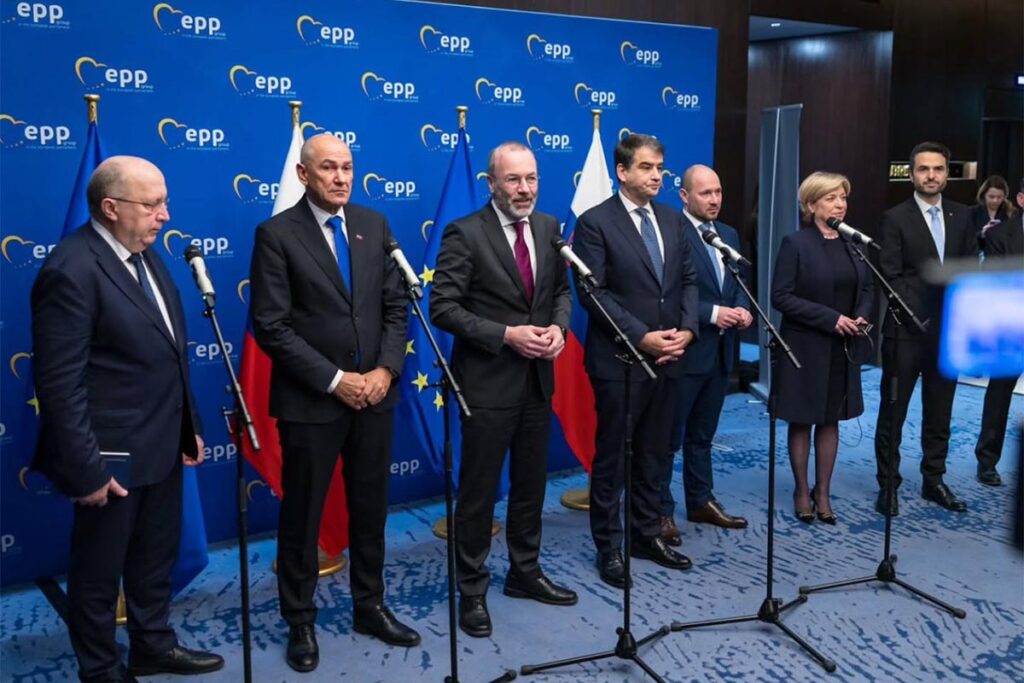
With Slovenia heading into a closely watched general election on 22 March, the leaders of the European Parliament’s three largest political groups have converged on Ljubljana to back their local allies — and to draw sharp ideological battle lines. Representatives of the centre-left Socialists & Democrats (S&D), the liberal Renew Europe, and the centre-right European People’s Party (EPP) all used the visit to frame the Slovenian vote as part of a broader struggle over Europe’s democratic direction.
The S&D delegation adopted a so-called Ljubljana Declaration calling on the EPP to exclude the Slovenian Democratic Party (SDS), led by former prime minister Janez Janša, warning of what it described as the growing influence of the far right. S&D leader Iratxe García Pérez said Slovenia symbolised a wider European choice between a “strong democratic future at the heart of Europe” and political marginalisation driven by leaders aligned with Hungary’s Viktor Orbán and US President Donald Trump.
Renew Europe leader Valérie Hayer echoed that message, throwing her support behind Prime Minister Robert Golob and arguing that the Slovenian election was a key test of Europe’s ability to resist far-right politics.
The EPP struck a very different tone. Its leader, Manfred Weber, openly endorsed the SDS and its ally New Slovenia (NSi), arguing that Slovenia needs a stable centre-right government to boost economic competitiveness and strengthen European defence. Janša dismissed the S&D declaration as a negative campaign lacking substance, insisting that Slovenia faces serious problems with the rule of law and judicial independence and calling on EU institutions to scrutinise the current centre-left government more closely. With polls suggesting the SDS could win the largest share of the vote, Slovenia’s election is shaping up not only as a national power struggle, but as a proxy fight over Europe’s political future.