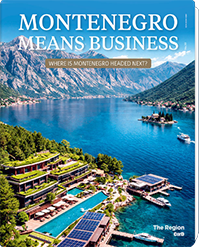
Montenegro’s economy is often described in numbers: growth rates, investment volumes, arrivals, megawatts. Useful, yes. Complete, no. Because an economy isn’t only measured by what it produces — but by how it feels to the people inside it.
In recent years, that feeling has changed. Volatility has given way to pressure. Growth is no longer a rebound story; it is becoming a test of capacity, discipline and speed.
Start in Bar, where the port works long before the coast wakes up. Logis- Working Montenegro tics is no longer background noise here; it is a frontline industry. Cargo volumes are up. Transit routes matter again — not as strategy papers, but as daily operations. Every delay now carries a price tag. The work is steadier than it was five years ago. It is also far less forgiving.
That sense of necessity runs through other sectors as well.
Move inland to tourism, where success now comes with an asterisk. Hotels are fuller. The season is longer. Montenegro is no longer selling only July and August — a strategic goal years in the making. But volume has exposed weaknesses. Staffing remains fragile. Energy and food costs rise faster than room rates. And “quality tourism” demands something Montenegro is still learning to systematise: yearround professionalism, not seasonal improvisation.
THE SEASON THAT NO LONGER FITS THE CALENDAR
September is no longer quiet. October is no longer off-season.
Flights, hotels and restaurants now operate beyond the traditional summer peak, while labour contracts, energy pricing, school schedules and local services still assume a short, compressed season. Businesses adjust in real time. Institutions move slower.
The next phase of tourism is not about attracting more visitors. It is about redesigning the economy around the season that already exists.
Growth is here. But it comes with discipline. And discipline is expensive.
The strain shows up most clearly in connectivity.
“We have been creating the foundations for economic development and attracting credible investors, in order to diversify Montenegro’s economy and ensure long-term, sustainable growth.” Milojko Spajić Prime Minister of Montenegro
Then there is the young professional who stayed — or came back. Not because it was easier, but because the equation changed.
Salaries are still not European. Housing costs bite. Public systems lag. But opportunity is closer. Remote work, regional employers and hybrid careers have widened the definition of success. Staying is no longer an emotional default or a lack of options. It is a calculated decision.
TIVAT AIRPORT
When Growth Shows Up Physically
Tivat Airport has quietly become one of the most intense traffic nodes in the Adriatic relative to the size of the country it serves.
• 1.32 million passengers in the first 11 months of 2025, around 17% more than the year before
• More than 1 million passengers in 2024, the strongest post-pandemic result
• Around 80% of traffic concentrated between May and September
• Together with Podgorica, Montenegro’s airports handled over 3 million passengers in a single year — a national record
For a country of just over 600,000 people, these numbers are not just about tourism. They are a measure of pressure — on infrastructure, labour, housing, energy and services. When growth accelerates through airports, it stops being theoretical.
That shift may be subtle, but it is consequential. When people stop leaving automatically, an economy gains time — and time is the rarest asset small markets have.
Put together, these realities tell a simple story: Montenegro’s economy is no longer fragile — but it is demanding. It rewards competence. It exposes inefficiencies. And it leaves less room for excuses.
That is not a problem.
That is progress.
