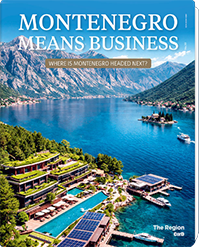
For much of the past decade, Montenegro has been discussed through a narrow lens: tourism, luxury real estate and its dramatic Adriatic coastline. But as the second half of the 2020s begins, the country is quietly entering a different phase of its economic story.
Among EU accession candidates, Montenegro now occupies a distinctive position. It is not the largest market in the Western Balkans, nor the fastest growing. Yet it is themost institutionally aligned with the European Union, operating under regulatory frameworks that increasingly mirror those of the single market it hopes to join.
That distinction does not eliminate risk. But it changes the nature of that risk.
For investors navigating a world of geopolitical fragmentation, tightening capital conditions and rising regulatory scrutiny, direction matters more than promises. What markets reward today is not rhetoric but policy momentum and institutional predictability.
Montenegro, in that sense, is no longer simply a small tourism economy on Europe’s periphery. It is becoming a test case for how a small system can reposition itself within a larger European economic architecture.
The question now is whether that repositioning can translate into durable growth.
GROWTH, IN CONTEXT
Montenegro’s economic trajectory over the past five years reflects both the vulnerability and resilience of small open economies.
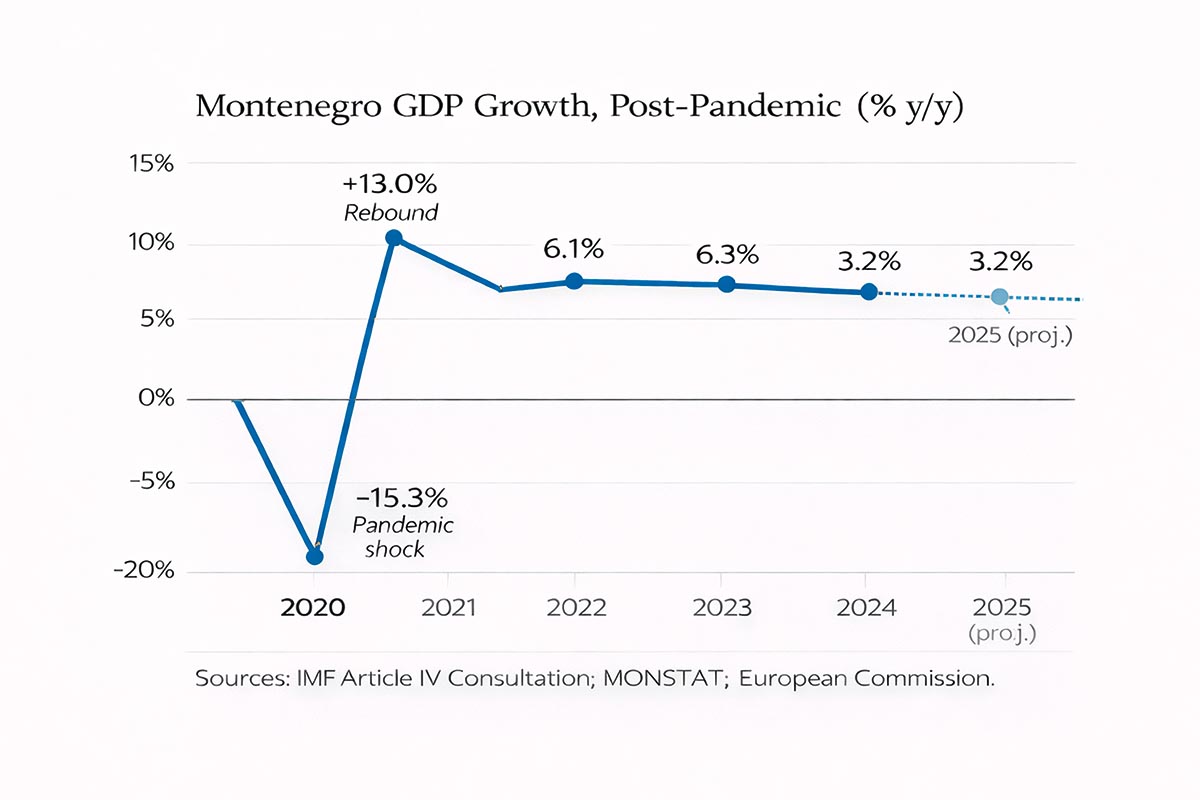
The pandemic shock of 2020 exposed the country’s dependence on tourism more brutally than in most European states. GDP contracted by more than 15 percent, one of the sharpest declines on the continent. Yet the rebound that followed was equally dramatic, driven by the rapid reopening of travel and the revival of international demand for the Adriatic.
Since then, growth has gradually stabilised.
Recent economic expansion has been supported not only by tourism recovery, but also by infrastructure investment, services expansion and increasing capital inflows linked to regional connectivity.
The composition of growth is therefore slowly shifting.
Where earlier cycles relied heavily on seasonal tourism revenue and domestic consumption, the current phase shows stronger contributions from capital formation, logistics investment and energy development projects.
That transition is still incomplete. Tourism remains a central pillar of the economy. But the direction of change suggests that Montenegro’s growth model is evolving from a seasonal economy toward a more structurally diversified one.
For long-term investors, that distinction is crucial.
FOREIGN DIRECT INVESTMENT: CHANGING SHAPE
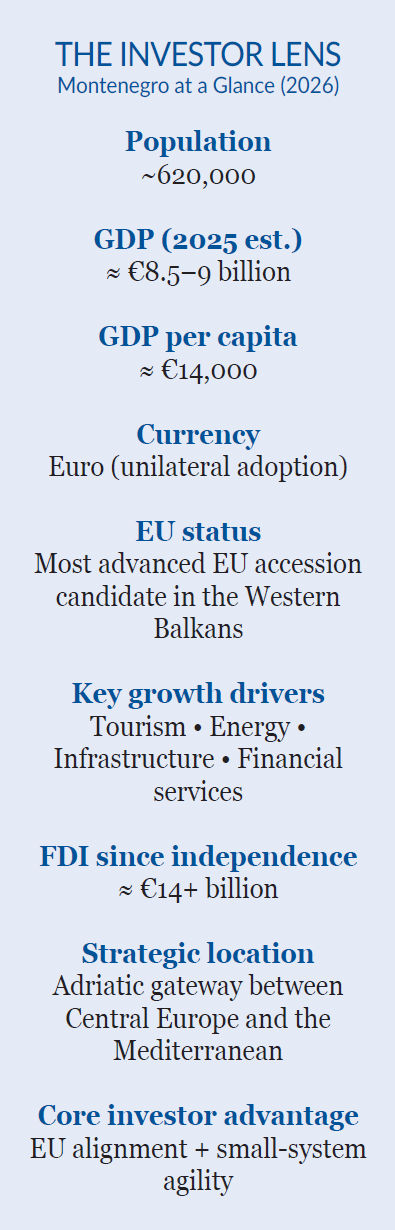
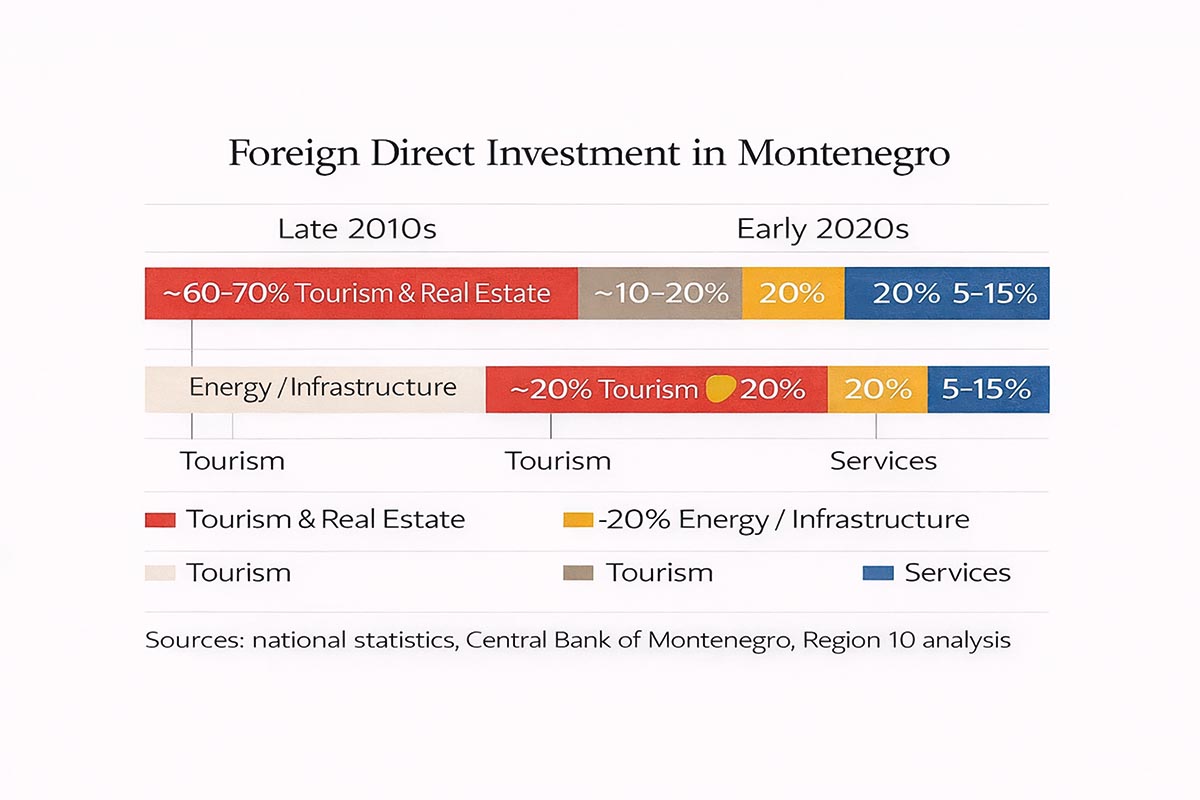
Foreign direct investment has long been Montenegro’s most visible economic strength. Since independence in 2006, the country has attracted more than €14 billion in cumulative FDI, a remarkable figure for an economy of just over 600,000 people.
But the structure of that investment has historically been narrow. Large inflows into coastal real estate and tourism developments helped transform the country’s physical landscape — from Porto Montenegro to Portonovi and Luštica Bay — but they generated limited spillovers into productivity, exports or industrial capacity.
Today, that mix is beginning to change. Recent investment flows show a gradual diversification across several sectors:
• renewable energy projects
• transport and logistics infrastructure
• financial and business services
• digital infrastructure and connectivity
Real estate remains significant — and will likely remain so given Montenegro’s geographic advantages. Yet it is increasingly one component of a broader investment ecosystem rather than its defining feature.
Another emerging trend is the growing role of regional capital and institutional investors, including European development banks and infrastructure funds. Their participation introduces longer investment horizons and stricter governance standards, which in turn influence project design and regulatory expectations.
In other words, the story of foreign investment in Montenegro is shifting from volume to structure.
PRIORITY SECTORS: SELECTIVE BY DESIGN
Montenegro’s economic strategy is not built on scale. It is built on selectivity.
With limited domestic demand and a small labour pool, the country’s competitive advantage lies in targeted sectors where capital intensity and geographic positioning create leverage.
Four areas stand out for the 2026–2030 horizon.
Energy.
Hydropower, solar and wind projects are accelerating as the region seeks greater energy security and alignment with European decarbonisation goals. Montenegro’s geography and grid interconnections position it as a potential energy node in the Adriatic system.
Infrastructure and logistics.
Road corridors, port capacity and digital infrastructure are gradually strengthening Montenegro’s role in regional supply chains linking the Adriatic coast with Central Europe.
High-value tourism and real estate.
The country is moving beyond mass tourism toward luxury hospitality, marina economies and branded residential developments that generate year-round revenue rather than seasonal peaks.
Financial and business services.
Banking, project finance and advisory services are expanding alongside cross-border investment activity, increasingly operating under EU-compatible regulatory frameworks.
What links these sectors is not volume but long-term capital commitment.
Energy projects illustrate this most clearly. Renewable investments require not only capital but regulatory stability, grid integration and cross-border energy trading frameworks. For Montenegro, the success of this sector will function as a credibility test for institutional capacity.
EU ACCESSION: ECONOMICS BEFORE POLITICS
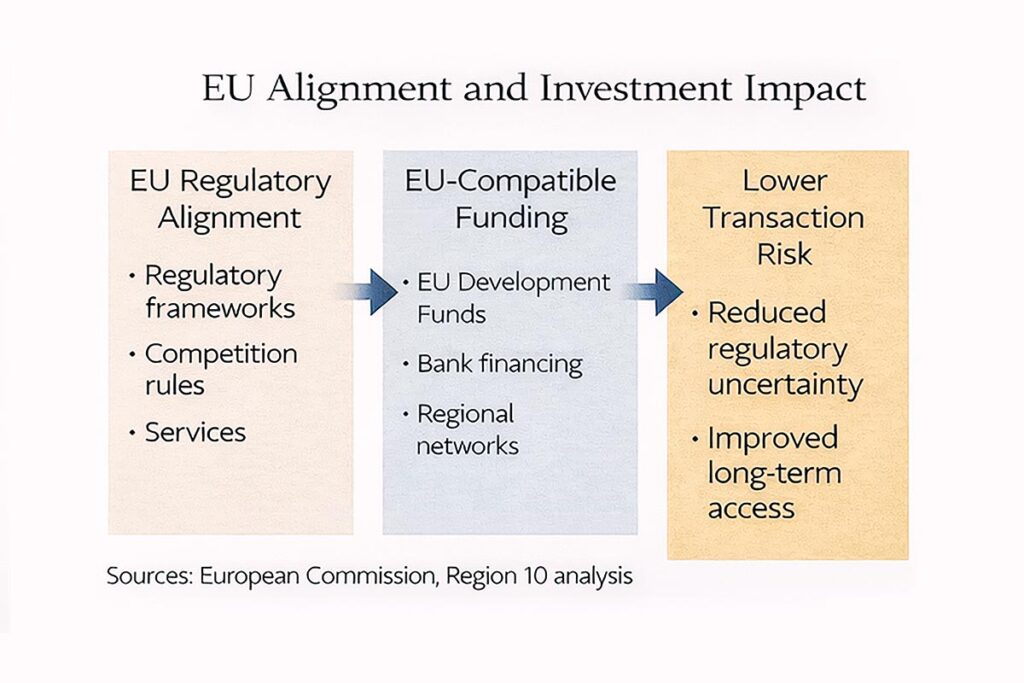
Montenegro’s EU accession process is often framed as a diplomatic or political milestone. For investors, its significance is primarily economic.
Alignment with EU rules already affects key areas of the business environment:
• competition policy
• public procurement standards
• financial supervision
• regulatory transparency
These adjustments gradually reduce transaction risk and increase compatibility with European funding instruments, including development finance from institutions such as the European Investment Bank and the European Bank for Reconstruction and Development.
The impact of this process is cumulative rather than immediate. Yet markets tend to price momentum early.
Being the most advanced accession candidate does not mean Montenegro is finished with reforms. It means it is subject to earlier scrutiny — and earlier credibility tests — than its regional peers.
REGULATION: PRO-BUSINESS, WITH REAL TESTS
Montenegro’s regulatory environment is broadly pro-business in intent. Corporate taxation remains competitive.
Company formation procedures are relatively streamlined. Institutional coordination has improved compared to earlier phases of transition.
Yet structural challenges remain. Administrative capacity still varies between sectors. Large infrastructure projects occasionally face delays. Labour shortages are emerging in several industries, particularly tourism and construction.
None of these constraints are unique to Montenegro. But in a small system they are felt faster and corrected faster.
Credibility in such an environment depends less on policy declarations than on the consistent execution of projects and reforms.
THE STRATEGIC ADVANTAGE OF SIZE
Montenegro’s small scale is frequently described as a weakness. In practice, it can also function as a strategic advantage.
Smaller systems often benefit from:
• faster policy adjustments
• shorter institutional feedback loops
• closer coordination between public and private stakeholders
When direction is clear, implementation can follow rapidly. When direction is uncertain, however, there is little room to conceal it.
That dynamic makes policy clarity particularly important.
WHAT THIS MEANS FOR INVESTORS
Montenegro’s economic environment today is shaped by a convergence of structural factors:
• faster regulatory alignment with EU standards than most regional peers
• infrastructure projects increasingly moving from concept to execution
• energy and tourism sectors shifting toward higher value models
• greater scrutiny from European institutions alongside improved market access
For investors, the country represents neither a risk-free environment nor a speculative frontier. It occupies a more nuanced space: a small but strategically positioned economy undergoing institutional consolidation while remaining open to external capital.
THE BOTTOM LINE
Montenegro is no longer competing for attention through promises alone. It is competing through positioning.
The coming four years will determine whether its EU-aligned institutional framework translates into durable investment, diversified growth and deeper integration into regional economic networks.
The conditions for that transition are forming.
The scrutiny surrounding it is increasing.
For investors looking at the Adriatic region, the question is no longer whether Montenegro is interesting. It is whether the country can convert direction into execution.
The pages that follow examine that question through evidence rather than optimism.
