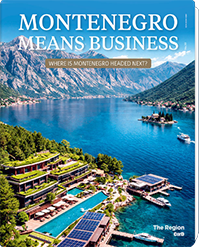
Viewed from above, Montenegro’s investment landscape reveals a pattern that is both simple and strategic. Capital does not disperse randomly. It concentrates — along the coast, through the capital, and increasingly across a network of infrastructure and energy corridors that are beginning to redraw the country’s economic map. What appears at first as geography is, in fact, a system.
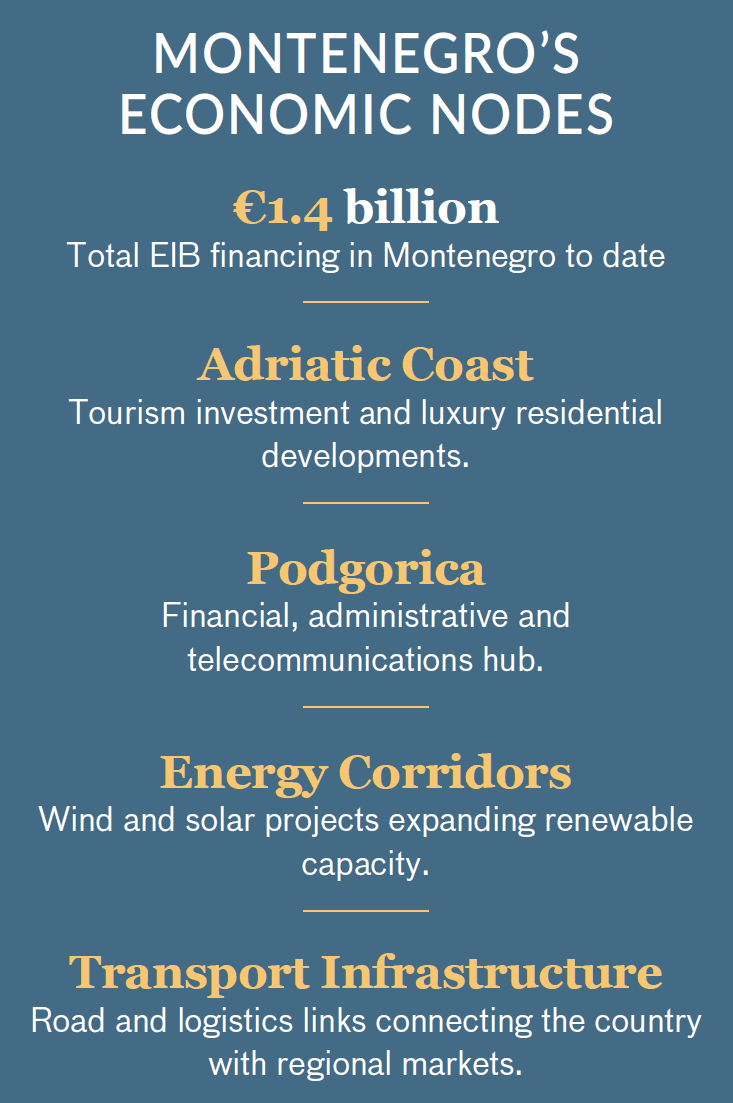
The Adriatic coastline remains the most visible expression of this system. Over the past decade, large-scale tourism and residential developments have turned previously quiet towns into globally recognised destinations. Projects in Tivat, Kotor Bay and along the Budva riviera did more than attract visitors — they anchored Montenegro within the circuits of international capital.
But the real impact lies beneath the surface. Around each development, secondary economies have emerged: hospitality services, property management, logistics, retail and a growing ecosystem of professionals supporting an increasingly international clientele. What began as real estate investment has evolved into a broader economic platform.
Yet the coastline tells only part of the story.
IN MONTENEGRO, DISTANCE IS SHORT — BUT ECONOMIC IMPACT TRAVELS FAST.
Further inland, Podgorica operates as the country’s economic control centre. Unlike the coast, where capital is visible in cranes and construction sites, Podgorica’s influence is structural. It is where decisions are made, capital is managed and systems are coordinated. Financial institutions, telecom operators and service providers form a dense network that connects Montenegro not only internally, but also to regional and European markets.
In practical terms, this makes Podgorica less of a destination and more of a switchboard — a place where economic activity is directed rather than displayed.
Connecting these two poles is the country’s most consequential transformation: infrastructure.
The Bar–Boljare highway, still incomplete but already influential, represents more than a transport project. It signals a shift in how Montenegro positions itself — from a coastal destination to a transit and logistics corridor linking the Adriatic with inland Europe.
Each new kilometre reduces internal fragmentation, bringing the north closer to the coast and the country closer to regional supply chains.
Infrastructure, in this sense, is not just about movement. It is about integration.
Parallel to this, a quieter but increasingly important layer of investment is taking shape in energy.
Wind farms such as Krnovo and Možura, alongside planned solar projects like Briska Gora, are gradually expanding Montenegro’s renewable capacity. What was once a peripheral sector is becoming central to the country’s long-term positioning.
Energy investment does two things at once: it strengthens domestic resilience and signals alignment with European green transition priorities. For investors, this combination is increasingly decisive.
Taken together, these layers — coastal development, administrative concentration, infrastructure expansion and energy investment — form a compact but highly interconnected system. Montenegro’s small size, often perceived as a limitation, becomes an advantage within this framework. Distances are short, decision-making structures are concentrated, and projects can move faster than in larger, more fragmented markets.
Proximity, in Montenegro, is not just geographic. It is economic.
This creates a distinct investment logic. Rather than competing on scale, Montenegro competes on coherence — the ability to align sectors, shorten timelines and create visible impact within a relatively small space.
For investors, that clarity can be more valuable than size.
The next phase of development will depend on how well these connections are deepened. The coastline will continue to attract capital, but its long-term value will increasingly depend on how effectively it is linked to inland regions. Podgorica will remain the control centre, but its role will expand as financial and digital services grow. Infrastructure will determine speed. Energy will determine sustainability.
What emerges is not a finished map, but a framework still in motion.
Montenegro may be geographically small. Its investment network, however, is becoming increasingly sophisticated — and, with each new connection, harder to ignore.
