
When roads, ports and cables stop being projects — and start being leverage
In Montenegro, infrastructure is often discussed as ambition. For business, it is something simpler and more unforgiving: a multiplier. When it works, markets expand. When it stalls, growth does too.
For years, Montenegro’s geography did half the work. Proximity substituted for scale; coastline compensated for capacity. Geography helps — until it doesn’t. What determines competitiveness now is not where the country sits, but how efficiently people, goods and energy move through it.
Roads are the most visible test. New highways have shortened distances that once dictated business decisions, pulling the north closer to the coast and compressing internal travel times. The effect is quiet but consequential. Logistics firms plan differently. Tourism operators rethink season length. Labour mobility increases without policy intervention. Infrastructure does not announce these changes. It enables them.
Ports are a more complicated story. The Port of Bar has long been described as strategic, less often as decisive. Its advantage lies not in volume but in optionality — the ability to serve regional trade flows if rail and road links deliver consistently. For exporters, reliability matters more than rhetoric. The port’s business impact depends less on expansion plans than on integration: how seamlessly cargo moves onward, and how predictably timelines are kept. Infrastructure only becomes leverage when it removes excuses.
When delays disappear, so do rationalisations. That is when markets respond.
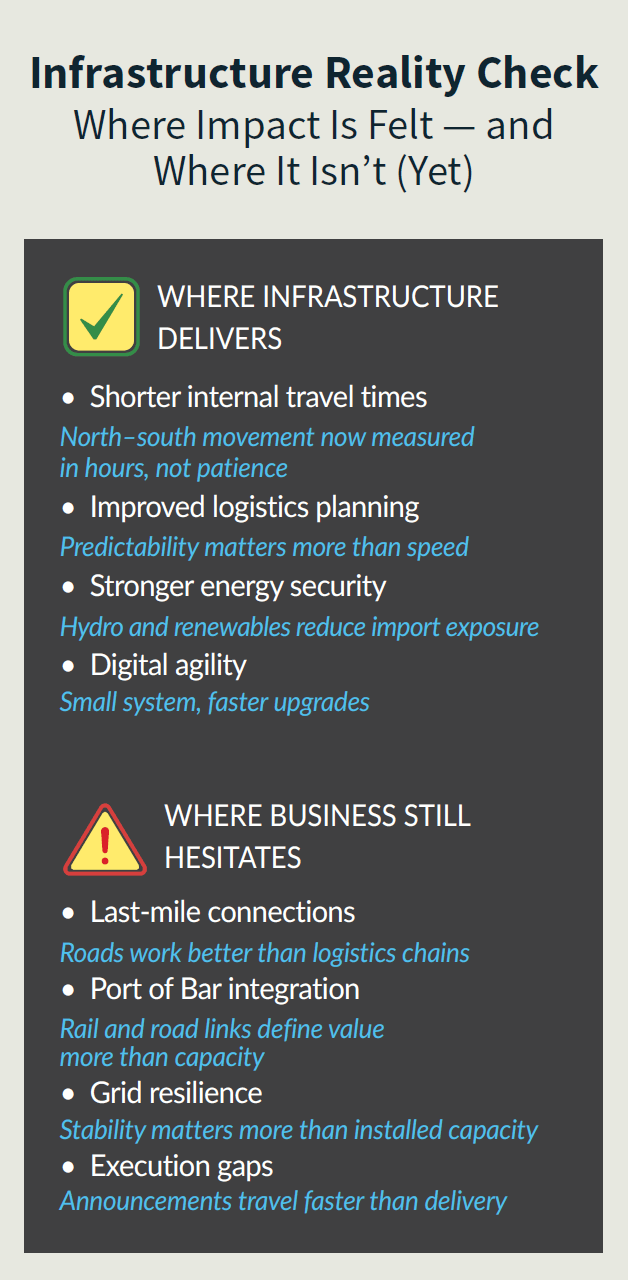
Energy has become infrastructure’s most strategic layer. Montenegro’s renewable potential is real, but business interest focuses on stability rather than symbolism. Investors care about grid resilience, transmission capacity and the ability to support industrial demand yearround. In energy, credibility is built not through announcements, but through uninterrupted supply.
Digital infrastructure is where Montenegro’s size becomes an advantage. Smaller systems adapt faster. Connectivity projects and data capacity upgrades do not need scale to matter — they need execution. For service-based industries, speed and reliability outweigh market size. The question is whether policy keeps pace with technical potential.
What links these strands is impact, not intention. Infrastructure changes business behaviour only when it reduces friction: shorter delivery times, lower energy risk, more predictable access. When that happens, capital responds without being asked.
Montenegro’s challenge is not a lack of projects. It is sequencing and follow-through. Roads without logistics strategy underperform. Ports without hinterland connections stall.
Energy without grid investment limits growth. Infrastructure works as a system, or it does not work at all.
The next phase of Montenegro’s growth will be decided less by what is announced than by what is completed — and used.
For business, infrastructure is not a backdrop. It is the operating environment. And it is increasingly where credibility is either reinforced, or quietly lost.
