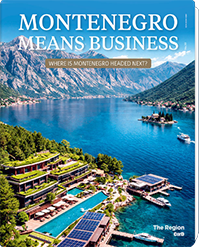
How Montenegro turns visitors into long-term value
Tourism has always been Montenegro’s advantage — and its risk. The country sells beauty effortlessly. The harder task is turning that beauty into a business that works beyond the season.
For years, success was measured in arrivals. More beds. More nights. Fuller beaches. That logic is no longer enough. In a global tourism economy shaped by inflation, labour shortages and changing travel habits, volume alone does not equal resilience. What matters now is structure: who comes, how long they stay, and what they leave behind once the season ends.
Recent figures underline the shift. In 2025 Montenegro recorded 2.7 million tourist arrivals and 15.4 million overnight stays. Arrivals increased by 4.7%, yet overnight stays fell by 1.5%, signalling a shorter average visit. The structure of demand is also evolving. Traditional European markets declined sharply, losing more than 625,000 overnight stays, partly reflecting the disappearance of Russian tourists after sanctions and geopolitical disruption. At the same time, non-European markets expanded rapidly — particularly Israel (+46%), Azerbaijan (+68%), the United States (+12%) and China (+27%). Montenegro is attracting visitors from a wider geography, but they are staying for less time.
Montenegro’s strongest tourism assets are not its numbers, but its density. Few countries can compress coastline, capital, airport access and high-end infrastructure into such a small radius. That proximity creates a different kind of value — one that rewards longer stays, repeat visits and hybrid use. Tourism increasingly overlaps with real estate, services and lifestyle migration. The line between visitor and resident is no longer fixed.
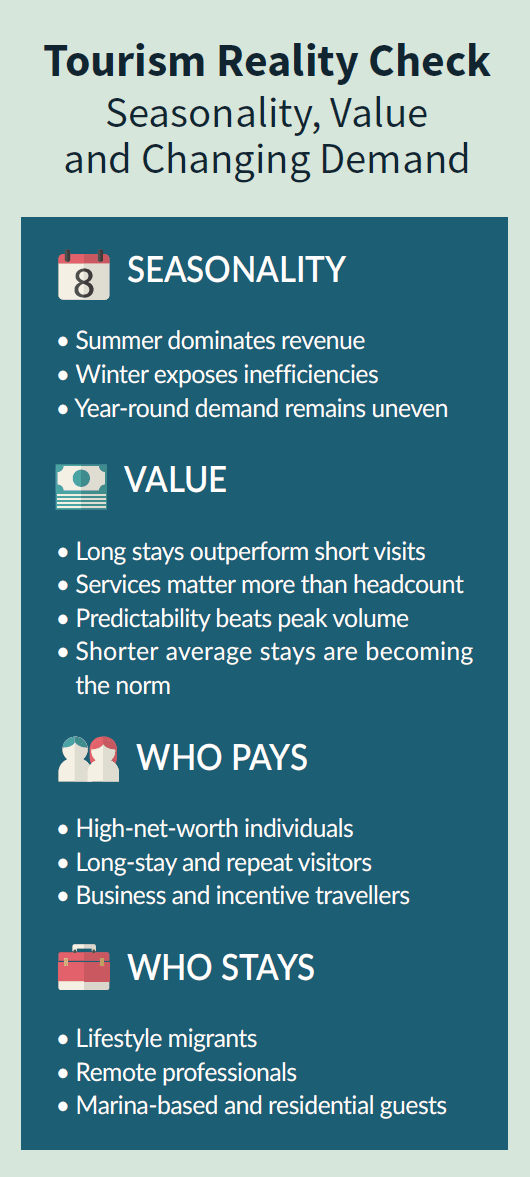
Tourism that fails to recognise this shift ends up optimising the wrong metrics.
Luxury developments along the coast understood this early. They were never designed as seasonal resorts, but as ecosystems: residences, marinas, hospitality and services operating year-round. Their economic impact lies not in occupancy rates, but in continuity. Maintenance, staffing, supply chains and local spending do not disappear when summer ends. This is tourism behaving like an industry, not a season.
The marina economy tells a similar story. Yachting is often framed as spectacle, but its real value is logistical. Boats stay. Crews return. Services recur. High-net-worth visitors behave differently from short-stay tourists: they plan ahead, spend locally and come back. For Montenegro, this is less about glamour and more about predictability.
The biggest untapped opportunity lies beyond leisure. Business travel, conferences and incentive events remain underdeveloped relative to Montenegro’s potential. Geography works in its favour. Accessibility does too. What’s missing is scale and coordination. MICE tourism extends the season almost by default. It fills hotels midweek. It stabilises employment. It links tourism to sectors that are not weather-dependent.
Seasonality remains the structural fault line. Summer still does the heavy lifting, while winter waits. Closing that gap does not require reinvention. It requires alignment: transport that runs year-round, hospitality that plans beyond peak months, and policy that treats tourism as infrastructure rather than entertainment.
There is also a quieter shift underway. Remote work, long stays and lifestyle-driven relocation are changing the profile of demand. Visitors increasingly arrive with laptops, not itineraries. They stay longer, spend differently and integrate more deeply into local economies. Montenegro’s challenge is to recognise this not as a trend, but as a category.
The danger is complacency. Beautiful destinations can afford inefficiency — until they can’t. Climate pressure, labour shortages and competition from equally attractive markets are forcing tourism economies to choose: optimise, or drift.
Montenegro’s future in tourism will not be decided by how full its beaches are in August. It will be decided by how productive the rest of the year becomes. The country already knows how to attract visitors. The smarter question now is how much value stays.
