As Montenegro advances toward European Union membership and deeper integration with regional energy markets, the country’s energy sector is entering a period of strategic transformation. The government is accelerating the integration of renewable sources, modernising infrastructure, and strengthening market connectivity with Europe.
In this conversation, Minister of Energy and Mining Admir Šahmanović discusses Montenegro’s current energy mix, the investment pipeline for new renewable projects, the importance of grid modernisation, and the strategic decisions that could shape the country’s economic trajectory over the next decade.
Which energy sources currently produce electricity in Montenegro, and how secure is the current energy mix?
Security of supply is the foundation of our energy policy. The stability of the system depends on the ability of production facilities to respond quickly to fluctuations in demand and potential disturbances in the network, and this principle guides the development of the sector.
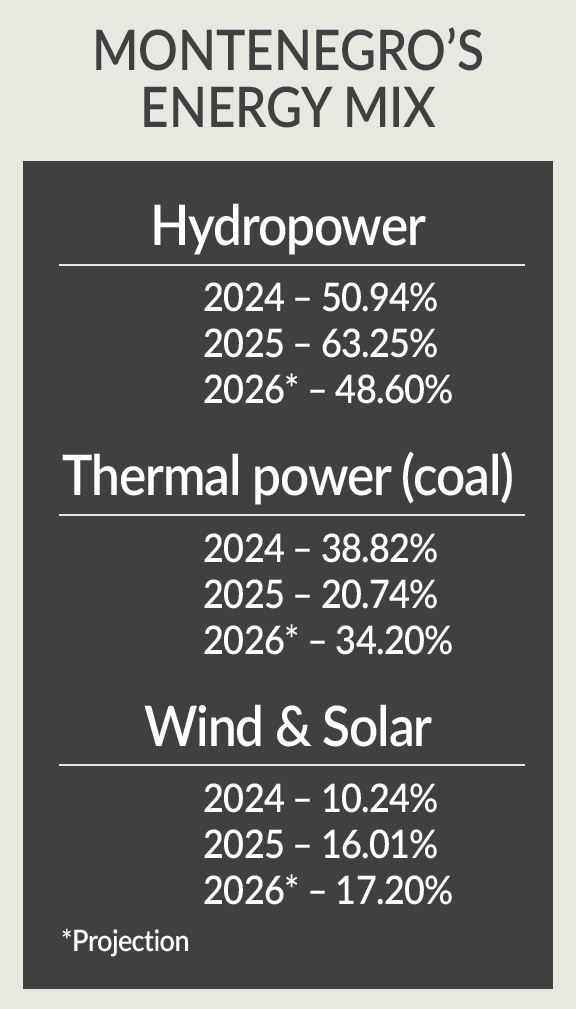
Montenegro currently produces electricity predominantly from hydropower plants and a coal-fired thermal power plant, with wind and solar power steadily increasing their share. Hydropower is our most important resource. It is flexible, stable and essential for balancing the system. The thermal power plant provides baseload security and continuity of production.
According to available data, hydropower accounted for 50.94% of electricity production in 2024 and 63.25% in 2025, while projections for 2026 indicate a share of 48.60%. The thermal power plant accounted for 38.82% in 2024 and 20.74% in 2025 due to ecological reconstruction, with a projected share of 34.20% in 2026. Wind and solar power together represented 10.24% in 2024, increased to 16.01% in 2025 and are expected to reach around 17.20% in 2026.
This mix ensures stability while clearly pointing to the future direction of development — diversification and faster integration of renewable energy sources, while maintaining system reliability.
Which energy projects are financially closed and realistically next for implementation?
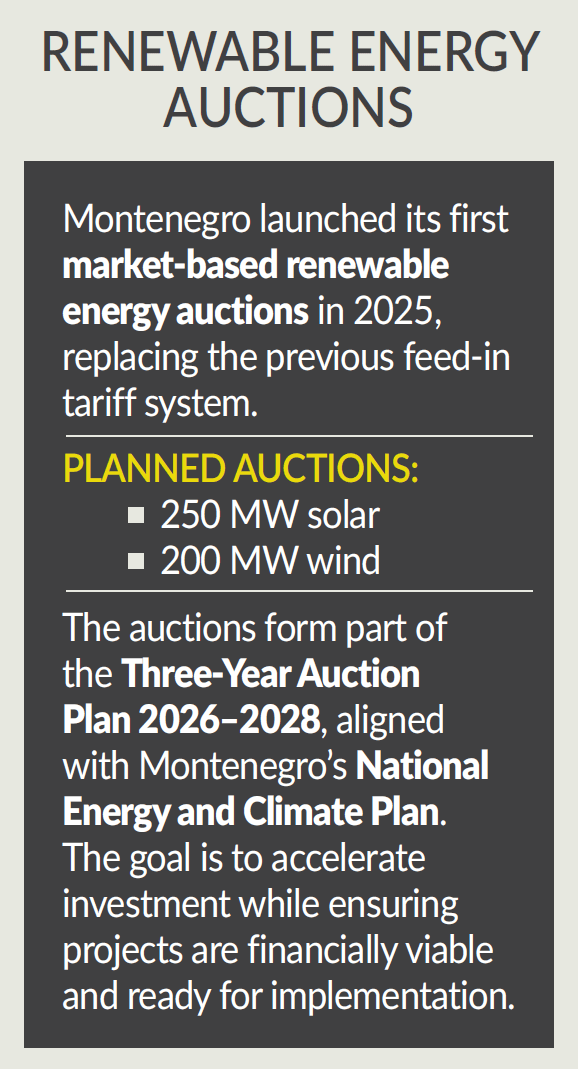
In 2025 Montenegro launched its first market-based auction model for renewable energy projects, with a capacity of up to 250 MW for solar projects. This represents a significant step forward towards the European model and marks the transition away from the feed-in tariff system.
A Three-Year Auction Plan for the period 2026–2028 has also been adopted, aligned with Montenegro’s National Energy and Climate Plan. Already this year, two auctions are planned — 250 MW for solar power and 200 MW for wind energy projects.
Countries capable of ensuring long-term energy security will become key drivers of the next phase of economic development
We expect financially closed projects that are ready for implementation. Our objective is not administrative statistics but investments that genuinely transform the structure of our economy.
Strategic partnerships with France and the United Arab Emirates are particularly important in this context. Our focus is on advancing projects that are technically mature and environmentally sustainable, bringing them to the stage of concrete implementation.
At the same time, the global economy is undergoing a transformation in which digital infrastructure, data processing and advanced technologies play an increasingly central role. Behind every server and every algorithm lies something fundamental — stable and reliable electricity. Energy demand from the digital sector is growing rapidly, and countries capable of ensuring long-term energy security will become key drivers of this new phase of economic development.
Montenegro has natural advantages for clean energy production, a stable energy system and a geostrategic position that enables it to become a reliable energy platform for new industries — from data centres to high-tech investments. Our task is to translate these advantages into projects faster and more efficiently than before.
How serious is the challenge of grid capacity?
It is a strategically crucial challenge. Our network was designed for a system of centralised production, while the energy transition requires a decentralised, digitalised and far more flexible architecture.
We are therefore modernising both the transmission and distribution networks, introducing smart-grid systems, developing energy storage and strengthening flexible resources within the system. Investments in grid infrastructure are not simply a cost — they are a prerequisite for development.
Without strong infrastructure, there can be no serious integration of renewable energy sources and no long-term stability of the energy system.
Which decision taken today will most strongly influence Montenegro’s economy ten years from now?
The most important decision is the full integration of Montenegro into the European energy market. Montenegro already operates a day-ahead electricity market through the BELEN exchange, while the strategic objective is market coupling with the region and the European Union.
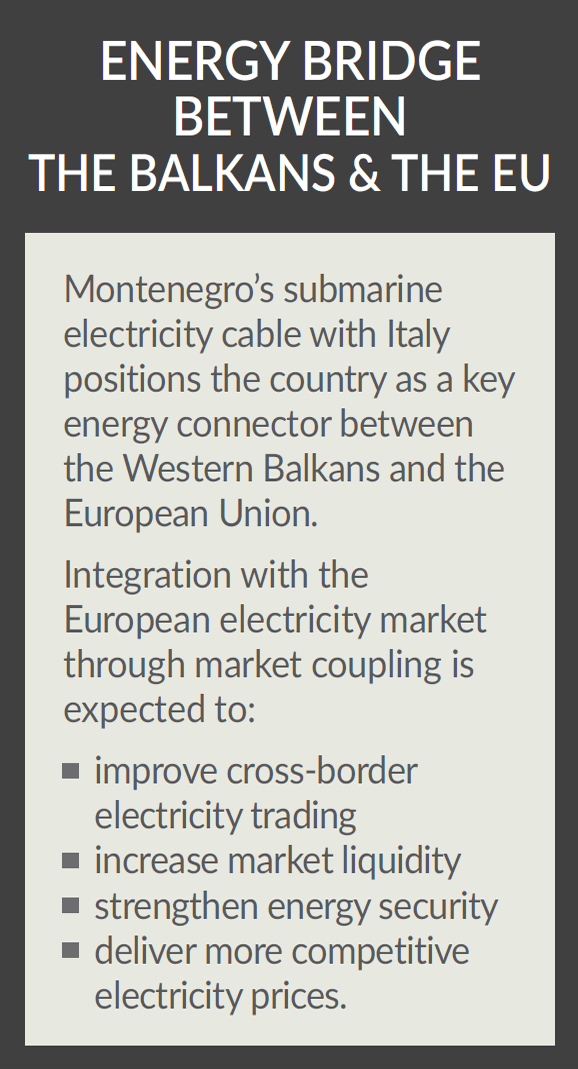
With Italy, we have signed a Memorandum of Understanding on electricity market integration, and the process is now progressing through technical and regulatory alignment towards full integration into the European electricity trading framework. The submarine cable connecting Montenegro and Italy positions our country as an energy bridge between the Balkans and the European Union.
This means more efficient management of cross-border capacities, the exchange of balancing energy, greater market liquidity and more competitive prices.
However, to fully realise this position, Montenegro must also undertake major investments in new energy facilities, production capacity, energy storage and modern infrastructure capable of ensuring long-term system stability. Without a strong investment cycle, there can be neither energy security nor economic transformation.
Montenegro’s energy future is not tied to a single partner. Instead, we are building a broad and carefully structured network of cooperation — with the United Arab Emirates, France, EU member states and the United States.
Energy today is more than a sector. It is a geopolitical position, a development opportunity and Montenegro’s European pathway. The decisions we make today will shape the competitiveness of our economy, the attractiveness of our investment environment and the pace of our European integration.
