How MTEL is turning connectivity into a competitive advantage for Montenegro
In a small, open economy, digital infrastructure is not background technology — it is economic architecture. As Montenegro positions itself as an investment, tourism and services hub, the reliability of its networks increasingly defines its competitiveness. Zoran Milovanović, CEO of MTEL, outlines how market leadership, infrastructure scale and cybersecurity investments are shaping the country’s digital backbone.
Montenegro is a small market. Why is the quality of telecommunications infrastructure even more critical here than in larger economies?
Montenegro’s economy is open, seasonally intensive and heavily dependent on tourism and international cooperation. The market is small only in population. That is precisely why telecommunications infrastructure is not a luxury but a prerequisite for functioning.
In a small economy, every network disruption or drop in quality has an immediate and visible impact on business performance, national reputation and competitiveness. Trust is measured in numbers.
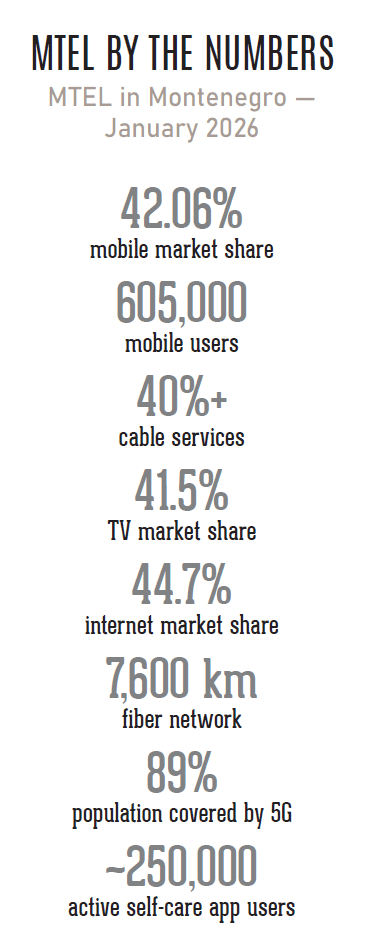
At the end of January 2026, MTEL held 42.06% of the mobile market, serving 605,000 users — the absolute market leader in Montenegro. We exceed 40% market share in cable services, hold 41.5% in television and 44.7% in internet services. These figures reflect infrastructure quality and continuity of investment.
Our fiber network extends more than 7,600 kilometers — the largest in Montenegro — with strong coverage across both urban and rural areas. Fiber stability and reliability are essential for tourism, business and public services. In a connectivity-driven economy, the network becomes part of national infrastructure.
The past three years have permanently changed how people and companies use networks. From MTEL’s perspective, what has been the biggest and most unexpected shift?
The defining shift has been the full integration of digital services into daily life and business operations. There is no longer an “online” and “offline” world — only a continuous digital environment.
What surprised us most was the speed at which users adopted cloud services, video communication, remote work and digital platforms. This required constant upgrades in capacity, security and network resilience — and we delivered.
MTEL today is not only infrastructure; we build digital ecosystems. Our advanced MOVE streaming platform has elevated digital television, while nearly 250,000 active users rely on our selfcare application — a clear indicator of trust and behavioral change.
Looking ahead, MTEL positions itself as a pillar of Montenegro’s digital economy — in fintech, digital identity and smart business services. Technology must simplify life and create measurable value.
5G is often presented as a technological breakthrough. Where in Montenegro is it already delivering real business impact, and where does it remain more promise than reality?
5G is already producing tangible results in logistics, smart systems, industry, video production, gaming and tourism. Its speed, reliability and low latency are generating real business impact.
In a connectivity-driven economy, the network becomes part of national infrastructure
However, the full potential — smart cities, autonomous systems and large-scale IoT — requires a broader ecosystem: regulatory alignment, investment and digital readiness.
Our 5G network is commercially available to prepaid, postpaid and business users, covering nearly 89% of Montenegro’s population. The infrastructure is in place. The next phase depends on how effectively businesses and institutions leverage it.
When it comes to MTEL’s investments today, what takes priority: expanding coverage, strengthening capacity, or developing new digital services?
Our strategy is balanced. We invest simultaneously in coverage expansion, capacity strengthening and digital service development. Today, a network must be smart, secure and adaptable to new business models.
We are focused on digital platforms, cloud services, IoT solutions and supporting the digital transformation of the economy. Leadership requires innovation — and responsibility.
In parallel, society must be prepared for technological change. Together with the Government of Montenegro, MTEL organizes academies, competitions and workshops. We provide internet safety and robotics programs for primary school students, app development and 3D modeling initiatives for high school students, and support university students through the Digital Factory and hackathons.
At the same time, we continue expanding 5G and enhancing our OTT streaming platform MOVE. We remain a committed partner in sports and culture. Our investments are driven not only by technology, but by user trust and long-term societal development.
Small markets are often more vulnerable when it comes to cybersecurity and system resilience. How exposed is Montenegro in reality to these risks?
Small markets are often perceived as easier targets, which makes cybersecurity a strategic priority. Montenegro is not isolated from global risks; digital connectivity increases exposure.
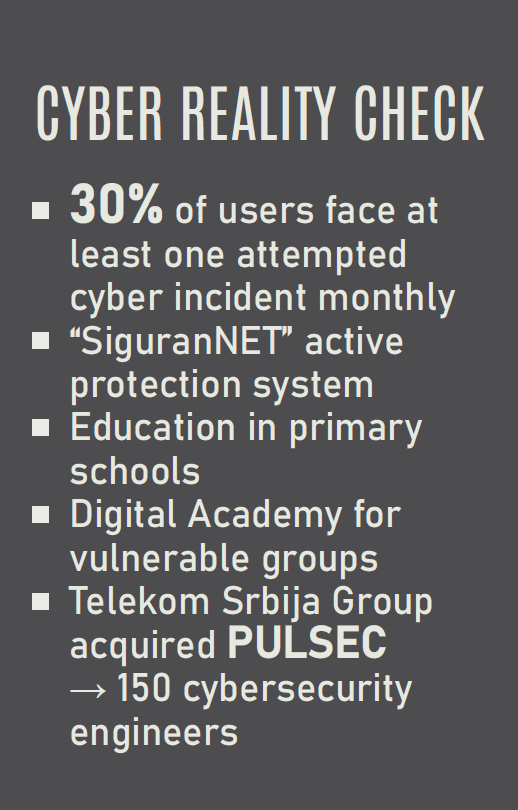
MTEL continuously invests in system protection, monitoring and user education. Our “SiguranNET” service adds an additional protection layer. Statistics show that at least 30% of users experience at least one attempted cyber incident per month — incidents our system prevents before damage occurs.
We began cybersecurity education in primary schools through interactive workshops and expanded it with the Government through the Digital Academy, focusing on digital literacy and cyber awareness for vulnerable groups.

For years, MTEL has invested in advanced detection systems, security centers and user protection mechanisms. Cybersecurity is not optional — it is foundational to digital economic stability.
The broader ecosystem has been strengthened by Telekom Srbija Group’s acquisition of PULSEC, a company with 150 cybersecurity engineers specialized in protecting business systems from complex cyber threats.
