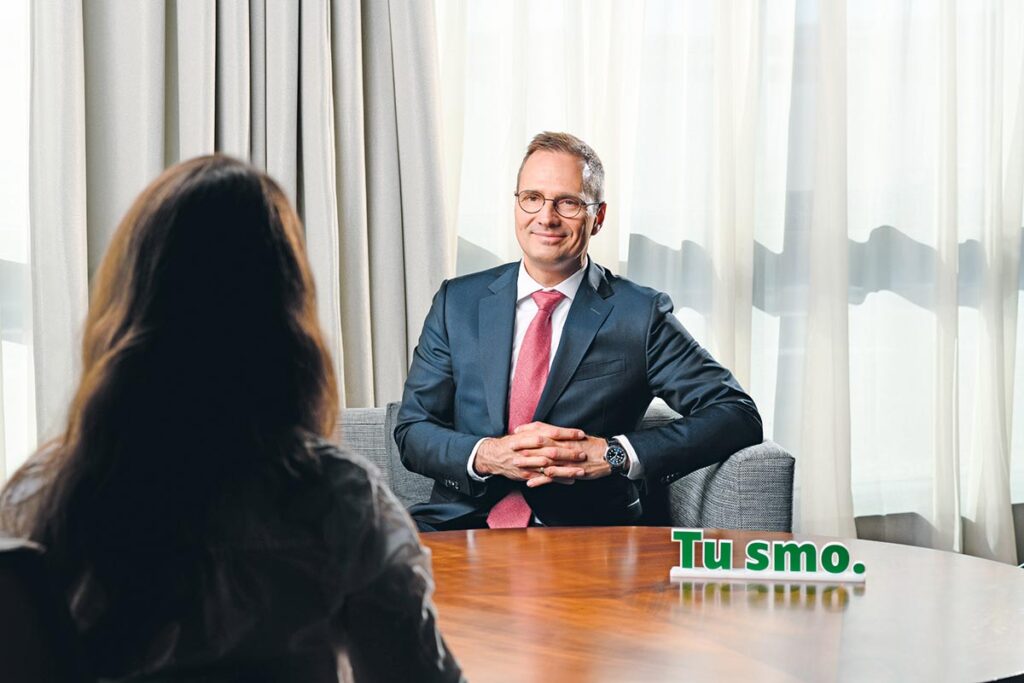
Tamás Kamarási, President of the Management Board of Crnogorska Komercijalna Banka, explains how Montenegro’s largest bank is navigating rapid technological change, growing competition and the country’s deeper integration into the European financial system.
Montenegro’s banking sector is entering a period of transformation shaped by digital innovation, tighter regulation and the country’s gradual integration into the European financial system. As the country’s largest bank, CKB stands at the centre of these changes. Yet for Tamás Kamarási, technology alone does not define leadership. Stability, trust and close relationships with clients remain the decisive factors in modern banking.
CKB has held a leading position in Montenegro’s banking sector for many years. What does leadership in banking mean today?
Leadership is not a title that can be won once and kept forever. It must be earned every day, through every interaction with clients. Of course, strong numbers matter — CKB today manages €2.2 billion in assets and holds a 33.6% share in lending — but leadership is not defended by numbers alone.
It is built through presence and service. A bank is not just a headquarters in Podgorica. Our goal is the same professionalism and quality of service in every city. One of the clearest confirmations of that approach are our internal awards for the best branch and best customer experience in 2025, which went to teams in Pljevlja and Budva. Leadership is ultimately built through people and trust.
What advantages does belonging to OTP Group bring to CKB?
OTP Group gives CKB the strength of a large international financial network operating across eleven markets in Central and Eastern Europe. This provides access to capital, expertise and technological solutions that significantly strengthen our position.
At the same time, this international network allows us to remain strongly local. Through the OTP network we support Montenegrin companies expanding abroad and serve as a natural partner for international investors entering Montenegro. Many of them already operate in markets where OTP Group is present, which makes cooperation easier and faster.
CKB also plays an active role in financing some of the country’s largest investment projects, either as the lead lender or as a partner in complex financing structures. This combination of international strength and local knowledge allows us to support investments that create new jobs and drive economic growth.
What has been the most challenging strategic decision in recent years?
The biggest challenge has been how to introduce deep digitalisation without losing the identity of the bank. Automating processes is relatively straightforward. Preserving the human element during that transformation is much more complex.
Leadership is not a title you win once and inherit — you earn it every day, in every interaction with a client.
Our decision was clear: technology should strengthen people, not replace them. That is why we continue investing in education, professional development and better working conditions for our employees. At the same time, we are aware that new digital players and neobanks will increasingly compete for younger clients, which raises the bar for traditional banks.
Do you expect consolidation in Montenegro’s banking sector?
With eleven banks competing in such a small market, consolidation is a natural question. The sector is facing rising costs related to digital infrastructure, cybersecurity and regulatory requirements, while margins are gradually narrowing.
In such an environment consolidation represents not only a possibility but a logical step toward a more efficient market providing incremental advantages also for the client side.
What do banking indicators reveal about Montenegro’s economy today?
From our perspective, the numbers show an economy that is more resilient than it is sometimes perceived. Tourism continues to drive growth, while household incomes have gradually stabilised.
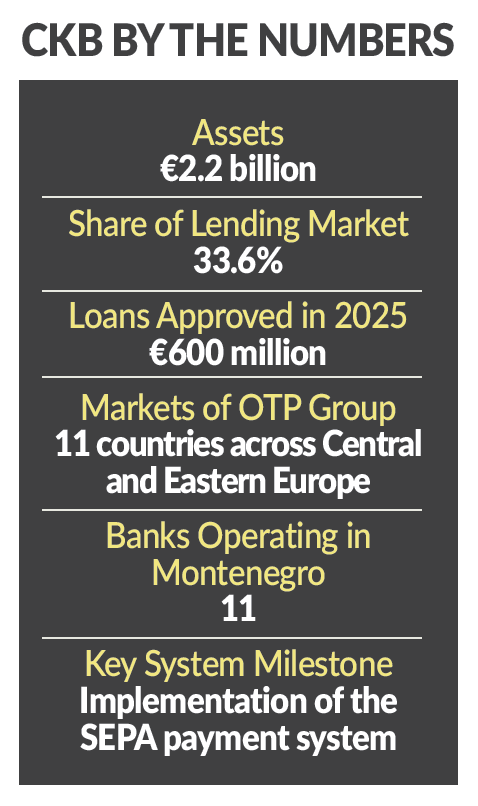
Last year alone CKB approved around €600 million in loans to households and companies, reflecting continued investment activity. At the same time, deposit growth has not always followed the same pace as lending, which highlights the importance of careful risk management and sustainable sources of funding.
How will EU integration reshape the banking sector?
The transformation has already begun. The introduction of the SEPA payment system marked a major step in integrating Montenegro into the European financial space, enabling faster and more efficient cross-border transactions.
As Montenegro moves closer to EU membership, interest from foreign investors will grow and cross-border business will expand. For banks this means operating in a more dynamic environment where services increasingly follow European standards. For clients, it means faster transactions, lower costs and improved financial services.
What message does Montenegro’s banking sector send to international investors?
The message is one of stability and reliability. Montenegro has a liquid and well-regulated banking system capable of supporting major investment projects. Cooperation between the Central Bank, the Association of Banks and individual institutions also plays an important role in maintaining trust in the sector.
For investors, predictability is crucial. A stable banking system provides exactly that and represents one of the foundations of a secure business environment.
How do you see CKB evolving over the next five years?
In the coming years CKB will become even more digital while remaining close to its clients. Banking will increasingly move onto mobile platforms and digital services, but the role of professional advice will remain essential.
The bank of the future will not simply be a place where transactions are completed. It will be a platform that helps clients manage their financial goals and important life decisions. Technology will make banking faster and simpler, but trust will remain the decisive factor in choosing a bank.
