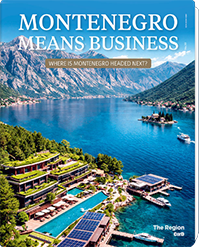
Martin Leberle on transformation, digital acceleration and the discipline required to lead
Over the past decade, NLB Bank Podgorica has undergone one of the most significant transformations in Montenegro’s banking sector. From digital acceleration to the complex integration with Komercijalna Banka, the institution has steadily repositioned itself as a modern regional player with strong local roots. As Martin Leberle marks ten years at the helm of the bank, he reflects on the strategic decisions, cultural shifts and disciplined execution that have shaped the institution’s evolution — and what they reveal about the future of banking in Montenegro.
Ten years at the helm: what moment defined NLB Bank Podgorica’s transformation under your leadership?
There was no single moment, but rather a shift in awareness. It became clear early on that tradition, however valuable, could not shield us from a market evolving faster than the region was ready to acknowledge. We needed a new rhythm, stronger discipline and the courage to act with intent.
The integration with Komercijalna Banka became the clearest symbol of that transformation — a complex, months-long project culminating at four in the morning, when every system turned green and two institutions became one. It was not simply a technological milestone but a statement of identity, proving that our people could deliver what many believed impossible: a seamless transformation executed with precision and without disruption.
From that point onward, innovation became a discipline rather than an initiative.
Regional Group vs. local market: did you need a different tempo for Montenegro?
The Group provides scale, expertise, platforms and a long-term compass that no single market could develop alone, while Montenegro contributes speed — the ability to recognise opportunities quickly and act decisively.
The launch of Apple Pay in just 37 days demonstrated how global capabilities and local execution can combine to set a regional benchmark. It is not a matter of opposing tempos but of alignment. Through honest dialogue, mutual trust and disciplined delivery, strategy adapts to the pace of the market without losing direction.
Digital banking is no longer innovation — it is survival. Where do traditional banks in smaller markets still underestimate the speed of change?
The most common misconception is that small markets move slowly. They do not. Customer expectations are global, regardless of geography, and clients in Montenegro expect the same seamless experience as those in major European cities.
The real challenge emerges when digital transformation is treated as an additional feature rather than a fundamental redesign of how the organisation operates. No interface can compensate for slow internal processes. Technology is the visible layer, but the decisive factors are disciplined execution, rapid decision-making and the willingness to replace procedures that persist simply because they have always existed.
After a decade at the helm, are you more cautious or more ambitious than you were in 2016 — and what does that mean for the future of banking in Montenegro?
I am far more ambitious today, because the past decade has shown what Montenegro can achieve when clarity of purpose is matched by strong execution.
We have transformed a traditional bank into a modern, innovation-driven institution, integrated two banks without disruption and implemented advanced technologies at a pace rarely seen even in larger markets. This experience gives me confidence that the future of banking in Montenegro will be increasingly European, digital and transparent.
The country may be small, but its capacity to leap forward is considerable. Our role is not to wait for change, but to help define it.
