Dragan Bokan, Owner & CEO of Voli, on major investments, a twodecade partnership with EBRD, and why disciplined infrastructure is the real competitive advantage in Montenegro’s retail sector.
In a small economy, scale is rarely a given—it has to be built deliberately. Over the past three decades, Voli has grown from a local retail company into Montenegro’s largest supermarket chain and one of the country’s most significant private employers. Its expansion has been defined not only by new stores, but by a steady focus on logistics, infrastructure, and long-term partnerships.
The company’s latest investment— up to €25 million in cooperation with the European Bank for Reconstruction and Development (EBRD) for a new logistics and distribution center in Podgorica—marks the largest single investment in Voli’s history. The project reflects a broader strategy: strengthening supply chains, modernizing operations, and aligning the company with European business standards.
In this interview, Dragan Bokan, Owner and CEO of Voli, speaks about the logic behind the investment, the structural challenges of operating in a small market, and the role that disciplined management, technology, and international partnerships play in building a resilient retail system.
Mr. Bokan, Voli has recently concluded its largest investment to date with the EBRD—up to €25 million for a new logistics center in Podgorica and strengthening its logistics system. What was the most important criterion when selecting this partner, and what signal does this send about the position of Montenegrin business in the region?
When selecting partners, the EBRD primarily evaluates credibility, long-term stability, experience in implementing capital-intensive infrastructure projects, and the broader market impact of the investments made by its partners.
The EBRD does not invest only capital—it brings international standards, a strong framework of corporate governance, and a clear message of confidence in the market where its partners operate.
For Montenegrin business, particularly for privately owned domestic companies, this represents an important signal that it is possible to build long-term partnerships with international financial institutions.
Over nearly two decades of cooperation with the EBRD, Voli has demonstrated financial discipline, transparency, and operational stability. These are the prerequisites for such investments and also a message to the region that Montenegro has companies capable of delivering serious development projects.
Voli does not compete through size, but through efficiency, reliability, and a deep understanding of local markets
This project also carries broader socio-economic significance. Montenegro’s economy must move toward stronger integration with European markets and adapt to the strict standards of the European Union. That is a process that requires discipline, strategic planning, and a readiness to adopt the highest criteria of business practice. I am convinced that this represents our key development opportunity.
As before, we remain strongly committed to sustainable development. The new distribution center has been designed to meet EPC B energy efficiency standards, which is one level above national requirements. In doing so, we reaffirm that EU standards are not an obstacle for us but a clear direction. Through earlier projects— such as the installation of solar panels and electric vehicle charging stations— we have already demonstrated our intention to be leaders of positive change.
Voli is expanding rapidly and investing tens of millions of euros in infrastructure and new facilities across Montenegro. How do you balance ambitious investment plans with the real risks of a small Balkan market?
As the largest retail chain in Montenegro, Voli has a responsibility to invest thoughtfully and with a long-term perspective. A small market leaves very little room for mistakes, which is why our investment model is not based on rapid expansion but on building an efficient and stable infrastructure.
That is precisely why logistics, distribution, and vertical integration are the core of our business model. The new logistics center in Podgorica represents the foundation for rationalizing costs, stabilizing supply chains, and increasing resilience to disruptions in global supply chains, while also adapting to evolving consumer needs.
This approach reduces the structural risks of a small market and makes the business environment more predictable, which is particularly important for long-term investors.
You have pointed out the shortage of labor and the imbalance within the public sector as serious obstacles to economic growth. How does Voli plan to address these challenges within its own organization?
Voli is one of the largest private employers in Montenegro, and issues related to labor availability affect us very directly. Our response is a combination of investment in people and investment in technology.
We continuously work on improving working conditions, training programs, and creating clear career paths for employees, because the development of a qualified workforce is essential for the stability of the system.
At the same time, we are significantly investing in automation and digitalization of processes, particularly in logistics and distribution. For international investors, it is important to see that companies have a clear strategy for managing this structural risk, because labor availability has become one of the key factors influencing the investment attractiveness of the entire region.
Your partnership with the EBRD spans nearly two decades. How has that cooperation changed Voli—not only financially, but culturally and operationally?
Voli is the only company in Montenegro that has gone through the entire process—from initial credit arrangements to recapitalization and the entry of an institutional investor into its ownership structure.
For that reason, I would strongly recommend to anyone who wants to conduct business in a serious, transparent, and modern way to consider cooperation with the EBRD.
On the other side, you gain a reliable and respected partner from whom you can learn, who can guide you and open new opportunities and perspectives.
My motivation to begin cooperation with the EBRD was precisely the ambition to implement demanding European standards of business practice within our company. In retrospect, that proved to be the right decision when viewed through the lens of building a modern and successful company that today stands among the largest employers in Montenegro.
Fifteen years ago, the first credit funds were directed toward capital investments and the expansion of our retail network. At the same time, we worked intensively on improving corporate governance, financial reporting, and establishing clear management and control systems.
With the continuation of cooperation through a second credit arrangement, we used the funds to acquire the Novito retail chain, which significantly increased our market share. Already in 2012, we began to feel the concrete value of this partnership through improvements in work processes, performance measurement, and operational optimization.
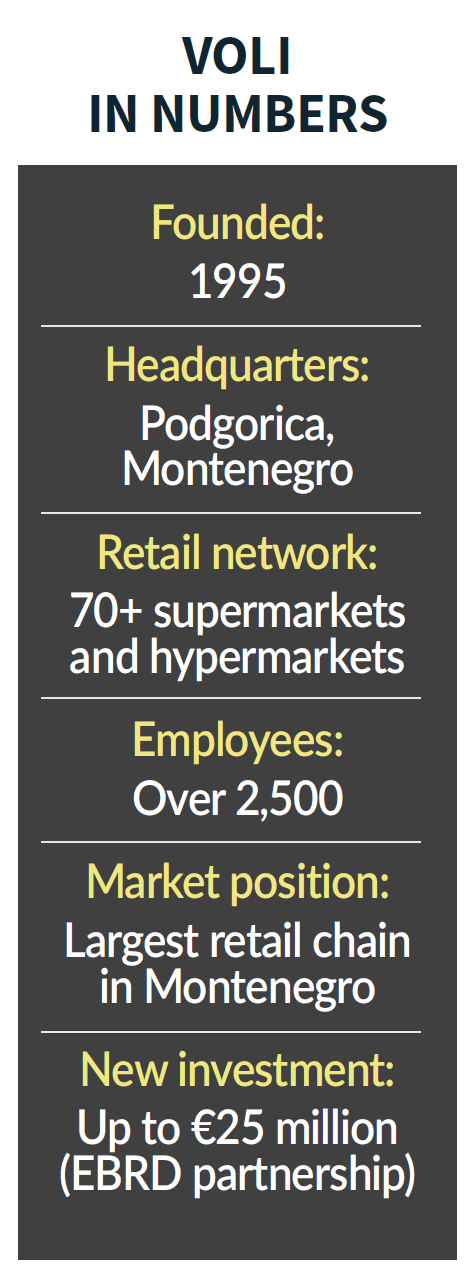
Our Board of Directors played a key role in this process, with EBRD representatives—highly experienced professionals such as Miljan Ždrale and Paul Foley.
The cooperation with the EBRD has had a profound transformational effect on Voli. In addition to financial support, it involved introducing international standards in corporate governance, financial reporting, and risk management. This process was built gradually over many years and has significantly improved the company’s internal organization.
Today, Voli operates as a system that is understandable and recognizable to international financial institutions. Such a framework reduces perceived risk and opens the door to new investment cycles—something particularly important for a company that remains fully domestically owned and has grown organically.
How do you see Voli’s role in the digital transformation of retail in the region, especially considering that the logistics center you are building includes technological innovations?
In this context, I would particularly highlight the cooperation related to digital transformation. With the expert technical support of the EBRD, we will conduct a comprehensive digital analysis, define a clear transformation roadmap, and perform a full cybersecurity assessment.
This is not merely an investment in technology—it is an investment in the long-term stability and competitiveness of Voli, but also in the modernization of business practices in Montenegro.
Digital transformation is a key prerequisite for competitiveness in modern retail. The new logistics center has been designed as a highly automated and technologically advanced platform, with integrated IT systems that allow full control over inventory, distribution, and costs.
Such infrastructure is not important only for Voli itself, but also for the broader ecosystem of suppliers, producers, and partners. It creates the foundation for scalable operations and potential regional integration—an element that institutional investors particularly value.
What does it mean today to be a “regional player” when a Montenegrin retail chain competes with companies from much larger markets?
Being a regional player today means operating according to international standards, maintaining stable infrastructure, and managing capital with discipline.
Voli does not compete through size, but through efficiency, reliability, and a deep understanding of local markets.
As the market leader in Montenegro, Voli serves as a platform around which broader logistics, distribution, and investment projects can be built. This makes us a relevant partner not only for regional but also for international investors.
How does Voli plan to balance its strategy of competitive pricing with branded positioning and the need for profitability and sustainable growth over the next five years?
Sustainable growth in retail is possible only through systemic investments and operational efficiency.

Voli’s strategy of affordable prices is based on economies of scale, our own production capacities, strong private-label brands, and a highly integrated value chain.
Our goal is not short-term profitability, but stable cash flows, continuous investments, and long-term predictability of operations. This model ensures sustainable growth, security for employees, and reliability for consumers, while also providing a clear and recognizable framework for international financial institutions and investors.
